

Your Browsing History


Brendan G.
Joined on 09/24/03
0
0
product reviews
- 19
The cheapest mass storage available!
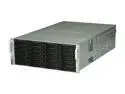
SUPERMICRO SuperChassis CSE-847E26-RJBOD1 Black 4U Rackmount Server Chassis 1400W Redundant
Pros: HUGE amounts of storage in just 4U of JBOD goodness. As-of the date of this review, using the latest 8TB disks, you can cram 360TB -- literally over one-third of a PETABYTE -- into just 4U of rack space. While Supermicro and others make 90-drive JBODs in 4U as well (720TB in 4U!), they're much, much more expensive (>$10k for the chassis). This unit seems to be the sweet-spot on a cost-per-slot basis. 45 bays for $2k, or just over $40 per slot. That's all great, but how well does it work? In a word, it works "well." There are certainly some niggles, negatives and drawbacks (see the "Cons" section) but keep in mind the low cost and solid performance and most of those are easily overlooked. PLEASE read the CONS section, as there is valuable information so you know what you're getting. Mated with a quality RAID or SAS HBA, performance of the JBOD is roughly in-line with that of any other SAS chassis. Your drives and HBA will be the limiting factors, as the JBOD is about as simple a device as it gets. If you're running a dedicated enterprise software SAN/NAS, like DSS7, OpenFiler, Windows Storage Server, etc you can overcome some limitations that RAID HBA's have. The unit is reasonably well constructed, but think "Kia" instead of an EMC "Mercedes." There is no digital readout, so everything is done in either HBA software or drive / chassis LEDs. The unit comes complete with sliding rails and power cables, along with all necessary trays and screws for mounting 45 drives. All you need to provide is a server / PC, a SAS HBA, and SAS cabling (you'll need TWO SFF-8088 SAS cables) and drives, of course. This is a 6Gb/s unit, but feel free to use any 12Gb/s controller if you wish. Keep in mind, almost everything in SAS today is still 6Gb/s until you get to 6-8TB drives. We do NOT use SATA drives, but SAS-only, so I can't comment on using this chassis with SATA (with is not recommended by Supermicro, but I presume enterprise-class SATA or NAS-rated SATA would likely work. AVOID consumer-grade SATA, as they don't RAID well at all in larger arrays. Drive manufacturers intentionally cripple their entry-level consumer drives in firmware to NOT work well in RAID arrays over four (4) drives. NO 2.5>3.5 inch adapters are included, so if you plan on using SSD or 2.5" drives you'll need to procure adapters separately. Performance is solid, setup is not difficult, though you need to be aware of one potentially serious issue addressed in the CONS section with regard to out-of-box setup. This E26 unit comes with redundant SAS pathways and dual, hot-swappable power supplies and is ready for even demanding enterprise deployments. For the price, nothing comes close.
Cons: Built with cheap-feeling components. Drive trays look and feel very fragile, cheap even. Internal cooling fans are HARD WIRED! No quick-swapping of any internal components / cables / backplanes (PSUs are external hot-swap and tool-less). For some mysterious reason, the internal SAS cables are NOT connected at the factory. We initially believed we had a defective unit, only to discover that we had to open it up and figure out the internal cabling layout ourselves. It wasn't that difficult, but it would've been nice to include a single letter-sized sheet of paper on top that lets their customers know. A cabling diagram would be even better! Fortunately, we're an IT-centric company, but I presume many potential consumers are not and this could be a deal-breaker for them. With the E26 unit, you can have EITHER redundant pathways OR the ability to daisy-chain additional enclosures -- you can't have both. NO extra drive trays are included, so if you want to keep cold spares at-the-ready -- which is an obvious provision, given the number of drives in a single chassis -- you'll need to purchase a few more trays. The proper tray for this particular unit are Model # MCP-220-00075-0B and are available here on the Egg. The unit is, obviously, extremely heavy. It is shipped via FREIGHT only, on a pallet. The entire pallet -- with NO drives installed -- weighs 180 pounds. The boxed unit weighs 130 pounds, and it is very well packaged. Supermicro strongly recommends that you do NOT ship the unit populated with drives, so if you're an integrator / reseller, your customer will have to pop the drives in on-site. The SFF-8088 connectors feel a little loose on the back, so use caution when making connections and be sure there is no stress on the cabling into the 847 chassis. The unit is fairly loud, so using it next to a workstation will be too noisy for most, but it's not a hair dryer and can be tolerated. As with most chassis, when first turned on it sounds like the flight deck on an aircraft carrier. There will be NO stealth boot-ups with this unit. To guarantee uptime, I'd strongly recommend having spare drives on hand and pre-trayed and also have a spare hot-swap power supply. I believe the PSU is Model #: PWS-1K41P-1R, also available here on the Egg. It might not be a bad idea to have a spare fan handy as well, or take some initiative and buy some Noctua fans of the same size to reduce noise and increase reliability (just came to mind) -- remembering that the fans are all hard-wired and mounted with screws into the internal chassis, so you'll have to be off-line and unplugged to change those out. Sadly, since there really is no alternative, air is sucked in over one set of drives, warmed up by those drives, then that warm air is blown out over the other set of drives. I'd recommend NOT using this is a very warm or dusty / dirty room. Maybe hang a piece of gauze or cheesecloth over the intake side to reduce internal dust buildup.
Overall Review: All-in-all, this is a strong effort and offering for most deployments. Three of these filled with 8TB disks will push you over the 1PB storage barrier in just 12U of rack space at a chassis price that simply can't be believed. I can highly recommend them with a few caveats, spelled out in the CONS section. Just have ample spare disks, PSU(s), and fan(s) so you can perform your own warranty service and keep your array humming along without skipping a beat.
12/9/2015See more detail
You get what you pay for...
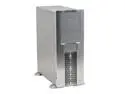
SilverStone TEMJIN TJ06S-W Silver Aluminum front panel, 0.8mm SECC body ATX Full Tower Computer Case
Pros: Good size, tons of expandability, nice looking, "tool-less" design. Cheap.
Cons: Drives are difficult to install and remove with "tool-less" rails. With few exceptions, chassis is constructed of heavy steel, not aluminum. MB tray is fixed/riveted and therefore non-removable. "Patented wind tunnel" is useless/unusable with a large HSF like the TR U120x. Demands PSU with long cables due to top placement. 2x120 and 1x80 fan placement could stand improvement.
Overall Review: For the price it's a decent case, but I personally should have opted for one of its more expensive siblings and somewhat regret "cheaping out" on this one. It looks nice and is built well but, as a whole, it leaves me wanting.
10/10/2007See more detail
Avoid HighPoint Like the Plague!
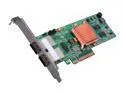
HighPoint RocketRAID 4522 SAS/SATA 6Gb/s Low Profile Ready SATA / SAS RAID Controller Card
Pros: Boards are 20% cheaper than their Areca counterparts, but... (read CONS).
Cons: HighPoint is, without exaggeration, the LEAST responsive company we have every had the "pleasure" (in the most masocistic sense conceivable) of dealing with. Highpoint's "customer service" is a cruel joke and a never-ending source of frustration. While end-user/consumers may not have much to lose buying their cheap home RAID products, any business or enterprise should AVOID HighPoint like the plague. Their enterprise-class (applied loosely) products are buggy, failure-prone, and once you hit some bumps in the road HighPoint support is literally nonexistent. This company is a true exercise in frustration that would push even the Dalai Lama to the point of homicidal rage.
Overall Review: If you value your data, and reliable access to it, stay as far away from any products with the HighPoint name on it.
4/1/2013See more detail
Decimates Cinema 4D / Adobe CS Workloads
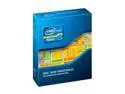
Intel Xeon E5-2687W 3.1GHz (3.8GHz Turbo Boost) 20MB L3 Cache LGA 2011 150W BX80621E52687W Server Processor
Pros: 16 physical cores (2-Socket WS Mobo) and 128GB of RAM take your productivity to entirely new levels. If your workstation is a *tool* and not a toy, these 8-core E5 CPUs decimate even the vaunted 3960X 6-core units by an order of magnitude in C4D and AE/Premiere. If you're a video and/or 3D motion graphics pro, just get two of these via any means possible -- sell blood, superfluous appendages, excess children, or whatever you need to do to get these. You'll make enough back in productivity gains to buy them back later.
Cons: 150 watts is a LOT of energy for thermal regulation, exacerbated when you have TWO of these monsters. Your entire build needs to revolve around sufficient cooling, as 300 watts of heat will turn the inside of your case into an "Easy Bake" oven without sufficient airflow. This is the first CPU that I felt really demanded the use of liquid cooling, which I have avoided until now. Obviously, a 1000+ watt PSU is also necessary now when you begin to cram GPU's, RAM, and 15K SAS drives (along with SSD). Oh yeah, at $1800/each they should ship with a free supply of Vaseline -- if you know what I mean.
Overall Review: Newegg is my overwhelmingly preferred vendor of choice, but when I got these they just happened to be out of stock that day. Figures. We put together a $9,000 build including the Mobo, CPUs, 128GB RAM, 600GB 15K SAS drives (6x RAID 10), Vertex 3 SSDs, a used Quadro 6000 from some auction site, Corsair 1200W, plus monster case and Noctua fans. RESULT: A Cinebench R11.5 Score of **31.02** -- a new record for a dual socket machine. Suck on that!
5/1/2012See more detail
It came, I popped, it ran...
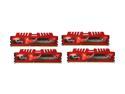
G.SKILL Ripjaws X Series 16GB (4 x 4GB) DDR3 1600 (PC3 12800) Desktop Memory Model F3-12800CL9Q-16GBXL
Pros: I've been out of the "Maximum Perfomance at any Cost!" game for a number of years now, so overclocking and squeezing every last microgram of speed (at the obvious cost of stability) is no longer on my radar. I just wanted a good deal on 16GB of matched DDR3 with solid out-of-the-box performance, and this kit delivered -- PERFECTLY! It arrived (with the remaining components in my new P67 i7-2600K build). I popped it in, booted the machine, and it posted the first time out of the gate without a single objection! For ~$600 I now have four cores of 4.2GHz P67 SB goodness with 16GB of DDR3-1600. Tack on a Vertex 3 boot drive, SliverStone case, Corsair HX750, Noctua fans, and SILENT HTPC GPU and you have a machine, for roughly $1k, that runs cool, quiet, and actually performs tasks before your brain can think them up -- and NEVER CRASHES! I leave games to children, but Photoshop CS5, Premiere Pro, and Cinema 4D R12 runs like a scalded feline on this box. Sick.
Cons: Looks pretty. Runs stable. Cheaper than dirt. Cons? Nope!
Overall Review: I can't speak to gamers and overclockers, but if your machine is a productivity TOOL that you need to perform well and not skip a beat, then this matched set of 4x4 DDR3-1600 is simply excellent. Never an issue, worked out of the box on my Gigabyte P67 (B3) mobo and i7-2600K combination and is rock STABLE!
6/17/2011See more detail
For $135, so far, so good
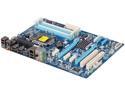
GIGABYTE GA-P67A-UD3-B3 LGA 1155 Intel P67 USB 3.0 ATX Intel Motherboard
Pros: Cheap, for a B3 P67 board with sufficient features and decent over-clock granularity. It's not packed full of anything, so you do get what you pay for. I'm running an i7-2600K with a modest (all-stock V's) 4.2 GHz O/C and 16GB of 1600 GS RipJaws (matched set, also from NE). I just punched in the relevant numbers in the BIOS and everything worked without a hitch. No issues, rock stable. I don't play games (not even Solitaire), so my priorities are, in order, (1) STABILITY, (2) NOISE (or lack thereof), (3) HEAT, and lastly (4) ABSOLUTE PERFORMANCE. I'll gladly sacrifice some of #4 to get more of numbers 1-3. I used my "old" ThermalRight Ultimate 120 Extreme (TRUE) cooler from my O/C 775 Q6600 (stable 3.6 on QUIET air) by ordering the $10 1155/6 mounting kit, so no additional costs there. Using AS 5 and careful mounting technique, my 4.2GHz 2600K's hottest core stays at ~33*C. The others 1-2 lower under stress -- all on STOCK voltages and bus speeds. Can't believe Intel released the "
Cons: Small board. Would like to see at least one PCIe 8x slot for SAS RAID or other controller. RAM slots are CLOSE to CPU socket, forcing me to mount the TRUE fan in the back (SUCK) position versus my preferred (BLOW) position. 8-pin MB power connector is ALL THE WAY AT THE BOTTOM of the motherboard, requiring either an extension cable, or a PSU with 24" (+) MB power cables. Reported VDROOP, but has not been an issue for me at a modest 4.2 O/C.
Overall Review: When I bought this board all of the re-released P67 boards were just out and were in high-demand / short-supply. This was really the only board NE had in stock at the moment. In hindsight, while this board does exactly what it should without a single serious issue, it's squarely an entry-level "enthusiast" board with real limitations. I would have easily spent the extra $100 on an Asus or higher-end GB board -- if one were available. Now that my system is built, my lazy side will live with it, as there are no real problems and I don't require more than what this board offers. The 2600K is a modern marvel, and just has to be the $$$/MHz King at this time. I'm only running a single ATI 5670 1GB, so no issues there (as I said, no games, quiet, HD/BR playback excellence, quasi-HTPC), along with 2x Samsung 128GB SSD in RAID-0 plus a 2TB WB Black RAID-1 for data. PSU is a Corsair HX750 (quiet), which is about twice what I need for this rig, plus an LG BD writer. Overall: Quiet, Cool, Fast.
4/1/2011See more detail