


 All CategoriesAll CategoriesAll Categories
Shipped by Newegg



Warranty Notice:
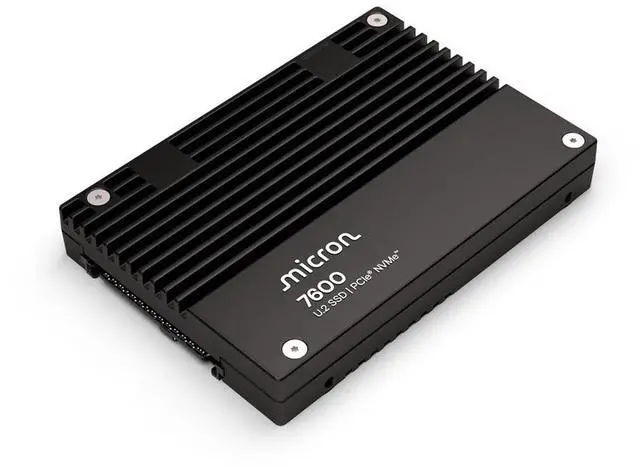
This product does not include manufacturer warranty when purchased or used outside of its designated sales region. By purchasing internationally, you acknowledge that warranty support from the manufacturer will not be available.The Micron 7600 MAX is a 12.8TB enterprise internal SSD for mixed-use server and data-center storage, combining high capacity with a 2.5-inch U.2 PCIe 5.0 x4 NVMe interface.
| Attribute | Value |
|---|---|
| Best For | Internal PC storage for mixed-use enterprise workloads |
| Capacity | 12.8 TB (12,800 GB) |
| Interface And Form Factor | NVMe solid-state drive with a U.2 interface and 2.5-inch form factor |
| Read Write Performance | Listed data transfer rate: 12,000 MB/s; maximum sequential read/write speeds: 12,000/7,000 Mbps |
| Cache And Features | DRAM cache and hardware encryption |
| Physical Specifications | 185 g; 10.045 × 7.01 × 1.5 cm |
| Model Identifiers | Micron 7600 MAX; model and part number MTFDLAL12T8THS-1BP1DFCYYR |
Q: Micron 7600 MAX vs 7600 PRO: which should I choose for mixed workloads?
A: Choose the 7600 MAX when the workload includes frequent writes: Micron rates it for 3 drive writes per day and up to 700K random-write IOPS, compared with 1 DWPD and up to 400K random-write IOPS for the 7600 PRO. Their published maximum sequential read and write rates are the same. The 7600 PRO is the more suitable choice when a 1-DWPD endurance rating fits the workload.
Q: Micron 7600 MAX vs 9550 MAX: is the 9550 worth choosing instead?
A: Choose the 9550 MAX if the application benefits from higher peak performance, particularly for demanding accelerator or high-throughput workloads. The 7600 MAX is positioned for mainstream PCIe Gen5 data-center use and still provides a 3-DWPD endurance rating. In StorageReview testing, the 9550 MAX led the 7600 MAX in some sequential-write tests, while results varied by workload; compare benchmarks that match your own workload before selecting.
Q: Should I upgrade from a Micron 7500 MAX to the 7600 MAX?
A: Choose the 7600 MAX when the server supports PCIe Gen5 and the workload can benefit from the newer interface and its higher potential bandwidth. The 7500 MAX is a PCIe Gen4 drive, so it remains a practical fit for Gen4 systems or deployments where a platform upgrade is not planned. Both are 3-DWPD MAX-class drives; the upgrade decision depends on platform support and workload needs.
Q: Will this SSD work in my server or desktop?
A: Only if the system supports a 2.5-inch U.2 NVMe SSD and provides a compatible PCIe connection. Check the host, backplane, cabling, and drive-clearance requirements before buying; a standard SATA drive bay alone is not sufficient.
Q: Who is the 12.8TB Micron 7600 MAX best suited for?
A: It is aimed at compatible data-center, server, and storage-system use where high capacity and mixed read/write workloads are priorities. Its U.2 NVMe interface makes it less suitable as a simple drop-in upgrade for a typical laptop or desktop.
Q: Is this SSD suitable for workloads with frequent writes?
A: It is classified as a mixed-use drive and is rated for 3 drive writes per day. That makes it a candidate for sustained mixed read/write workloads, provided the system supports its U.2 NVMe interface and the workload fits the drive’s endurance rating.