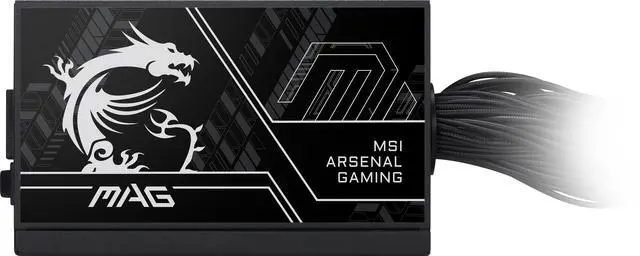
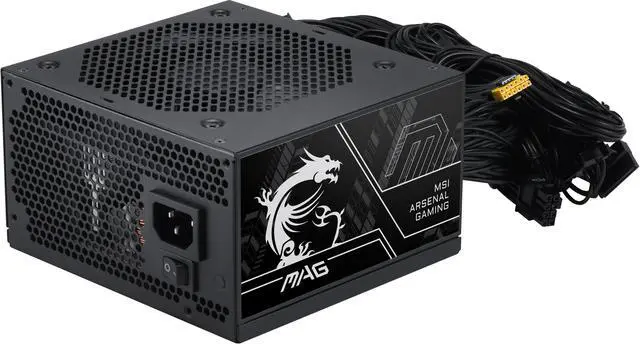
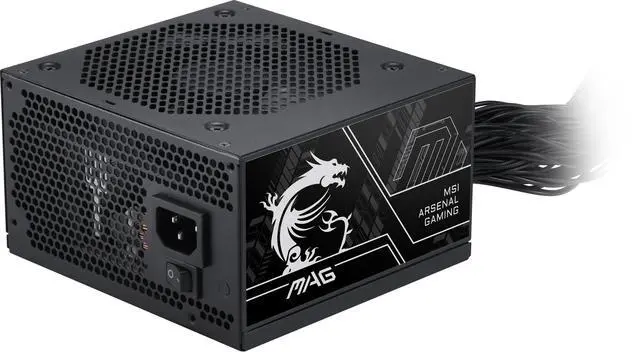
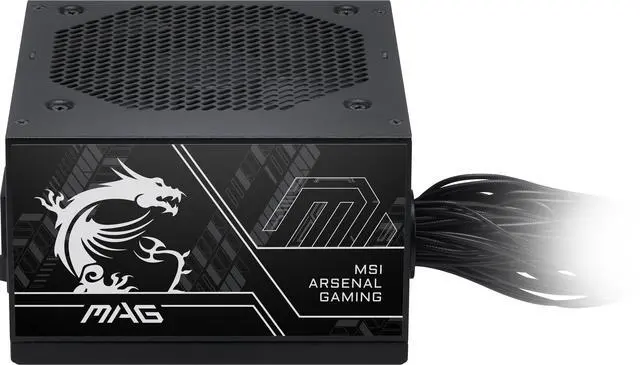
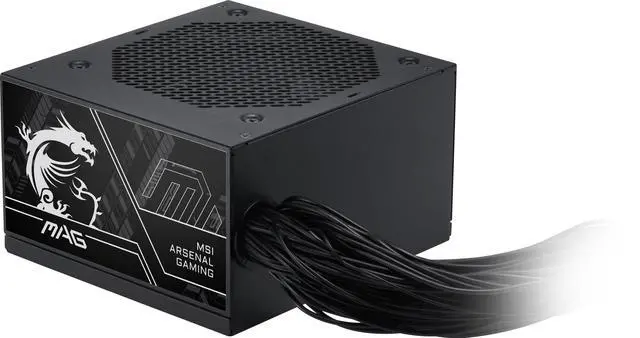
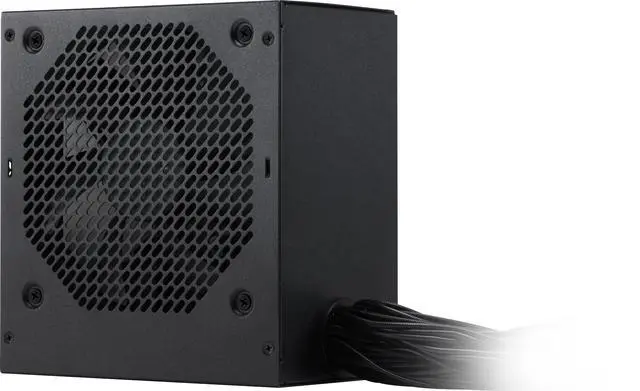
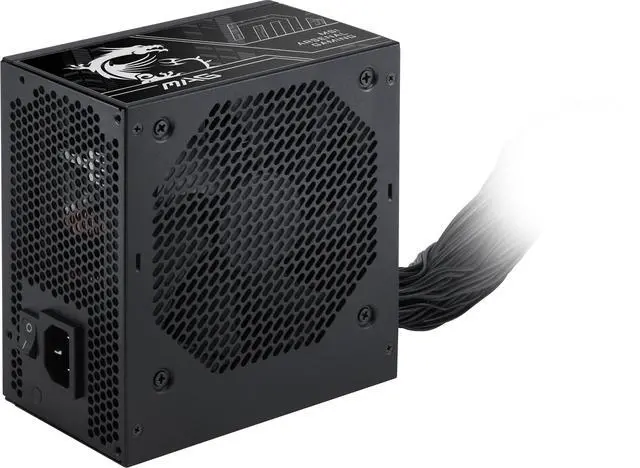
The MSI MAG A650BN PCIE5 III is a 650W non-modular gaming power supply for mainstream gaming PCs and upgrades, with ATX 3.1 and PCIe 5.1 readiness, a 12V-2x6 cable supporting up to 300W, 80 PLUS Bronze efficiency, and multiple protection features.
Recommended For
- Budget-conscious builders assembling a mainstream gaming PC with one midrange GPU and a total system load that fits within a 650W power budget.
- PC builders using a compatible newer graphics card who want a native 12V-2x6 connector and ATX 3.1 support instead of relying on a separate GPU power adapter.
- First-time or value-focused PC builders who prefer a straightforward ATX power supply and do not need to customize or remove individual cables during installation.
- Builders fitting a standard ATX power supply into a space-conscious case who can use the unit’s 140mm depth rather than requiring an SFX or other small-form-factor PSU.
- Users replacing an older entry-level PSU who want modern transient-handling standards, basic circuit protections, and 80 PLUS Bronze efficiency without moving to a higher-priced modular or Gold-rated model.
Real-World Use Scenarios
- Building a budget or midrange gaming PC with one modern graphics card: the 650W capacity and native 12V-2x6 cable provide a straightforward connection for compatible GPUs, while the system should remain within a practical power range when paired with appropriately rated components.
- Installing a newer PCIe 5.1 graphics card without relying on a separate adapter: the included 12V-2x6 connector can provide up to 300W through one native cable, which simplifies GPU power delivery and makes connector seating easier to check.
- Replacing an older power supply during a system refresh: ATX 3.1 support and built-in over-voltage, over-current, short-circuit, over-power, and under-voltage protection provide a current-standard platform for a typical single-GPU desktop.
- Fitting a power supply into a standard ATX gaming case with limited PSU depth: the 140mm-long chassis is relatively compact for an ATX unit, but the permanently attached cables require extra room behind the motherboard tray for routing and storage.
- Running a midrange gaming system with a single GPU and several storage drives: the available PCIe, SATA, and peripheral connections support a conventional desktop layout, although the non-modular design leaves unused cables inside the case.
- Planning a high-end GPU, heavily overclocked processor, or major future upgrade: the 650W rating can limit expansion headroom, so users with unusually high peak power requirements may have a better experience choosing a higher-wattage modular PSU instead.
Reference Q&A
Q: MSI MAG A650BN PCIE5 III vs the older MAG A650BN: which should I buy?
A: Choose the MAG A650BN PCIE5 III for a new gaming PC using a current graphics card. It keeps the same 650W, 80 PLUS Bronze, ATX-size, non-modular design but adds ATX 3.1 support, PCIe 5.1 compatibility, and a native 12V-2x6 connector rated for up to 300W. Choose the older MAG A650BN when your system uses legacy PCIe 6+2-pin GPU connectors and needs more SATA connectors; the older model provides five SATA connectors compared with three on the PCIE5 III.
Q: Should I get the MSI MAG A650BN PCIE5 III or the MAG A750BN PCIE5 III?
A: Choose the MAG A650BN PCIE5 III for a mainstream gaming build whose estimated power requirement fits comfortably below 650W. Choose the MAG A750BN PCIE5 III if you are pairing the PSU with a higher-power CPU or GPU, want 100W of additional capacity, or want a native 12V-2x6 connector rated for up to 450W instead of 300W. Both models are ATX 3.1, 80 PLUS Bronze, non-modular units with 120mm fans and the same 140mm × 150mm × 86mm dimensions.
Q: Is the MSI MAG A650BN PCIE5 III better than a basic 650W PSU for a new GPU?
A: The MAG A650BN PCIE5 III is the more practical choice when the graphics card supports a native 12V-2x6 connection. Its ATX 3.1 design and native PCIe 5.1 cable avoid relying on an adapter, while its 650W output remains suitable for many mainstream gaming systems. A basic 650W PSU can still fit a lower-power or legacy-GPU build when it has the required PCIe connectors, but it does not provide the same native next-generation GPU connection described for the PCIE5 III.
Q: Can I use the MSI MAG A650BN PCIE5 III in a small-form-factor PC?
A: Use the MAG A650BN PCIE5 III only if the case accepts a standard ATX power supply. It measures 140mm × 150mm × 86mm and uses permanently attached cables, so an SFX or SFX-L PSU is usually the better choice for cases designed around compact power supplies. The MSI unit is more appropriate for standard ATX and compact ATX gaming cases where 650W capacity and native 12V-2x6 support are the priorities.
Q: Is 650W enough for a gaming PC?
A: The 650W capacity is generally suited to entry-level and mid-range gaming PCs, but suitability depends on the CPU, GPU, storage devices, and other components. Check the graphics card manufacturer's recommended PSU wattage and leave additional headroom for high-power or future upgrades. ([newegg.com](https://www.newegg.com/insider/how-to-pick-the-right-psu-for-your-pc-build/))
Q: Is this PSU suitable for a newer graphics card?
A: It is designed for newer GPU platforms because it supports ATX 3.1, PCIe 5.1, and includes a 12V-2x6 cable rated for up to 300W according to the provided product specifications. You should still verify the GPU's connector type and recommended PSU wattage before buying. ([newegg.com](https://www.newegg.com/Power-Supply/Category/ID-32?cm_sp=NeweggInsider-_-BuyingGuides-_-ChoosePSU))
Q: Is a non-modular power supply a good choice?
A: A non-modular design can be a practical choice for a value-focused desktop build because all cables are permanently attached and no detachable-cable planning is required. The trade-off is less flexibility for cable management, potentially more unused cable inside the case, and less convenience in compact or highly visible builds. ([newegg.com](https://www.newegg.com/Power-Supply/Category/ID-32?cm_sp=NeweggInsider-_-BuyingGuides-_-ChoosePSU))
Q: Will this power supply fit in a standard PC case?
A: The unit measures 140mm x 150mm x 86mm, so it is compact for a desktop PSU. Confirm that your case supports the PSU's required form factor and has enough clearance for the fixed cables, especially in small-form-factor or tightly arranged cases. ([bestbuy.com](https://www.bestbuy.com/site/questions/corsair-cx-m-series-650w-atx12v-2-4-eps12v-2-92-80-plus-bronze-modular-power-supply-matte-black/5845214))
Q: Is this PSU quiet enough for everyday gaming and desktop use?
A: The product is specified with a low-noise 120mm fan, but no decibel rating is provided. Actual noise will vary with system load, temperature, case airflow, and fan behavior, so it should be considered a low-noise design rather than guaranteed silent. ([bestbuy.com](https://www.bestbuy.com/site/questions/corsair-cx-m-series-650w-atx12v-2-4-eps12v-2-92-80-plus-bronze-modular-power-supply-matte-black/5845214))
Q: Is the MSI MAG A650BN PCIE5 III a good choice for a budget gaming PC?
A: It is best suited to budget and midrange gaming PCs with a planned power draw comfortably below 650W. Its 80 PLUS Bronze rating, ATX 3.1 support, PCIe 5.1 readiness, and built-in protection features cover basic current-generation requirements, but the non-modular design and limited upgrade headroom make it less suitable for premium or frequently upgraded systems.
Q: Is 650W enough for a gaming build with a modern graphics card?
A: 650W can be sufficient for a balanced system using a midrange graphics card, provided the CPU, GPU, and other components remain within the power budget. It offers less reserve for high-end GPUs, aggressive CPU boosting, or future upgrades, so the graphics card manufacturer's power recommendation and the complete system load should be checked before buying.
Q: Is the single daisy-chained PCIe cable a concern for a graphics card that needs two 8-pin connectors?
A: The product is non-modular, and community discussion identifies a single PCIe cable with two pigtailed 6+2-pin connectors on this model. That can work when the graphics card's power demand and the cable configuration are within specification, but a GPU with high sustained draw or significant power spikes may be better paired with a PSU that provides separate PCIe cables or a suitable native 12V-2x6 connection.
Q: What are the main trade-offs of buying this power supply?
A: The main advantages are its compact 650W capacity, ATX 3.1 and PCIe 5.1 support, native 12V-2x6 cable, 80 PLUS Bronze efficiency, and five-year warranty. The trade-offs are the non-modular cabling, limited cable flexibility, Bronze rather than higher-efficiency certification, and less upgrade margin than a higher-wattage model. It is more appropriate when price and basic compatibility matter more than maximum expandability.


 All Categories