
Shopping for an AMD graphics card can mean choosing between affordable 1080p performance, smooth 1440p gaming, high-refresh-rate play, and more practical 4K capability. AMD’s RDNA 4 desktop lineup covers all of those targets, with the Radeon RX 9060 XT available in 8 GB and 16 GB versions, plus the Radeon RX 9070, RX 9070 XT, and market-specific RX 9070 GRE.
Choosing the right model involves more than comparing numbers in the product name. Your monitor resolution, preferred settings, ray tracing use, target frame rate, and the amount of VRAM your games need all matter. The 8 GB RX 9060 XT is a practical value option for standard 1080p gaming, while the 16 GB version is better suited to modern 1440p titles. The RX 9070 family is built for higher settings, higher refresh rates, and more demanding workloads.
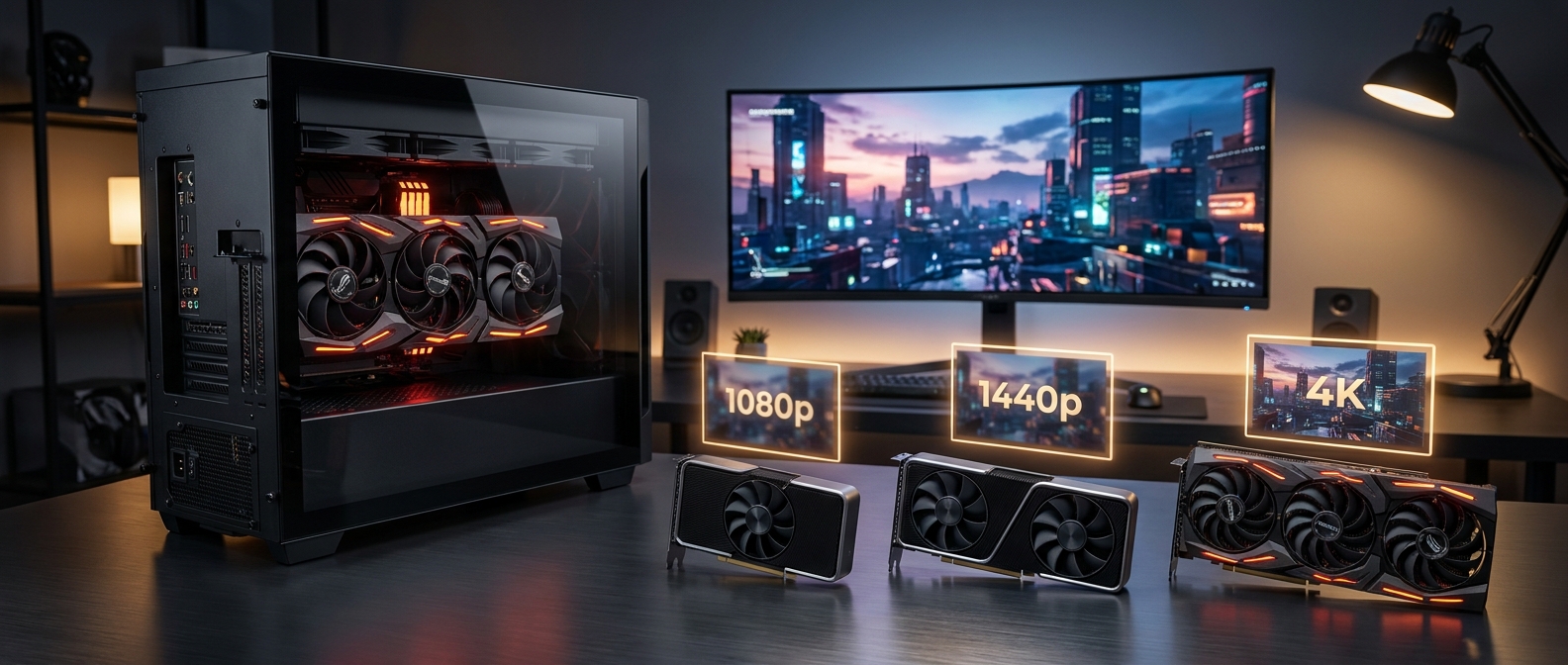
Contenders Overview
Each card in this comparison uses AMD’s RDNA 4 graphics architecture and supports modern features including hardware-accelerated ray tracing, FSR upscaling, frame generation through supported technologies, and AV1 video encoding. Performance varies by game, but the lineup is easy to understand: the RX 9060 XT is the entry point, the RX 9070 GRE sits in the middle, and the RX 9070 and RX 9070 XT target stronger 1440p and 4K performance.
The RX 9060 XT 8 GB and 16 GB share the same basic GPU design. The key difference is memory capacity rather than a fundamentally different graphics processor. That extra capacity becomes more useful with large texture packs, ray tracing, and games that stream substantial amounts of background content. The RX 9070 GRE has fewer compute units and a narrower memory bus than the RX 9070, while the RX 9070 XT adds more graphics resources and higher power consumption for additional frame-rate headroom.
- Radeon RX 9060 XT 8 GB: A 1080p-focused pick for high settings without large texture requirements.
- Radeon RX 9060 XT 16 GB: A better long-term option for 1440p gaming and high-resolution texture packs.
- Radeon RX 9070 GRE: A regional midrange card positioned between the RX 9060 XT and RX 9070.
- Radeon RX 9070: A balanced 16 GB GPU for high-refresh-rate 1440p and entry-level 4K gaming.
- Radeon RX 9070 XT: The fastest card here, designed for demanding 1440p settings and more consistent 4K performance.
Side-by-Side Comparison
These specifications help explain the performance differences between the cards. Stream processor and compute unit counts indicate the amount of parallel graphics hardware, while memory bandwidth describes how quickly the GPU can move data. They are useful comparison points, but the game engine and driver optimization still determine the final FPS result.
- RX 9060 XT 8 GB: 32 compute units, 2,048 stream processors, 8 GB GDDR6, a 128-bit memory bus, and approximately 320 GB/s of memory bandwidth. It is best suited to 1080p gaming and selected 1440p settings.
- RX 9060 XT 16 GB: 32 compute units and 2,048 stream processors with 16 GB GDDR6, a 128-bit bus, and approximately 320 GB/s of bandwidth. The additional capacity helps avoid texture-memory limits, although it does not double GPU performance.
- RX 9070 GRE: 48 compute units, 3,072 stream processors, 12 GB GDDR6, a 192-bit bus, and approximately 432 GB/s of bandwidth. It is a substantial step up from the RX 9060 XT but has less memory capacity than the other RX 9070-series cards.
- RX 9070: 56 compute units, 3,584 stream processors, 16 GB GDDR6, a 256-bit bus, and approximately 640 GB/s of bandwidth. This combination provides considerably more headroom for 1440p ultra settings and 4K upscaling.
- RX 9070 XT: 64 compute units, 4,096 stream processors, 16 GB GDDR6, a 256-bit bus, and approximately 640 GB/s of bandwidth. It offers the most rasterization capacity and is the strongest choice for high settings at demanding resolutions.
When a game fits comfortably within 8 GB of VRAM, the RX 9060 XT 16 GB generally delivers a similar core performance level to the 8 GB model. The 16 GB version becomes more valuable as resolution, texture quality, and ray-traced effects increase. The RX 9070 GRE should normally outperform both RX 9060 XT models, while the RX 9070 and RX 9070 XT deliver the clearest gains in GPU-limited games.
Deep Dive: RX 9060 XT 8 GB and 16 GB
The RX 9060 XT is a strong fit for 1080p and mainstream 1440p gaming. In competitive games such as Counter-Strike 2, Valorant, Fortnite with performance-oriented settings, and Overwatch 2, it can produce high frame rates when paired with a capable processor. At 1080p ultra settings in demanding single-player games, results vary significantly: some titles can fall below 60 FPS, while lighter or well-optimized games can exceed 100 FPS, depending on the game and whether ray tracing is enabled.
The 8 GB model is most comfortable with high textures instead of an unnecessarily aggressive ultra preset. Games such as Hogwarts Legacy, The Last of Us Part I, and newer open-world releases can use more than 8 GB under demanding settings, particularly at 1440p. The 16 GB model will not automatically deliver twice the FPS, but it provides more room for texture data and can reduce stutter caused by VRAM pressure.
- Best resolution: 1080p, with 1440p available after adjusting demanding settings.
- Expected advantage of 16 GB: Better texture stability and greater longevity, rather than a universal large FPS increase.
- Ray tracing: Playable with optimized settings and FSR, but less comfortable than on the RX 9070-series cards.
- Recommended buyer: Someone building a value-oriented gaming desktop with a 1080p or entry-level 1440p monitor.
Deep Dive: RX 9070 GRE
The RX 9070 GRE occupies an unusual position because availability varies by market. Its 48 compute units and 12 GB memory configuration put it above the RX 9060 XT in rendering capacity, but below the RX 9070 in compute resources and memory bandwidth. It is an appealing option for 1440p gamers who want more performance than the RX 9060 XT without stepping up to the full capability of a 16 GB RX 9070.
At 1440p high or ultra settings, the RX 9070 GRE should provide a clear improvement over the RX 9060 XT in GPU-limited games. The difference may be more apparent in demanding scenes than in lightweight esports titles, where the processor can become the limiting factor. Its 12 GB of VRAM can be adequate for current 1440p gaming, but the 16 GB models provide more headroom for future releases and large texture packs.
- Best resolution: 1440p high settings.
- FPS position: Typically faster than the RX 9060 XT and slower than the RX 9070.
- Main limitation: 12 GB of VRAM provides less long-term margin than the RX 9070 and RX 9070 XT.
- Recommended buyer: A regional-market shopper looking for a strong 1440p GPU at an attractive price.
Deep Dive: RX 9070 and RX 9070 XT
The RX 9070 is the balanced pick in this group. With 56 compute units, 3,584 stream processors, 16 GB of GDDR6 memory, and a 256-bit memory interface, it is well suited to 1440p ultra gaming. In many modern titles, it can support high-refresh-rate gaming at 1440p. 4K gaming is also more practical when FSR is enabled or a few especially demanding settings are reduced.
The RX 9070 XT raises the compute unit count to 64 and the stream processor count to 4,096. It also has a higher total board power target, so a desktop built with this card should include a stronger power supply and adequate case airflow. The usual performance gap between the RX 9070 XT and RX 9070 is meaningful but not transformational. The XT is easiest to justify when you have a high-refresh-rate monitor, want demanding ultra presets, or plan to keep the GPU for longer.
- RX 9070: Excellent for 1440p ultra settings and capable of 4K gaming with upscaling.
- RX 9070 XT: The best option here for maximum rasterized FPS and stronger 4K results.
- Ray tracing: More practical than on the RX 9060 XT because the larger GPU has greater compute and memory headroom.
- System planning: Pair either card with a modern processor, fast dual-channel memory, and a power supply that meets the specific board-partner recommendation.
Winner by Category
The right winner depends on your monitor, game library, preferred settings, and upgrade schedule. For example, a 1080p player with a fixed budget may get more practical value from the RX 9060 XT 8 GB than from a faster GPU that the display cannot fully use.
For many shoppers, the 16 GB models offer the best combination of capacity and longevity. The RX 9060 XT 16 GB is the value recommendation for mainstream gaming, the RX 9070 is the most balanced all-rounder, and the RX 9070 XT wins on performance. The RX 9070 GRE can be compelling where it is available and priced below the RX 9070, but its 12 GB memory capacity deserves consideration before purchase.
- Best value for 1080p: RX 9060 XT 8 GB, provided high-resolution texture packs are not a priority.
- Best long-term mainstream choice: RX 9060 XT 16 GB.
- Best regional midrange option: RX 9070 GRE, when its price clearly undercuts the RX 9070.
- Best overall balance: RX 9070 for high-refresh-rate 1440p gaming.
- Best FPS and 4K potential: RX 9070 XT.
When comparing complete gaming desktops, do not shop by graphics card name alone. Insufficient system memory, an older processor, or a weak power supply can prevent a fast GPU from reaching its expected performance. For the most consistent experience, choose at least 16 GB of system RAM, use a modern six-core-or-better processor for high-refresh gaming, and match GPU memory capacity to the games and resolution you plan to use.
Final Verdict
The RX 9060 XT 8 GB and 16 GB are designed for accessible gaming desktops, with the 16 GB model offering a safer fit for modern 1440p titles. The RX 9070 GRE provides an intermediate option where available. The RX 9070 is the most versatile choice for serious 1440p gaming, while the RX 9070 XT delivers the highest FPS and strongest results for demanding settings and 4K upscaling.
In short, choose the RX 9060 XT for value, the RX 9070 GRE for regional midrange pricing, the RX 9070 for balance, and the RX 9070 XT when maximum performance matters more than power consumption or total system cost.
Frequently Asked Questions
Which AMD Radeon GPU is best for 1080p gaming?
The RX 9060 XT 8 GB is the most practical option for standard 1080p gaming when priced competitively. Choose the 16 GB version if you play demanding open-world games, use high-resolution texture packs, or want more VRAM headroom for future releases.
Is the RX 9060 XT 16 GB worth buying over the 8 GB model?
The 16 GB version does not provide twice the frame rate because both cards use the same basic GPU design. Its extra VRAM can improve texture stability, reduce memory-related stutter, and make it a safer choice for modern 1440p gaming.
Should I choose the RX 9070 or RX 9070 XT for 1440p gaming?
The RX 9070 is the better-balanced choice for high-refresh-rate 1440p gaming and usually offers strong performance without the XT model’s higher power target. The RX 9070 XT is worth the additional cost when you want maximum rasterized FPS, demanding ultra settings, or stronger 4K performance with upscaling.
What power supply and system hardware do these GPUs require?
AMD lists a 650W minimum PSU recommendation for the RX 9070 and a 750W recommendation for the RX 9070 XT, although the exact requirement can vary by board partner model. Use a modern six-core-or-better processor, dual-channel memory, at least 16 GB of system RAM, and a case with adequate airflow to reduce bottlenecks.
Is the RX 9070 GRE available in every region, and how does warranty coverage work?
No, RX 9070 GRE availability depends on the region, retailer, and local distribution agreements, so shoppers should verify stock before planning a build around it. Warranty terms are typically handled by the graphics-card board partner or system retailer rather than applying uniformly to every Radeon card, so check the specific product listing before purchase.
Read More
- AMD Radeon RX Graphics Cards — AMD’s official Radeon page provides lineup information, feature details, regional availability notes, and specifications for current desktop GPUs.
- AMD Radeon RX 9060 XT Product Page — Review AMD’s official RX 9060 XT specifications, memory options, power connector, display support, and supported technologies.
- AMD Radeon RX 9070 Product Page — This official product page lists the RX 9070’s compute units, 16 GB memory configuration, power requirements, and media capabilities.
- AMD Radeon RX 9000 Series Quick Reference Guide — AMD’s PDF offers a concise specification overview for the RX 9070 XT, RX 9070, and other RDNA 4 desktop graphics cards.
- AMD Radeon RX 9060 XT 16GB Review — TechSpot’s review covers RX 9060 XT 16 GB gaming benchmarks, resolution scaling, and value comparisons with competing GPUs.