
The RTX 50 Series gaming laptop market in 2026 is defined by one simple truth: DLSS 4 Multi-Frame Generation has changed what “playable” means on battery-powered hardware. Laptops that previously struggled to maintain 60 FPS at 1440p now hit 120–180 FPS in demanding titles, reshaping how we think about portable gaming performance. This guide helps you find the right model for your specific needs, whether you are a student, a competitive gamer, or a mobile creator who also games.
Understanding RTX 50 Series Laptop GPU Tiers
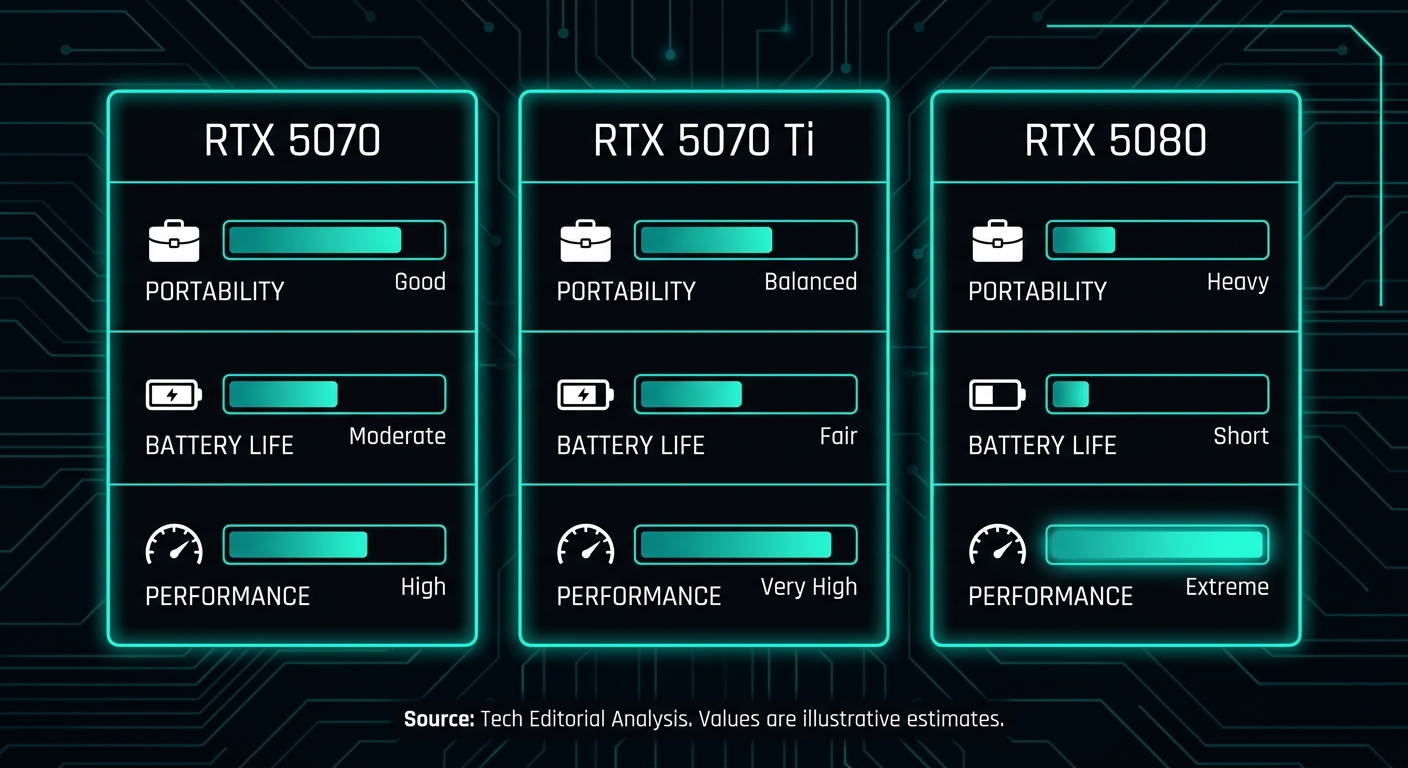
Not all RTX 50 Series laptop GPUs are equal. Manufacturers configure the same GPU chip at different wattage levels (Total Graphics Power, or TGP), and that number matters more than the GPU model name for real-world performance.
The RTX 5060 Laptop GPU (8GB GDDR7, up to 80W) is the entry point. It handles 1080p gaming at high settings and can run 1440p with DLSS 4 engaged. The RTX 5070 Laptop GPU (8GB GDDR7, up to 115W) is the mainstream sweet spot — solid 1440p gaming and capable 4K with DLSS 4. The RTX 5070 Ti Laptop GPU (12GB GDDR7, up to 150W) bridges mid-range and flagship, offering noticeably better 4K performance and more VRAM for future titles. The RTX 5080 Laptop GPU (16GB GDDR7, up to 175W) is the flagship for those who want maximum performance and are willing to pay for it.
Who Needs This? Three Buyer Scenarios
Scenario 1 — The Budget Gamer (Under $1,500): You want a genuine gaming laptop for 1080p–1440p play at a reasonable price, without sacrificing the RTX 50 Series’ DLSS 4 benefits. You are not buying for a workstation or content creation.
Scenario 2 — The All-Rounder ($1,500–$2,000): You want a laptop that handles both work and gaming well — solid 1440p performance, a good display, reasonable weight, and enough battery life for daily use. You may also use it for content creation.
Scenario 3 — The Premium Portable ($2,000+): You want the best portable gaming experience available, with an OLED display, flagship GPU performance, top-tier thermals, and no compromises. Budget is secondary to quality.
Best Pick Per Scenario
Best Budget Pick: GIGABYTE Gaming A16 RTX 5070 ($1,399.99)
The GIGABYTE Gaming A16 at $1,399.99 is the most affordable new RTX 5070 laptop on Newegg from a major brand, offering a 16-inch 165Hz IPS display, Intel Core i7-13620H, 16GB RAM, and 1TB SSD. At this price, the RTX 5070 Laptop GPU with DLSS 4 delivers 1080p and solid 1440p gaming performance that no previous-generation laptop under $1,500 could match.
Best All-Rounder: ASUS TUF Gaming 18″ RTX 5070 ($1,499.99)
The ASUS TUF Gaming FA808 at $1,499.99 (on sale from $1,899.99) is a standout deal — an 18-inch 240Hz display with AMD Ryzen 7 260 and RTX 5070 Laptop GPU in an 18-inch chassis. For buyers who want an immersive screen experience and strong gaming performance at the lowest possible entry price, this is the obvious choice right now. ASUS’s thermal solution keeps the RTX 5070 at its full TGP in sustained gaming sessions.
Best Mainstream All-Rounder: Acer Nitro V16 RTX 5070 ($1,487.99)
The Acer Nitro V16 at $1,487.99 pairs an Intel Core 7 240H with the RTX 5070 Laptop GPU in a slim 16-inch chassis with a 180Hz WQXGA IPS display. It hits a sweet spot for college students and professionals who want strong gaming performance without carrying a large machine.
Best Premium Pick: ASUS ROG Zephyrus G16 OLED RTX 5070 ($1,898.99)
For the premium all-rounder, the ASUS ROG Zephyrus G16 at $1,898.99 delivers a 2.5K OLED 240Hz display, Intel Core Ultra 9 285H, 16GB RAM, RTX 5070 Laptop GPU, and a chassis that weighs under 1.9kg. This is the laptop for buyers who want OLED visuals, thin-and-light portability, and genuine gaming performance in a single package.
Key Buying Tips
Always look for the laptop’s advertised TGP before buying. An RTX 5070 at 80W performs significantly below one running at 115W. Reputable brands like ASUS ROG, MSI, and Acer Predator publish TGP figures; always check the spec sheet.
Display matters as much as GPU. A 165Hz IPS panel looks and feels different from a 240Hz OLED even when running the same game. If you can spend a little more for an OLED display, the visual improvement is dramatic in everyday use.
RAM and storage are upgradeable in most gaming laptops. Do not pay a premium for 32GB RAM or 2TB storage if the same model is available cheaper with 16GB and 1TB — you can often upgrade later for less.
Final Verdict
The RTX 50 Series gaming laptop market in 2026 offers genuine flagship-tier performance at mainstream prices. For most buyers, the ASUS TUF Gaming 18″ at $1,499.99 or the Acer Nitro V16 at $1,487.99 represent the best value. For those who want the ultimate portable experience, the ASUS ROG Zephyrus G16 OLED at $1,898.99 is hard to beat.
Browse the full RTX 5070 gaming laptop selection on Newegg to compare all current models and pricing.
Related Posts
- DDR5 Got Expensive. Here Is the Memory Kit I Would Buy in 2026
- Best Gaming Monitors in 2026
- Best NVMe SSDs in 2026
- GPU Prices Climbed Again. Here Is What I Would Buy in 2026
- Best Mechanical Keyboards in 2026
Frequently Asked Questions
Common questions about buying an RTX 50 Series gaming laptop in 2026.