It's one of the most practical purchase decision questions in consumer tech: Should I buy a refurbished laptop or a new one? In 2026, the answer is more nuanced — and more favorable to refurbished buyers — than at any point in computing history. But that doesn't mean refurbished is always the right call.
This guide cuts through the marketing noise and helps you make a clear-headed decision based on your needs, risk tolerance, and what you want your laptop to be able to do.
What Does "Refurbished" Actually Mean?
First, a crucial distinction: refurbished is not the same as used.
A used laptop is a secondhand device sold as-is, with no testing, no reconditioning, and no warranty protection beyond what the seller offers.
A refurbished laptop has been returned to the manufacturer or a certified refurbisher, tested against a quality checklist, repaired where necessary, cleaned, and repackaged — typically with a warranty included. Grades vary by seller:
| Grade | Condition | What to Expect |
|---|---|---|
| Manufacturer Certified | Near-perfect | Original parts, full-function guarantee, often factory warranty |
| Grade A | Excellent | Minor cosmetic marks, fully functional, typically 90-day to 1-year warranty |
| Grade B | Good | Visible wear (scratches, small dents), fully functional, shorter warranty |
| Grade C | Fair | Noticeable cosmetic damage, functional but aged, limited warranty |
For everyday buyers, Grade A or Manufacturer Certified refurbished units offer the strongest value and lowest risk.
The Case for Buying Refurbished in 2026
Access to Premium Hardware
Refurbished units often give you access to last-generation premium hardware — models that were flagship devices 12–18 months ago. In practice, a well-maintained previous-generation business laptop running an Intel Core Ultra or AMD Ryzen AI processor will handle every productivity task a new entry-level machine handles — and then some.
For users who don't need the very latest Copilot+ NPU features or haven't yet committed to an AI-first workflow, this is a genuinely compelling trade-off.
Environmental Responsibility
In 2026, sustainability is no longer just a values statement — it's a purchasing signal that resonates across demographics. Extending a laptop's lifecycle by purchasing refurbished reduces e-waste and the carbon footprint associated with manufacturing a new unit. This is a real benefit, not just PR language.
Warranty and Risk Mitigation
Reputable refurbishers provide warranties — typically 90 days to one year. This protects against the most common failure modes (display issues, battery degradation, keyboard faults) that might not be immediately visible. If something goes wrong within the warranty period, you have recourse.

The Case for Buying New in 2026
AI Features Require Latest Hardware
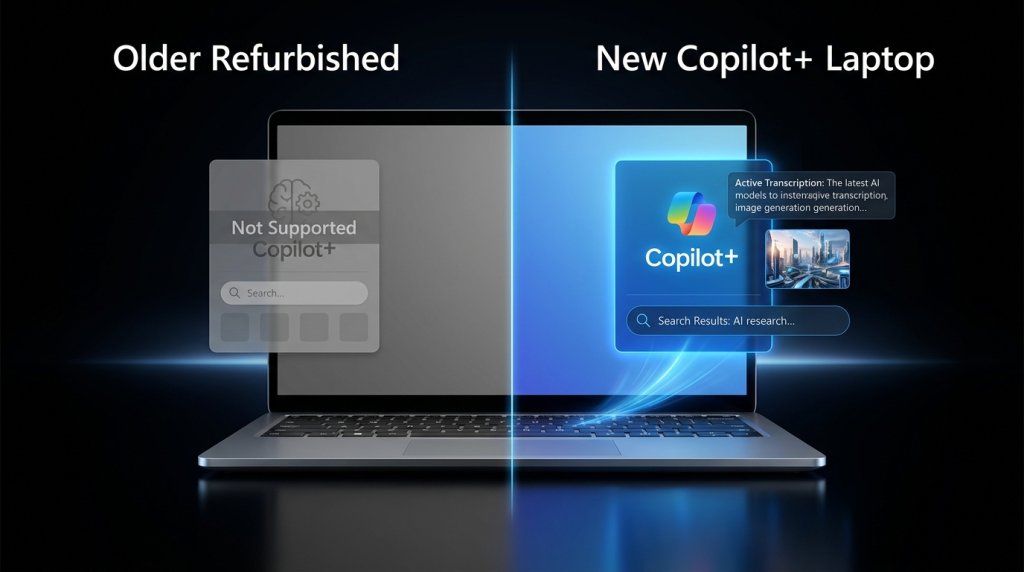
This is the defining factor in 2026 that tips the scale toward new. The newest generation of AI-powered features — including the full Copilot+ PC experience — requires a Neural Processing Unit (NPU) capable of 40+ TOPS of AI inference. Most laptops manufactured before mid-2024 do not meet this threshold.
If you intend to use tools like real-time AI translation, Windows Recall, on-device AI image generation, or advanced Copilot assistant features, only a new laptop with the right silicon will deliver that experience natively.
GPU Performance Leaps Forward
Discrete GPU performance has taken a significant step forward in 2026. NVIDIA GeForce RTX 50 Series laptops deliver meaningfully higher frame rates and AI-accelerated rendering capabilities compared to their predecessors. For gaming or GPU-intensive creative work, buying refurbished means leaving real performance on the table.
The same logic applies to gaming laptops broadly — Intel gaming configurations and AMD-powered alternatives in 2026 are significantly more capable than 2023 or 2024 models.
Full Manufacturer Warranty and Support
New laptops come with manufacturer warranties (typically one year, often extendable) and direct manufacturer support channels. For business users or anyone who depends on their laptop professionally, this support structure has real value that refurbished warranties typically can't fully replicate.
Storage and Memory at Current Standards
New Windows laptops in 2026 ship with fast NVMe SSDs as standard, and 16GB of RAM has become the baseline for mid-range configurations. Refurbished units from 2022–2023 may still have SATA SSDs or 8GB RAM that creates noticeable bottlenecks in modern workflows — particularly those involving AI tools or heavy multitasking.
Head-to-Head Decision Matrix
| Factor | Refurbished | New |
|---|---|---|
| Copilot+ / AI NPU Support | Unlikely (pre-2024 hardware) | Available in current models |
| GPU Performance | Last-gen ceiling | Current-gen (RTX 50, RX 9000) |
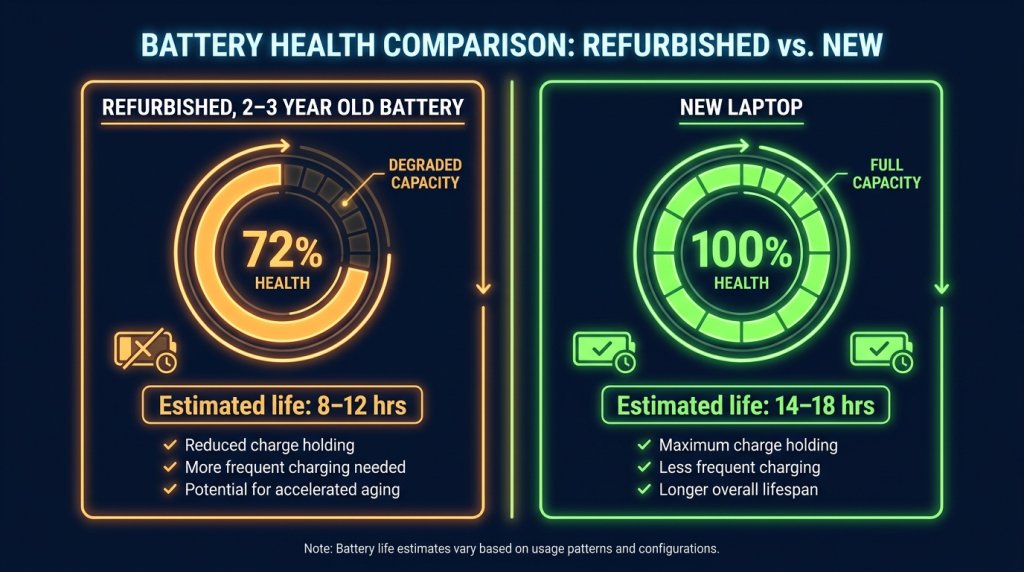
| Battery Health | Degraded (60–90% capacity) | 100% capacity |
| Warranty | 90 days–1 year (third party) | 1 year manufacturer (extendable) |
| Environmental Impact | Lower (extends device life) | Higher (new manufacturing) |
| Storage / RAM Standards | May be behind (SATA SSD, 8GB) | Current standard (NVMe, 16GB+) |
| Best For | Budget productivity, light tasks | AI workflows, gaming, future-proofing |
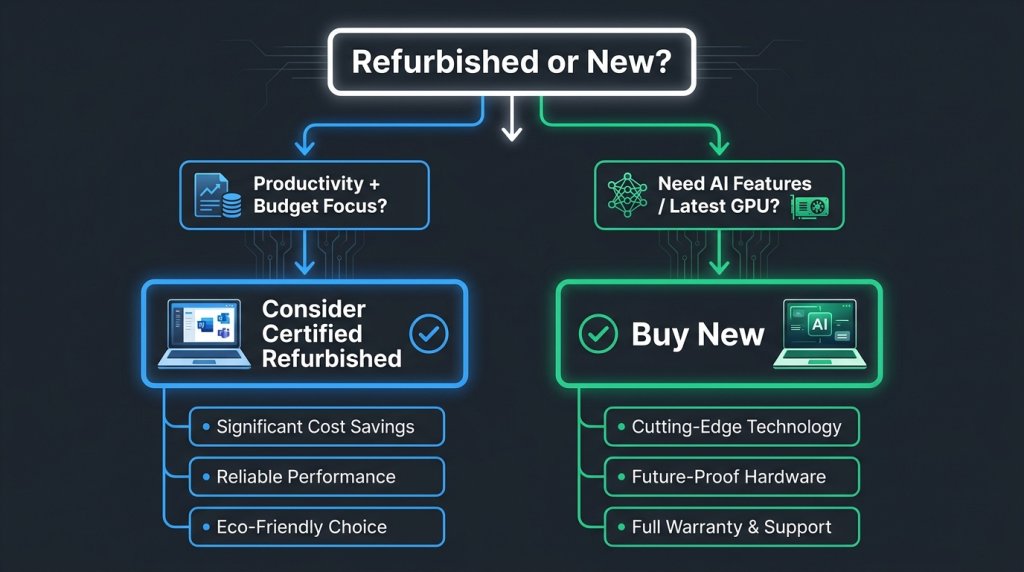
Who Should Buy Refurbished?
- Students who need a reliable machine for documents, browsing, and video calls
- Budget-conscious buyers who want premium build quality without premium outlay
- Users who plan to run productivity apps rather than cutting-edge AI features
- Buyers with a secondary-device mindset — a travel laptop or backup machine
Who Should Buy New?
- Anyone who wants full Copilot+ AI capabilities
- Gamers seeking current-generation GPU performance
- Professionals who depend on their laptop and need full manufacturer support
- Users investing in a primary machine for the next 4–5 years
Smart Shopping: New vs. Refurbished in the Same Budget
One practical exercise: visit the Newegg Laptop Finder and compare what a new laptop and a Grade A refurbished laptop offer at similar investment levels. You may find a refurbished premium model from a prior generation competes well with a new entry-tier machine in real-world use. Or you may discover that current-generation AI and GPU features are worth the step up to new.
For curated deals on both certified and new configurations, the Newegg Premium Laptop Upgrades page is a reliable starting point — with transparent product listings that help you compare across both categories without guesswork.
The Bottom Line
Refurbished laptops in 2026 are a legitimate, often smart option — but not for every buyer. If AI-powered features, current GPU performance, and long-term primary-machine reliability are priorities, a new laptop is the stronger investment. If you need a dependable everyday machine and current-generation AI hardware isn't a requirement, a certified Grade A refurbished unit can deliver outstanding value.
The answer isn't refurbished vs. new. It's about matching the right tool to your actual workflow.