

 here!
here!
I’m your shopping assistant for PC builds, upgrades, and everything tech.
Got questions? Ask away!
Start a conversation
here!
I’m your shopping assistant for PC builds, upgrades, and everything tech.
Got questions? Ask away!
Start a conversation



Any questions? Ask CelesteSM will help you find out quickly.
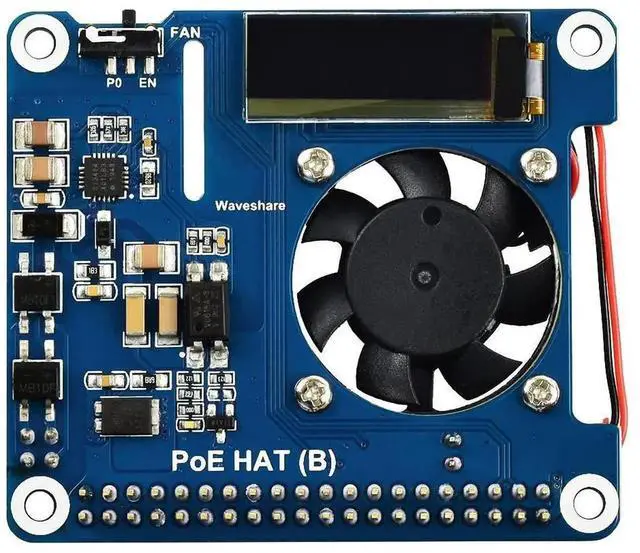
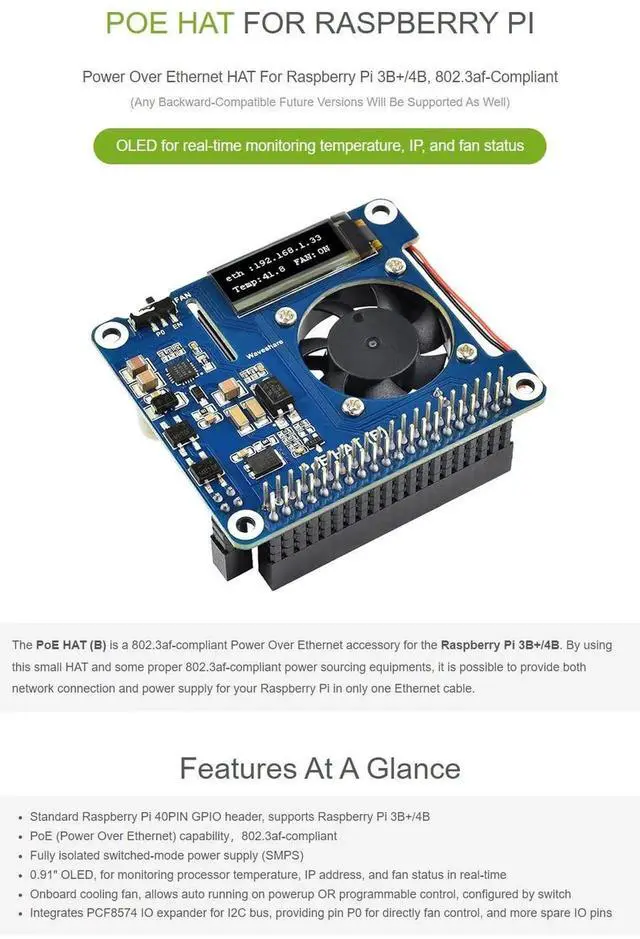
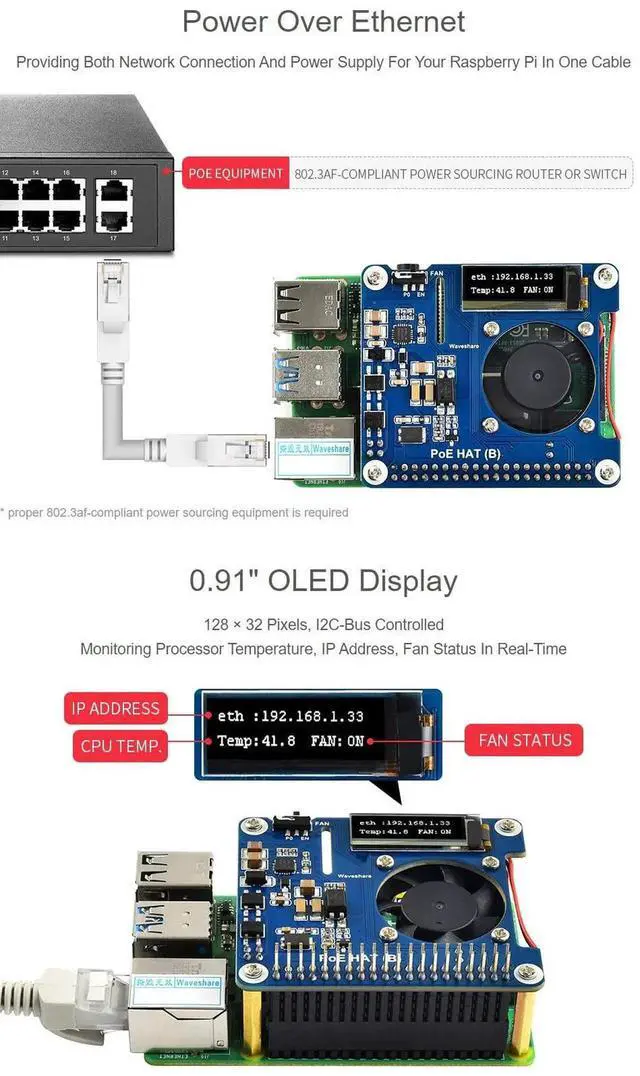
This PoE HAT (B) power over Ethernet expansion board is an official standard HAT module specially customized for Raspberry Pi single-board computers, mainly compatible with Raspberry Pi 3B+ and Raspberry Pi 4B versions. It strictly follows the IEEE 802.3af PoE industry protocol, which realizes one-cable dual functions: network data communication and DC power supply input. You only need to connect a PoE-enabled switch or PoE injector to the Ethernet port, the Raspberry Pi can get power and access the network at the same time, completely replacing the traditional separate USB-C power adapter.
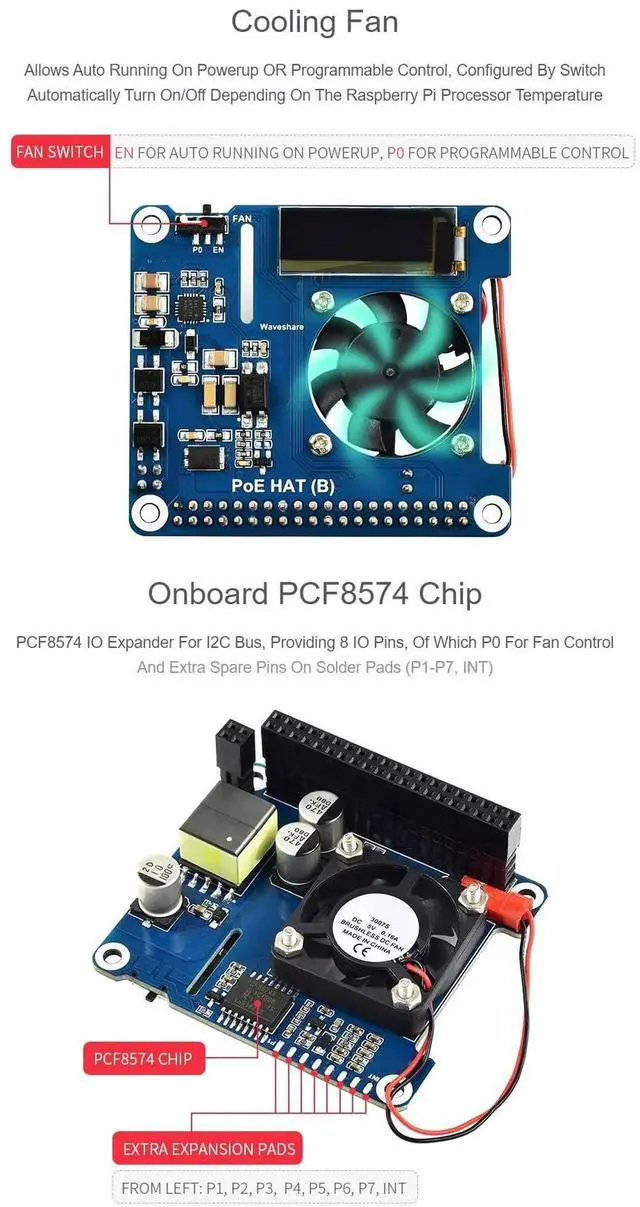
The module adopts high-efficiency isolated power conversion circuit, with overvoltage, overcurrent, short-circuit and reverse connection multi-layer protection mechanisms, effectively avoiding damage to the Raspberry Pi mainboard caused by unstable PoE power supply. A miniature quiet cooling fan and aluminum heat sink are pre-installed on the PCB, which actively dissipates heat for the Pis CPU and power management chip when running 24/7, preventing thermal throttling and system crash under high load tasks such as server operation, camera monitoring and data collection.
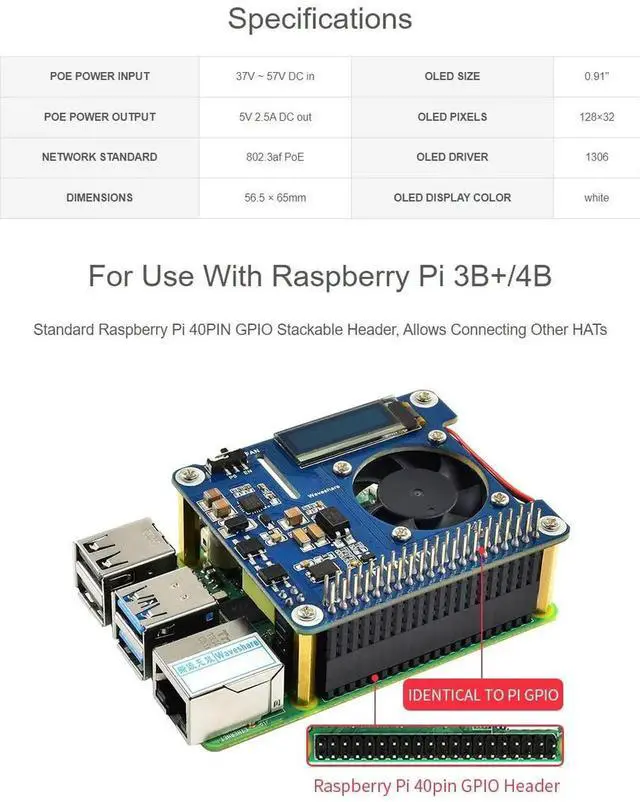
It adopts the standard Raspberry Pi HAT stacking design, accurately aligns with the 40Pin GPIO pin header, does not block other peripheral expansion ports, and reserves complete GPIO expansion space for external sensors, relays and display screens. No driver installation or system modification is required, physical stacking and network cable connection can complete deployment in seconds.
Widely applied in unattended remote monitoring systems, home NAS storage servers, IoT gateway nodes, indoor environmental detection equipment, smart access control and industrial embedded long-running projects. It greatly optimizes the on-site wiring layout, reduces hidden dangers of power line arrangement, and improves the stability and integration of the overall Raspberry Pi application system.