
Your Browsing History
 Holiday Shipping Details & Extended Holiday Returns Holiday Shipping Details & Extended Holiday Returns

Joined on 12/21/08


Mechanical Hard drive worth Buying
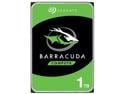
Pros: For a 3.5 inch drive it is very thin Very quiet under load and idle No bad sectors or errors 2 year warranty isn’t too bad in case something goes wrong. Benchmark performance results are listed below: Crystal Disk Mark: • Seq Q32T1: Read = 220.73 MB/s, Write = 145.27 MB/s • 4K Q32T1: Read = 2.09 MB/s, Write = 1.454 MB/s • Sequential: Read = 216.63 MB/s, Write = 165.37 MB/s • 4k: Read = 1.18 MB/s, Write = 1.42 MB/s ATTO Disk Benchmark: • Read: 214.41 MB/sec • Write: 175.16 MB/sec HD Tune • Minimum: 105.8 MB/s • Maximum: 210.2 MB/s • Average: 171.0 MB/s • Access Time: 14.2 ms • Burst Rate: 239.63 MB/s Power Consumption • Idle = 4.8 Watts • Load Read = 6.9 Watts • Load Write = 6.4 Watts Maximum Temperature while testing: 93.2 °F
Cons: Write speeds are a bit low compared to the read speeds Despite many attempts the drive refused to enter its low power sleep state where the platters stop spinning and the head docks itself. Tried changing windows settings and bios settings but still couldn’t get it to sleep.
Overall Review: Overall this drive performed very well for a mechanical hard drive while running relatively cool. It’s good to see that mechanical drives are still improving and finally getting close to the SATA II (3 Gbps) barrier. Considering its low price, this is a great choice if you need a drive with more space than then your SSD. *All tests were conducted three times to ensure accuracy and repeatability of results.
Great keyboard with mediocre software
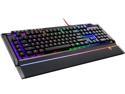
Pros: Individually backlit RGB keys. Has a USB pass-through for other peripherals such as your mouse or headset. Keyboard has built in storage to store your custom configurations. 100% anti-ghosting and 109 key rollover is great. Includes software to greatly customize and add more functionality to this keyboard. Includes a key puller that easily takes the key caps off. Has function keys to quickly switch between lighting profiles. The software can disable the Windows key to prevent issues while gaming. Palm rest connects via magnets which makes it very quick and easy to attach and detach. Features a pull out dock in the center which could be used to hold your phone or your cables that go to the pass-through USB on the right. Also has audio pass-through and even comes with an audio splitter for discrete mic and head phone connections. Features a bunch of really cool lighting effects such as ripples wherever you type, a rain drop looking effect or even keys lighting up after you use them. Also all of these effects can be set to slow, medium or fast speeds.
Cons: There is no way to configure a custom lighting profile and have a lighting effect at the same time. Meaning all of the cool lighting effects can either be used with one static color or random ones. Otherwise if you want a custom per key backlight with different colors set to different keys, you cannot use any effects at the same time. Sometimes after applying changes to custom lighting profiles the brightness setting is set to 0 turning of the lights completely for no reason. An easy fix, but still a bug that needs to be addressed in this software. The popup windows that come up during certain operations of their software look terrible and doesn’t really match the rest of the look and feel of the main page. The keys are way louder than my Cherry MX red keyboard, it’s more comparable to Cherry MX blues as far as noise is concerned. USB pass through is only a USB 2.0 port, so don’t use it for any external HDDs or flash drives. • Read: 42.07 MB/s • Write 43.31 MB/s Space bar, Enter, Backspace and the shift keys are noticeably louder than all of the other keys. The fast forward a rewind button media keys did not work at all. Not really important to me, but they should still function.
Overall Review: Overall this is a great mechanical keyboard with a lot of worthwhile features and functionality. However, the software to manage it is quite bad and needs to fix some bugs as well as add some required functionality. Having a keyboard that can be managed by software with support for custom profiles and per key backlighting but can’t have effects on at the same time is ridiculous and needs to be fixed. Once that is done, I would recommend this keyboard.
Nice Looking Ram

Pros: No stability issues at 6400 M/T Has a Lifetime warranty Not a bad looking heat spreader Supports Intel XMP and AMD EXPO Crucial Pro Overclocking using EXPO1 (6400 M/T at 1.35v) Timing: 32-40-40-103 AIDA64 Memory Test: Memory Copy = 77,523 MB/s Memory Read = 75,391 MB/s Memory Write = 99,097 MB/s Memory Latency = 70.3 ns Cinebench R23: Multi-Threaded = 17744 Single-Threaded = 1804 3DMark Fire Strike Graphics Score = 9,439 Physics Score = 27,176 Combine Score = 3,356 3DMark Steel Nomad Light Graphics Test = 22.90 FPS Geekbench AI ONNX DirectML AMD GPU Single Precision = 8602 Half Precision = 12,901 Quantized = 6426 Temperature: 110.3° and 110.3° Fahrenheit Crucial Pro Overclocking JDEC, no EXPO/XMP (5200 M/T at 1.1v) Timing: 42-42-42-84 AIDA64 Memory Test: Memory Copy = 66,220 MB/s Memory Read = 61,883 MB/s Memory Write = 81,148 MB/s Memory Latency = 87.8 ns Cinebench R23: Multi-Threaded = 17992 Single-Threaded = 1795 3DMark Fire Strike Graphics Score = 8,162 Physics Score = 27,440 Combine Score = 2,902 3DMark Steel Nomad Light Graphics Test = 20.17 FPS Geekbench AI ONNX DirectML AMD GPU Single Precision = 7659 Half Precision = 12,091 Quantized = 5670 Temperature: 102.2° and 102.2° Fahrenheit
Cons: The biggest con here, is Crucial leaving the consumer business. The second is memory prices right now. Outside of that and just looking at the product, if using an integrated GPU, it does offer a small performance bump, however its nothing huge over the default JDEC speeds. This does also slightly lower CPU multi core performance for my particular CPU. Interestingly enough if you use the EXPO2 profile for 6000 M/T, you will get about the same performance as the 6400 M/T profile but with no drop in CPU performance.
Overall Review: Overall, this memory was stable at all speeds and worked fine. It did offer a small performance improvement in memory intensive tasks like AI or gaming on the iGPU. However, this bump is very minor over the default JDEC speeds and given the current market I cant think of a reason to justify the added cost for negligible performance and higher heat and power consumption. CPU: AMD Ryzen 7 8700G Motherboard: Asus ROG STRIX X670E-I GAMING WIFI GPU: AMD Radeon 780M
Good QLC SSD
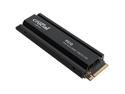
Pros: Compatible with Crucial Storage Executive to manage and monitor drive health. Endurance is lower than a TLC SSD at 440 TBW but is still plenty for most use cases. Has a decent 5-year warranty Included heatsink is great as temperatures were excellent during the benchmarks, maximum was only 118° Fahrenheit or 48° Celsius. Also, unlike a few other SSDs with included heatsinks this one left plenty of room on the end for larger m.2 thumbscrews which some motherboards use now. Benchmark results below and in the attached screenshots show great performance. Crystal Disk Mark 8.0 Sequential 1MiB (Q8T1): Read = 7142.89 MB/s, Write = 6372.15 MB/s Sequential 1MiB (Q1T1): Read = 3602.21 MB/s, Write = 5326.08 MB/s Random 4KiB (Q32T1): Read = 422.17 MB/s, Write = 361.57 MB/s Random 4KiB (Q1T1): Read = 68.22 MB/s, Write = 152.49 MB/s AS SSD Benchmark 2.0 16 MB: Read = 338.86 IOPS, Write = 328.07 IOPS 4K: Read = 19,267 IOPS, Write = 34,538 IOPS 4k-64Thrd: Read = 621,390 IOPS, Write = 738,377 IOPS 512B: Read = 36,190 IOPS, Write = 35,066 IOPS ATTO 4.0.1 Read = 6.82 GB/s Write = 6.27 GB/s
Cons: It is using QLC NAND so if there is a sustained write workload over 400 GB (SLC Cache rough limit), the drives write performance will drop to that of a SATA SSD, around 350 MB/s. Granted this is not a common situation/workload. This is a DRAM-less SSD, however it supports HMB (Host Memory Buffer) so assuming the OS supports it such as Microsoft Windows, it will use a small amount of system memory as the DRAM cache for the SSD. This SSD is supported in the PS5, though the PS5 does not have HMB support for DRAM less SSDs so performance will likely degrade for that use case.
Overall Review: Overall, this is a great performing QLC SSD however at the price, there are a few similarly performing options as well as faster TLC based PCIe 4.0 SSDs that are cheaper than this one. If you're looking for a value-driven SSD from a reputable brand for your Windows system, this drive is worth considering though. Test System specs: CPU: AMD Epyc 8324P Motherboard: ASRock Rack SIENAD8-2L2T
Efficient little black box
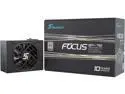
Pros: Super long warranty High efficiency for an SFX power supply Fan is very quiet while in use Power consumption Idle: ~35 watts Load: ~136 Watts
Cons: Cables are a bit stiff which made a little hard to get them routed in my small HYTE Revolt 3 case but still better than sleaved cables as those would have taken up more space. The flat cables are definitely a nice touch as they are easier to flatten out against tie down points in the case.
Overall Review: Overall, this is the best SFX power supply for the efficiency rating I could find without going SFX-L or increasing the wattage output, the latter would have reduced the idle power efficiency. System Specs: CPU: AMD Ryzen 7 8700G Ram: G.Skill Flare XS Series 32GB DDR5-6000 Mob: ASUS X670E-I ROG Strix Gaming Wifi SSD: Samsung 990 Pro 2 TB Case: HYTE Revolt 3 PSU: Seasonic FOCUS SPX-750
Good cooler with poor instructions
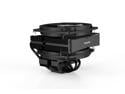
Pros: Design looks good and is the largest air cooler that would fit in my case which is the HYTE Revolt 3 The heatsink mounting process was simple with AMD, cant speak for Intel mounts. Fairly quiet under load but not the quietest cooler Idle Temps: ~100-110 °F Load Temps: ~175 °F
Cons: Instructions are very poorly written in regards to determining which fan goes on top and which goes in the middle. The only way I figured it out was based on the metal retention clips as they unique to each fan and comparing that to the pictures on Newegg.
Overall Review: Overall, this is a decent cooler and is the best air cooler for HYTE Revolt 3 case as nothing bigger will fit unless you go with liquid cooling. System Specs: CPU: AMD Ryzen 7 8700G Ram: G.Skill Flare XS Series 32GB DDR5-6000 Mob: ASUS X670E-I ROG Strix Gaming Wifi SSD: Samsung 990 Pro 2 TB Case: HYTE Revolt 3 PSU: Seasonic FOCUS SPX-750