

Your Browsing History


Eddy M.
Joined on 07/27/05
0
0
product reviews
- 5
Awesome
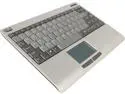
Adesso WKB-4000US SlimTouch 2.4 GHz RF Wireless Mini Keyboard with Touchpad, with min USB receiver and receiver pocket (Silver / grey)
Pros: Great keyboard: small, includes touchpad, great feeling when using it.
Cons: I wish Ctrl was the lower left key instead of Fn (I rarely use Fn, but always use Ctrl). I also wish it didn't include Windows keys, not everybody in the world uses Windows, and since this is a compact keyboard, adding such keys doesn't make sense. A blank piece of plastic like in the old days would be better. For the price, it should include a USB extension cable with a stand, I am using one from another keyboard and it improves range reception dramatically. Expensive, but I knew that when I bought it.
Overall Review: I'm using this on a home theater PC running Linux, and this keyboard is perfect for my occasional use and then stowing away. It works right from the beginning of the boot process, so I can enter the BIOS.
10/5/2009See more detail
Terrible
Adesso WKB-4000US SlimTouch 2.4 GHz RF Wireless Mini Keyboard with Touchpad, with min USB receiver and receiver pocket (Silver / grey)
Pros: - Perfect size, weight, key distribution (except for swapped Fn and Ctrl) - Mousepad is perfect size sensitivity, etc. - Keys material feels good
Cons: -Keyboard was defective almost from the beginning. ESC, F1, etc. don't work. - Range is not so good - Receiver is huge
Overall Review: I bought this keyboard for my HTPC. I almost never use it because I have a remote control, but sometimes I need it to change something in the BIOS, or edit some file in the console using VI (ESC key is used a lot in VI). This would be the perfect keyboard for me if only it WORKED. I would buy another keyboard from this brand, except I don't trust them anymore after spending so much money on this and getting this quality in exchange. Next time I'm getting one made in Japan.
8/5/2010See more detail
Not so good
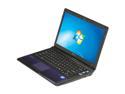
SONY VAIO CW Series 14.0" Intel Core i3-330M 4GB Memory DDR3 1066 Windows 7 Home Premium 64-bit VPCCW23FX/L
Pros: - Nice keyboard design (except for lacking dedicated PgUp, PgDown, Home and End) - Powerful video card - VTE Virtualization Extensions are enabled (shouldn't even have to mention it, but you never know with Sony)
Cons: - HUGE touchpad! I keep moving the mouse accidentally when typing, how annoying. This is my main grip against this laptop: -1 egg. - Video card is still not completely supported in Linux (see other thoughts): -1 egg. - Battery life is not good. The laptop is new and I get less than 2 hours (even after swapping the HD for an SSD): -1 egg. - Laptop is thicker than average - A pain to open (around 40 screws), but not too hard.
Overall Review: I've been using this laptop almost exclusively with Linux (kernel 2.6.34.1). Webcam and bluetooth work well in Linux. The Nvidia driver doesn't support changing the backlight at the moment, which is not so good for battery life and the eyes, I hope nvidia fixes this soon. There is a "Display off" button which does turn the backlight off even in Linux, so its either ON or OFF. TV out doesn't work in Linux (xrandr doesn't even show the output). The wifi card is an Atheros AR9285, which was completely unreliable. After not getting support for Atheros I had to swap it for an Intel 5100.
8/2/2010See more detail
Clumsy design
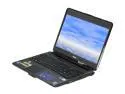
ASUS N51 Series 15.6" Intel Core 2 Duo P8700 4GB Memory Windows Vista Home Premium N51Vn-X1A
Pros: Good specs. Intel VT switch present in BIOS (unlike my previous laptop: a Sony vaio). No dead pixels, or any hardware problem.
Cons: Ugly design, palm resting space is so big, it makes it uncomfortable to type when resting over lap. Frame around screen is huge. Touchpad button is too hard to press. It includes a complete numeric keyboard? Why? I really wish Asus didn't include the numeric keyboard on their laptops, and instead they had a normal location for home, end, pgup and pgdown keys.
Overall Review: I was excited about this laptop until I started to use it. Everything is fine with it, but the design is way worse than my old Sony VAIO. I'm giving it to my sister and keeping the old laptop for myself, as I didn't like this one. It would be great if they didn't include Windows, as the first thing I always do is scrap Windows and install Linux, I could save some money on a license I'll never use anyway. Network driver atl1c in linux worked fine, but the latest nvidia driver made the screen look fuzzy at all resolutions. It was possible to workaround this by setting a "ModeValidation" option in xorg.conf, but when switching to textmode the problem persists.
9/29/2009See more detail
Good DECT SIP phone
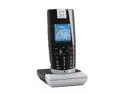
snom m3 Wireless VOIP Phone
Pros: - Good audio quality - Handles 8 SIP accounts - Base expandable to 8 phones, each of them can use more than one SIP account - Handles G.711 (alaw/ulaw), iLBC and G729 - Handsfree operation
Cons: - Cheap plastic feeling - No custom ringtones - Poor ringtone selection - Unable to define ringtones by caller Id - Annoying sounds (some can't be disabled) - Handsfree audio quality could be better - No paging capability! - Useless intercom feature (only works between m3 headsets, why don't you implement paging?) - Limited to 3 concurrent calls (because of DECT limitations) - RFC2833 DTMF signalling not working, had to use SIP INFO instead (bug?) - No phonebook provisioning - No GSM codec (don't care much about this) - Doesn't use DHCP options 42 (ntp server) 2 (timezone) - Doesn't include my timezone (GMT-4.5) - Unable to configure current DST rules
Overall Review: This review was done with firmware 01.16. At the time of writing, this is the best wirelesss VoIP phone in the market. I have bought 3 of these phones, and I use them together with some Grandstream GXP2000 and Linksys SPA941 (none of them is wireless). I really hope they release a new firmware with real paging, phonebook provisioning, DHCP options 2 and 42, and custom ringtones (or at least better ringtones). I don't consider this phone suitable for office use (yet). Despite this harsh review, I really like the Snom M3. I'm just frustrated because it could be much better. I really hope they make it better in next firmware release.
10/8/2008See more detail