




 here!
here!
I’m your shopping assistant for PC builds, upgrades, and everything tech.
Got questions? Ask away!
Start a conversation
here!
I’m your shopping assistant for PC builds, upgrades, and everything tech.
Got questions? Ask away!
Start a conversation

Joined on 04/03/01
320GB per platter
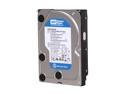
Pros: High performance, very quiet.
Cons: No history, hard to say what reliabilty will be.
Overall Review: WD's 2 platter design using their new 320GB/platters. HD Tach measured average transfer rate reflects the high-density platters with a rate of close to 91MB/s. Exceptional...better than a Raptor. (But of course the access times don't match a Raptor's.)
Speed, IPv6, and a quality build
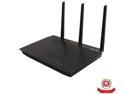
Pros: The ASUS RT-AC66U provides a quality out-of-the-box IPv6 implementation, including a very simple configuration for native IPv6 provisioned via DHCPv6-PD, which is what is required for Comcast's IPv6 deployment (in order to obtain a subnet allocation). All my local hosts now have native IPv6 allocations from Comcast. I was surprised by the speed increase for wifi access. Using my old Linksys 320N (with a DD-WRT firmware), I was only pulling 8 Mbits/sec. With the Asus, my Surface Pro 2 is pulling at least 30 Mbits/sec (which is the limit of my internet connection, I've not had time to test local access). The build quality appears good, and I actually like the look and feel of the finish.
Cons: WIFI range does not seem much improved from my old router, but I've not had time to do very much testing on this.
Overall Review: I've only had the unit for a day, so I can't comment on uptime or longevity.
Solid Unit. Performs well
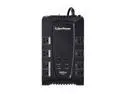
Pros: Works as advertised, power keeps flowing when the plug is pulled. The provided software, PowerPanel Personal Edition has a decent UI, a decent set of features and information, and seems fairly bug free. Powering a Core 2 Duo E6750 with 4GByes, 4 hard disks and an Nvidia 6600 (system draws about 100 - 120 watts), the battery will last about 25 minutes (no monitor included).
Cons: The system has an "autorestart" function: After line power is restored, the system waits about 70 seconds, and then briefly power-cycles the battery-powered outlets (the power is cut briefly, for a second or two and then restored). An attached computer will sense the off-then-on power cycle and, depending on BIOS settings, restart the computer. (Otherwise there would be no automatic way to restart a computer that has done an orderly shutdown on battery power.) This is all a good thing. However, if the power goes out, the computer shuts down, the power gets restored, and then during the next 70 seconds (before the autorestart power-cycle happens) the power goes out again, then when the power comes on the 2nd time the system does not perform the autorestart function, which means any attached PC does not get restarted. So there is a 70 second window during which a 2nd power outtage will leave any attached PCs in a permanent off state.
dual core sweetness
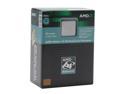
Pros: Dual core. Runs fairly cool, even with both cores maxed out.
Cons: somewhat high in price compared to Intel dual core
Overall Review: Once you dual-core, it's hard to go back. Everything is so smooth, even with big jobs running.
fantastic power supply
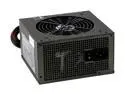
Pros: Modular cabling system is great. Relatively quiet fan system. Braided cables combined with modular cabling system cleans up the cable mess in a case.
Cons: n/a
Overall Review: I use the NEOPower in a home theather system and the power supply is quiet enough for that environment. It's not the loudest fan in the system. It's quieter than a Zalman ZM-F1 running full spead, louder than the ZM-F1 running low speed (at low speed the ZM-F1 is basically noiseless). The pictures of the NeoPower are incorrect: current versions of the product come with braided power cables.
Loaded with features, stable, and good Nvidia drivers
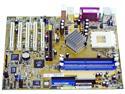
Comments: I like the board a lot. So far the A7N8X has been a solid platform with good drivers from Nvidia. A stable product is my biggest desire and good drivers is also a big requirment and so far the A7N8X has fit the bill. It's loaded with features and the room around the CPU socket is comparable to an IWILL KK266 board (supposedly an Alpha PAL8045 heatsink will fit). The only nit so far is the location of the IDE connectors, which are little too far to the left side of the board for my tastes. It limits how far up in a big tower case you can place an IDE drive. They should have swapped the floppy-ATX power connector location with the IDE connector location.


