
Your Browsing History


Richard H.
Joined on 07/22/03
0
0
product reviews
- 4
replacement tested
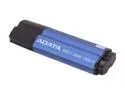
ADATA 32GB S102 Pro Advanced USB 3.0 Flash Drive, Speed Up to 100MB/s (AS102P-32G-RBL)
Pros: I wrote the first review with the DOA unit. I wasn't able to update that review, so here is the replacement as promised. The replacement works well (including on USB3). It's not a particularly fast unit, but more than adequate (especially given the NewEgg sale price). The speed is what you'd expect for a consumer-level USB flash stick in this price range.
Cons: The manufacturer responded to my post and requested I go through ADATA support. I went through the hoops, then learned there was nothing of benefit to me. Definitely stick with the NewEgg replacement if you get a DOA.
Overall Review: If you're looking to USB3 specifically for the write speed, this probably isn't the best drive for you. On the other hand, if you're looking to USB3 for faster simultaneous access with other devices on a hub, this should be perfect. The read speed is almost as fast as a laptop hard disk.
10/6/2012See more detail
Defective chipset
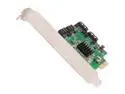
SYBA SI-PEX40062 PCI-Express 2.0 x2 Low Profile Ready SATA III (6.0Gb/s) Controller Card
Pros: Low cost.
Cons: The underlying chipset for this family is defective. After a large amount of research, I finally figured out that the 9xxx series of marvell chipset incorrectly handles DMA transfers (bad addressing), which makes it unusable on modern Linux machines (anything with an IOMMU, like 990FX, etc). Basically, the IOMMU hardware correctly denies the invalid transfer request.
Overall Review: Manufacturer provides no Linux support, troubleshooting etc, but still claims product support. Support will be a big waste of your time (even asking simple things like a configuration it's known to work under). Beware. Recent work is being done to develop a software workaround, but that is targetting patches for 3.6.11, and still not yet functional. In another month or two, support might be available via a bleeding-edge patched custom kernel, but mainstream kernel support is ways off.
8/21/2013See more detail
Defective Hardware

HighPoint 600 Lite Series Rocket 640L PCI-Express 2.0 x4 Low Profile SATA III (6.0Gb/s) RAID Controller Card
Pros: Price
Cons: Invalid DMA addressing in the Marvell chip this is based on causes IOMMU units to correctly fail the tansfer requests. This prevents the card from working with boards containing IOMMU hardware (ex. 990FX boards). Lower-end motherboards may be fine, but this is very incompatible with any hardware used for running modern virtualization, etc. There is some work Linux being done to attempt a software workaround via patches to bleeding edge kernels, but I doubt there will be even a final patch merged before year end. If lucky, support will be available in the Summer 2014 distros.
Overall Review: Should not have advertised Linux support.
8/25/2013See more detail
Unknown Compatibility
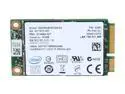
Intel 310 Series SSDMAEMC080G2C1 mSATA 80GB mSATA (mini PCIe form factor) MLC Enterprise Solid State Disk
Pros: Theoretical Fast Speed in a good sized package. Being able to use a hard disk and an SSD in a standard notebook device (ie. not a 19" lap-desktop) would give the best of both worlds: OS and data files on SSD, bulk media on HDD.
Cons: Unknown system compatibility
Overall Review: I've spent a couple hours searching, but can't seem to find whether the Soda Creek cards are compatible with a standard mini PCI express slot like supported off a standard ICH 9 southbridge, or if it just uses the same physical dimensions and connector, but requires a specialized port. I suggest avoiding a purchase until compatibility information is available. If anyone has access to such information, I would really appreciate it.
1/16/2011See more detail