


Your Browsing History


Roy Z.
Joined on 01/24/04
0
0
product reviews
- 19
The best bidirectional device
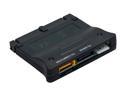
SYBA SD-ADA50016 SATA II to IDE ATA133 Bi-directional Adapter
Pros: 1. Bidirectional -- SATA HDD to PATA/PATA HDD to SATA 2. Passes SMART data to smartmontools: ID, Data, error/self-test logs 3. Reaches UDMA 5/6 90.6/82.7 MB/s burst/average speed SATA HDD to PATA socket 4. Reaches UDMA 5/6 91.8/64.1 MB/s burst/average speed PATA HDD to SATA header 5. Best device package engineering of eleven tested CCBA devices 6. Complete cabling: power M/F pass-thru Molex Y-cable, one SATA data cable 7. Price at $13 is the bonus 8. Manufacturer contact is easy two-clicks to email inquiry from your system, reply is prompt. 9. No jumpers
Cons: 1. SATA HDD to PATA is single-drive only 2. Transfer speed drops from UDMA5 to UDMA2 (33 MB/s) in Tyan MPX S2466N-4M server motherboard
Overall Review: This is the best bidirectional device tested. From the point of view of product management, this is the best product of 11 CCBAs tested (connectors, converters, bridges and adapters, as opposed to HBAs - Host Bus Adapters). Superior device packaging -- fully enclosed PCB, clearly marked connections, no jumpers -- as user-proof as a device like this can get. Contacting customer service is no-hassle simple email -- no filling out fields, logging into Syba website, nothing. Reply was prompt. Price is perfect. Main drawback is that because it plugs into the motherboard IDE socket and has only a single SATA connection, can't attach two SATA HDDs to device, sacrifice one HDD capacity on IDE channel. In addition, like all the CCBAs tested, the interface does not pass muster with Tyan MPX S2466N-4M server motherboard, as transfer mode drops from UDMA 5 (100 MB/s) to UDMA 2 (33 MB/s). So is compliant/compatible but not identical to PATA HDD interface. -- Roy Zider
4/4/2011See more detail
Defective design
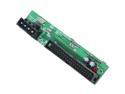
KINGWIN ADP-06 SATA to IDE Bridge Board
Pros: 1. Clean, tight mechanical design, blue plastic keyed shroud around PATA header pins. 2. Passes all SMART data to smartmontools: ID, Data and error/self-test logs 3. Red and green LEDs
Cons: 1. Won't work with another HDD on same PATA channel -- interference, recognition problems. 2. Burst/transfer rates capped at ATA/66, won't reach ATA100/133. Only adapter I've seen do this. Burst and transfer rates on Tyan MPX about 15% below already conservative 33 MB/s UDMA2 recognition rate.
Overall Review: Possible file system corruption associated with testing this device, "no operating sytsem found" errors, Chkdsk automatically run on reboot. Does not work with another HDD on the same IDE channel. Evidently a design defect not picked up in testing. Did not test PATA HDD to SATA motherboard. Myster chipset. -- Roy Zider
4/3/2011See more detail
Fundamental design defect
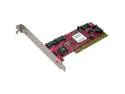
Addonics ADST114 PCI SATA RAID Controller Card
Pros: 1. 93.6/83.5 MB/s burst/average transfer rates over 2 TB drive range, 3% CPU 2. Nice 'Flash BIOS' tab in Properties window for device in Device Manager
Cons: 1. SMART data misreported when two HDDs attached -- last drive's data reported for both drives 2. Passes SMART ID and Data, fails to report error/self-test logs
Overall Review: Silicon Image Sil 3114 SATARaid Controller BIOS 5.0.73 PCI\VEN_1095&DEV_3114&SUBSYS_61141095&REV_02\4&23C0B1C&0&08F0 Like others with similar Sil chipsets, this implementation is clearly defective. SMART data reporting error when two HDDs attached; Query of drive 1 gets data from drive 2; drive 2 is reported correctly as drive 2. Appears to be associated with Silicon Image SATARaid Controller implementations (Sil 3114 here). SMART data pass-through only partially implemented -- ID and Data available, but not error/self-test logs (subject to design error of misreporting drives entirely). Did not test RAID. -- Roy Zider
4/10/2011See more detail
Fundamental design defect
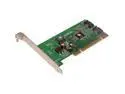
SIIG SC-SAT212-S4 PCI SATA Controller Card
Pros: 1. 94.6/87.2 burst/average Mb/s transfer rates over 2 TB drive range, 3% CPU
Cons: 1. SMART data misreported when two HDDs attached -- one drive's data reported for both drives 2. Passes SMART ID and Data, fails to report error/self-test logs
Overall Review: PCI\VEN_1095&DEV_3512&SUBSYS_35121095&REV_01\4&23C0B1C&0&08F0 This implementation is clearly defective. SMART data reporting error when two HDDs attached; Query of drive 1 gets data from drive 2; drive 2 is reported correctly as drive 2. Appears to be associated with Silicon Image Sil 3512 SATARaid Controller implementations (BIOS 4.5.02 here). SMART data pass-through only partially implemented -- ID and Data available, but not error/self-test logs (subject to design error of misreporting drives entirely). -- Roy Zider
4/10/2011See more detail
Fundamental design defect
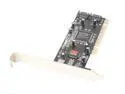
Koutech PSA150 PCI SATA Controller Card
Pros: 1. 94.6/87.6 burst/average Mb/s transfer rates over 2 TB drive range, 4% CPU
Cons: 1. SMART data misreported when two HDDs attached -- one drive's data reported for both drives 2. Passes SMART ID and Data, fails to report error/self-test logs
Overall Review: PCI\VEN_1095&DEV_3512&SUBSYS_65121095&REV_01\4&23C0B1C&0&08F0 This implementation is clearly defective. SMART data reporting error when two HDDs attached; Query of drive 1 gets data from drive 2; drive 2 is reported correctly as drive 2. Appears to be asscociated with Silicon Image Sil 3512 SATARaid Controller implementations. SMART data passthrough only partially implemented -- ID and Data available, but not error/self-test logs (subject to design error of misreporting drives entirely). -- Roy Zider
4/10/2011See more detail
No SMART data pass-through
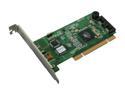
HighPoint RocketRAID 1720 PCI SATA II (3.0Gb/s) RAID Controller Card
Pros: 1. 107.0/92.1 MB/s burst/average transfer over 2 TB range, 4% CPU 2. Runs in 66MHz as well as 33MHz slot 3. HDD drive activity LED headers, plus disk fail LED headers, beeper audio alert 4. 64-bit LBA for 2 TB single partitions
Cons: 1. No SMART data pass-through available for smartmontools, HD Tune 2. Device managment console reports only SMART index values, not raw data, no data range monitoring 3. Transfer rates capped by PCI, not 3 Gbps 4. Can't copy data from managment console panes to clipboard for documentation purposes -- screenshots only
Overall Review: Inexcusably, this device passes no SMART data to Windows that can be used by SMART monitoring software like smartmontools or HD Tune. Does not even pass model and serial number, so useless as just a PCI host bus adapter onto which you can attach SATA drives to an older motherboard. Flexibility but complexity of a web-style managent console interface. Did not test RAID. -- Roy Zider
4/10/2011See more detail