
Your Browsing History


Dan B.
Joined on 12/02/02
0
0
product reviews
- 6
The Hot Rod Was Looking For
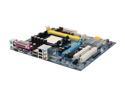
GIGABYTE GA-M61PME-S2 AM2 NVIDIA GeForce 6100 / nForce 430 Micro ATX AMD Motherboard
Pros: Performance. Price. The nForce 430 will use all the speed of your hard disk. If you have a fast drive (like the Seagate Barracuda 7200.11), this thing flies. Everything works. Gigabyte BIOS is super-easy to flash. Processor and memory speeds are easy to tweak. PCIe x16 yields serious performance improvements (in graphics and I/O) over the 6100/405 PCIe x8 version of this board.
Cons: Like other Gigabyte boards, the processor and memory voltage cannot be changed from the BIOS, but only through a Windows utility. This leaves us Linux fans out in the cold. BIOS does not display any voltages; just OK status. I also haven't been able to get 6-channel sound output; just stereo. The board is missing features the nForce 430 is capable of such as gigabit LAN.
Overall Review: I tried MANY AM2 motherboards in the last six months looking for the hot rod, and this is it. The performance improvement over the 6100/405 version is extreme when using a fast disk and running Linux. You won't see the dramatic performance difference if you run Windoze, however. The board is a terrific value, but I would be happy to pay a little more for more features. AMD 690G/SB600's and nVidia 7025/630a's are absolute dogs compared to this board.
5/23/2008See more detail
Oh, you wanted to parts inside?
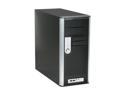
Cooler Master Centurion 541 RC-541-SKN1 Black Aluminum bezel, SECC chassis Micro ATX Mini Tower Computer Case
Pros: Very attractive case. Case disassembly / assembly pretty easy and no tools required. Tonight is trash night, so it won't take much longer to get rid of it. Good place to store baseball cards or jewelry.
Cons: Bad place to put computer parts. Band aids ARE required. Very thin metal. Sharp edges. Standard micro-ATX specs govern the size, so this isn't CoolerMaster's fault, but I have put 4 different configurations together in this case, and I can't get an acceptably neat product. Power supply has no bottom support, so if the mounting screws fail, the power supply is taking out everything on its way to the bottom of the case. The sheet metal is so thin, it is easily damaged. I've seen better structural integrity in potato chip bags.
Overall Review: This case looks great, but has been very frustrating for me because I want the inside of the computer to look as good as the outside. I just couldn't get that in this case. Super light and thin metal easily damaged. I really like some other CoolerMaster cases - Centurion full size and the Mystique are two that come to mind, but this case doesn't come close to its larger cousins in quality. Definitely not worth its price.
5/8/2008See more detail
4 Gig Memory is OK
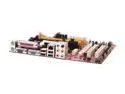
MSI K9N6SGM-V AM2 NVIDIA GeForce 6100 Micro ATX AMD Motherboard
Pros: There is no use to reiterate all the great reviews of this board. It is simply a great value! While the specs claim this board is limited to 2 gig of memory, the last 2 BIOS revisions released in recent weeks (ver 1.9 and 1.A) handle 4 gig. 8 channel sound - with all six audio jacks. Similar Gigabyte board has 8 channel sound but only three audio jacks.
Cons: Like the similar Gigabyte board (GeForce 6100/405), there are BIOS features available only through Windows utilities, which limits us Linux fans.
Overall Review: CPU fan runs at full speed only, and I'm not sure if this is a BIOS feature I haven't found, a fan defect, or a board defect. Not a deal breaker since it keeps the machine that much cooler, but the fan is a Pratt & Whitney, no General Electric, no a CoolerMaster Vortex 752 must have been inspired by something a designer saw on a Boeing. This fan is mechanically quiet, but the airflow sounds like a jet engine at full speed. Seriously, this package is impressive. Has all the features I need (high performance), and none of the features I don't need (Firewire, Gigbit LAN). After $1,500 of experiments, it amazes me that this very high performance Linux box has a $39 motherboard, a $46 video card, 4 gig of RAM for $63, all powered by an $89 AMD64 x2 5000+ BE, and fed by a Seagate 250GB drive with 100 MB/s throughput for 70$ (assuming all the rebates arrive). This is a great ensemble if you don't need the extra features whether you run Windows or Linux.
2/27/2008See more detail
Good, but could've been a little better
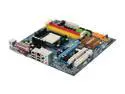
GIGABYTE GA-M68SM-S2 AM2 NVIDIA GeForce 7025 Micro ATX AMD Motherboard
Pros: Surprisingly good video quality and performance. Great set of features at a good price. Great HTPC or workstation board. Very good manual.
Cons: BIOS is somewhat underdeveloped in the respect that it lacks direct access to voltage and clocking controls. These are accessible with the EasyTunes utility, which runs in Windows only. You're out of luck in Linux. Other than video performance, boot speed and I/O performance is lackluster.
Overall Review: I would love this board - if I ran Windows, and if I hadn't seen its little brother the GA-M61SME-S2 absolutely leave this board in the dust. This board is great if you're looking for the features more than crisp performance. But I run Linux. And I love speed. There may be hope for this board with another BIOS update or two; it's only on rev f2. I'm not going to junk it, but I'm not going to run it yet, either. My fastest processor, RAM, and hard drives are going to the lesser Gigabyte board for higher performance.
2/20/2008See more detail
Does all it's supposed to, and does it well
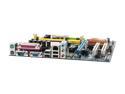
GIGABYTE GA-M61SME-S2 AM2 NVIDIA GeForce 6100 Micro ATX AMD Motherboard
Pros: Extremely good performance. Manual is excellent. Q-Flash updates BIOS without bootable floppy. Video quality and performance much better than I expected.
Cons: 8-channel sound requires an optional part that is difficult to find, so if you want to keep this board inexpensive, you'll have to live without surround sound.
Overall Review: I bought this board to replace a very disappointing ECS 690G that did poorly with Linux. WOW what a difference! Every piece of hardware and software attached to this board runs out of the box and in an optimal fashion. This was my first Gigabyte board, and will not be my last.
2/13/2008See more detail
What a Disappointment
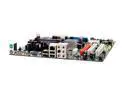
ECS AMD690GM-M2 AM2 AMD 690G Micro ATX AMD Motherboard
Pros: Runs well enough to figure out it doesn't run well.
Cons: Crippled SATA drive throughput. Very poor video quality in Linux. Catalyst drivers made it even worse.
Overall Review: Avoid this board if you run Linux. Am I the only one to notice the SATA drive throughput on this chipset is only about half the drive's rating? Same drives on Nvidia boards have nearly twice the throughput, which equals manufacturer's specs. I think the problems I experienced are the combination of Linux and the 690G chipset. I've used many ECS boards, but always with Nvidia chipsets, and they all performed well. Everything on this board runs - it just runs poorly.
2/13/2008See more detail