

 All CategoriesAll CategoriesAll Categories
OUT OF STOCK
OUT OF STOCK
OUT OF STOCK

OUT OF STOCK
OUT OF STOCK
OUT OF STOCK
OUT OF STOCK
OUT OF STOCK
OUT OF STOCK
OUT OF STOCK
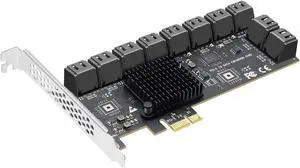
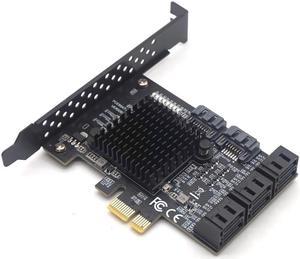
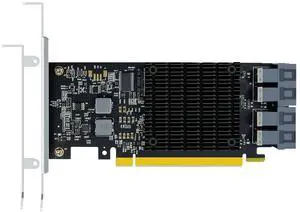
Redundant array of independent disks (RAID) controller cards allow your computer to communicate with HDDs and SSDs. There are several types of RAID controllers to fit the needs of both large companies with mission-critical systems and small start-ups with limited budgets. You can find SATA and SAS controller cards to meet your connectivity requirements.
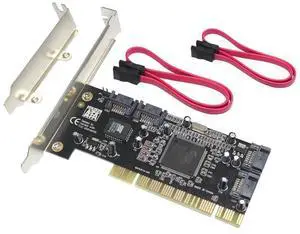
A controller card lets the host system and the storage system communicate with each other. Host Bus Adapters (HBA) expansion cards plug into a slot on the motherboard, usually PCIe®. They physically connect the server to HDDs and SSDs. These add-on cards are a fast and reliable way for storage devices to communicate with the host system. They can connect many HDDs and SSDs to the computer, and they allow the OS to read and write on the hard drives. These controller cards can support SATA, SAS and Fiber Channel. They’re very common in servers and workstations.
RAID controllers can improve the computer’s performance and reliability by storing data across multiple drives. They can also decide to write data on a SSD or HDD based on several factors. RAID cards can be hardware-based or software-based. Hardware RAID controller cards connect to the motherboard via PCI-X, PCIe or RAID-on-chip (ROC). RAID software, instead, runs on the CPU. The latter is typically a cheaper solution, as it doesn’t require dedicated hardware or impact server memory.
RAID 0, also called disk striping, improves write and read speeds by splitting data across different disks. The disks work as a single partition, and there’s no data redundancy with the RAID controller cards. RAID 0 requires a minimum of two drives.
RAID 1 provides redundancy by writing identical data to two drives. If one of the drives fails, the computer can still access data on the other, ensuring that your data remains intact. When you replace the faulty drive with a new one, the RAID card copies data on it from the remaining drive. Many technicians call this procedure “disk mirroring”. The system can read both of the identical disks at the same time, and RAID 1 can improve read speed.
RAID 10 uses both disk striping and mirroring to offer data redundancy and a performance boost. RAID 10 splits data across pairs of identical disks, just like RAID 1. It also uses a similar system as RAID 0 to provide better write and read speeds. This configuration requires a minimum of four storage drives. Since the data runs across different disks, these RAID cards typically use more storage space than other controller types. RAID 10 cards offer superior performance, and they are common in web servers and large databases.