• Sold by Newegg
  • New
Brands
Show More
Type
Show More
External Connectors
Show More
Internal Connectors
Show More
Interface
Show More
RAID
Show More
Sold by
All Top Brands
Condition
Useful Links
Customer Ratings
Sort By:
View:
Fujitsu 9211-8i D2607 6G HBA LSI FW:P20 IT Mode ZFS FreeNAS unRAID+2* SFF-8087
Quick View
  •  
  • S$111.64 –
  • Free Shipping
Adaptec ASR-81605ZQ 12G SAS 16-Port 1GB Cache PCIe x8 RAID Controller
Quick View
  •  
  • S$303.09 –
  • Free Shipping
Adaptec ASR-5405Z RAID Controller 512MB Cache PCIe x8 4-Port SAS SATA ZMCP Full-Height ASR-5405Z
Quick View
Adaptec ASR-5405Z RAID Controller 512MB Cache PCIe x8 4-Port SAS SATA ZMCP Full-Height ASR-5405Z
  • Part Number: ASR-5405Z+BB1
  • Part: 2274500-R
  • SSD Form Factor: Supports 2.5"/3.5" SAS/SATA SSDs (via SAS backplane or breakout cable)
  • Transfer Rate: Up to 6 Gb/s per port
  • Model #: 0ASR-5405Z, 2274500-R
  •  
  • S$135.57 –
  • Free Shipping
B+M Key Socket 2 M.2 NGFF (SATA) SSD to 2.5 SATA Adapter Card with Case New
Quick View
  •  
  • S$42.91 –
  • Free Shipping
LSI 9201-8i = (9211-8i) 6Gbps SAS HBA FW: P20 IT Mode ZFS FreeNAS unRAID
Quick View
  •  
  • S$59.63 –
  • Free Shipping
FOR DELL PERC H810 1GB VV648 RAID DELL POWEREDGE R620 R720 R720xd R820 HIGH PROFILE
Quick View
  •  
  • S$103.76 –
  • Free Shipping
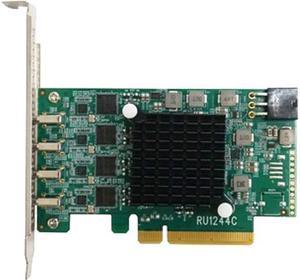
HighPoint RocketU 1244C PCIe 3.0 x8 4-Port USB 3.2 10G Controller
Quick View
HighPoint RocketU 1244C PCIe 3.0 x8 4-Port USB 3.2 10G Controller
  • External Connectors: 4 x USB 3.2 Gen 2
  • Transfer Rate: Up to 10Gb/s per port
  • Dimensions: 4.53" x 2.71" x 0.72"
  • Operating Systems Supported: Mac Mac Pro5,1 or 7,1 MacOS10.12.6+ Windows Computer with PCIe slots Windows 10, 8.1, 7 Windows Server 2019,2016,2012,and 2008(64-bit editions) Linux Computer with PCIe slots Linux kernel 3.10.0+
  • Model #: RU1244C
HighPoint SSD6204A Driverless, Bootable 4x M.2 PCIe Gen3 x8 NVMe RAID Controller
Quick View
HighPoint SSD6204A Driverless, Bootable 4x M.2 PCIe Gen3 x8 NVMe RAID Controller
  • Internal Connectors: 4 x M.2
  • Transfer Rate: 8GT/s
  • RAID: RAID 0/1 JBOD
  • SSD Form Factor: 2242/2260/2280/22110 (supports single & double sided)
  • Model #: SSD6204A
Adaptec 1000 2288400-R (1000-16i ) 8-Lane PCIe Gen3 Low-Profile, MD2 SATA / SAS 12 Gb/s PCIe Gen3  Host Bus Adapter
Quick View
Adaptec 1000 2288400-R (1000-16i ) 8-Lane PCIe Gen3 Low-Profile, MD2 SATA / SAS 12 Gb/s PCIe Gen3 Host Bus Adapter
  • Internal Connectors: 4 (x4) SFF-8643
  • Transfer Rate: Up to 12Gb/s
  • Dimensions: 2.54" x 6.60" (H x L)
  • Operating Systems Supported: Microsoft Windows, Red Hat, SuSE, CentOS, Ubuntu, VMware ESXi
  • Model #: 2288400-R
  •  
  • S$150.79 –
  • Free Shipping
LSI 9240-8i 6Gbps SAS HBA FW:P20 9211-8i IT Mode ZFS FreeNAS unRAID
Quick View
  •  
  • S$83.98 –
  • Free Shipping
shinreal PCIe3.0 to 2x M.2 NVMe RAID Adapter 2241-2IR
Quick View
  •  
  • S$605.92 –
  • Free Shipping

Redundant array of independent disks (RAID) controller cards allow your computer to communicate with HDDs and SSDs. There are several types of RAID controllers to fit the needs of both large companies with mission-critical systems and small start-ups with limited budgets. You can find SATA and SAS controller cards to meet your connectivity requirements.

HBA Controller Cards Are Reliable and Fast

A controller card lets the host system and the storage system communicate with each other. Host Bus Adapters (HBA) expansion cards plug into a slot on the motherboard, usually PCIe®. They physically connect the server to HDDs and SSDs. These add-on cards are a fast and reliable way for storage devices to communicate with the host system. They can connect many HDDs and SSDs to the computer, and they allow the OS to read and write on the hard drives. These controller cards can support SATA, SAS and Fiber Channel. They’re very common in servers and workstations.

RAID Controller Cards and Software Enhance Performance and Reliability 

RAID controllers can improve the computer’s performance and reliability by storing data across multiple drives. They can also decide to write data on a SSD or HDD based on several factors. RAID cards can be hardware-based or software-based. Hardware RAID controller cards connect to the motherboard via PCI-X, PCIe or RAID-on-chip (ROC). RAID software, instead, runs on the CPU. The latter is typically a cheaper solution, as it doesn’t require dedicated hardware or impact server memory. 

RAID 0 Boosts Write and Read Speeds

RAID 0, also called disk striping, improves write and read speeds by splitting data across different disks. The disks work as a single partition, and there’s no data redundancy with the RAID controller cards. RAID 0 requires a minimum of two drives. 

RAID 1 Prevents Data Losses

RAID 1 provides redundancy by writing identical data to two drives. If one of the drives fails, the computer can still access data on the other, ensuring that your data remains intact. When you replace the faulty drive with a new one, the RAID card copies data on it from the remaining drive. Many technicians call this procedure “disk mirroring”. The system can read both of the identical disks at the same time, and RAID 1 can improve read speed. 

RAID 10 Combines the Features of RAID 1 and RAID 0

RAID 10 uses both disk striping and mirroring to offer data redundancy and a performance boost. RAID 10 splits data across pairs of identical disks, just like RAID 1. It also uses a similar system as RAID 0 to provide better write and read speeds. This configuration requires a minimum of four storage drives. Since the data runs across different disks, these RAID cards typically use more storage space than other controller types. RAID 10 cards offer superior performance, and they are common in web servers and large databases.