
Understanding monitor response time specifications is one thing, but knowing how it impacts your actual gaming experience and which response time suits your specific needs is another. In 2026’s diverse gaming landscape, where genres range from hyper-competitive esports to cinematic story-driven adventures, matching response time to your play style has become essential for optimizing both performance and enjoyment.
Response Time Requirements Across Gaming Genres
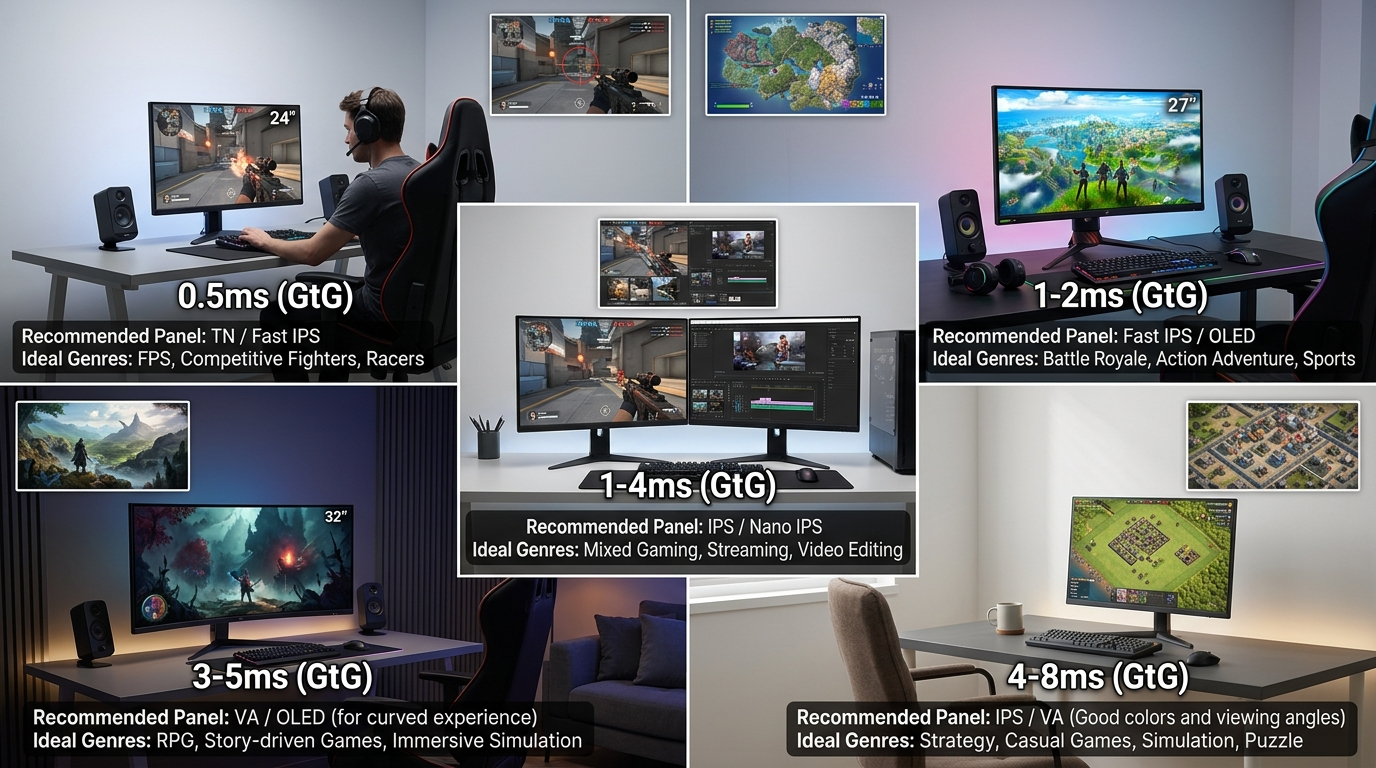
Different gaming genres place vastly different demands on display response time. Recognizing these requirements helps you make informed decisions without overspending on specifications you may not need or compromising on performance where it matters most.
Competitive Esports: Speed Is Everything
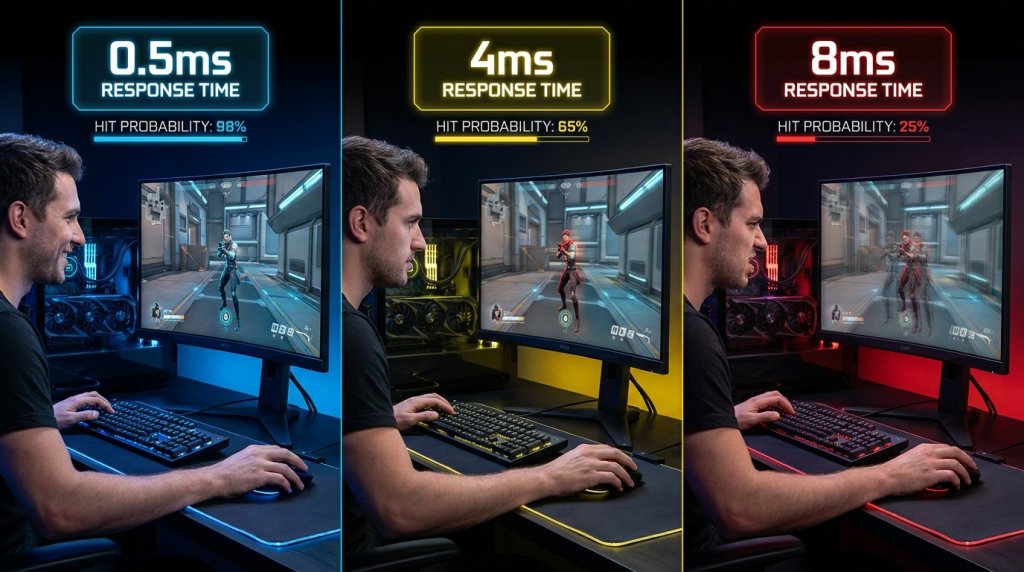
In competitive first-person shooters, battle royales, and fighting games, response time directly impacts your ability to track fast-moving targets and react to split-second situations. Professional players universally prioritize displays with sub-2ms response times, with many opting for 0.5ms to 1ms specifications.
Games like Counter-Strike 2, Valorant, Apex Legends, and Street Fighter demand pixel-perfect precision where even slight motion blur can mean the difference between victory and defeat. For these scenarios, ultra-fast gaming monitors with verified low response times provide measurable competitive advantages.
The combination of fast response time with high refresh rates creates the responsive, blur-free experience competitive gaming requires. Pairing these displays with capable graphics cards ensures you can fully leverage their performance characteristics.
Fast-Paced Action Games: Balanced Performance
Action-adventure titles, racing simulators, and looter-shooters benefit significantly from fast response times but don’t demand the absolute minimums required for competitive play. Response times between 1ms and 4ms provide excellent motion clarity while allowing consideration of other important display characteristics like color accuracy and contrast.
Modern IPS gaming monitors excel in this category, offering Fast IPS response times around 1-2ms while maintaining the superior color reproduction that enhances the visual experience in titles like Cyberpunk 2077, Forza Motorsport, and Destiny 2.
These displays work seamlessly with both NVIDIA and AMD adaptive sync technologies, ensuring smooth gameplay even when frame rates fluctuate during intense action sequences.
Story-Driven and RPG Gaming: Atmosphere Over Speed
For immersive single-player experiences, response time becomes less critical than visual quality characteristics like contrast, color accuracy, and HDR performance. Games like Baldur’s Gate 3, Final Fantasy XVI, and The Witcher IV prioritize atmospheric visuals over twitch reflexes.
Response times in the 3ms to 5ms range remain perfectly acceptable for these genres, allowing you to prioritize curved displays with superior contrast ratios and HDR capabilities that bring these worlds to vivid life.
Many players find that the deep blacks and high contrast ratios of VA panels, despite their slightly slower response times, create more engaging experiences in atmospheric games than faster but lower-contrast alternatives.
Screen Size and Response Time Considerations
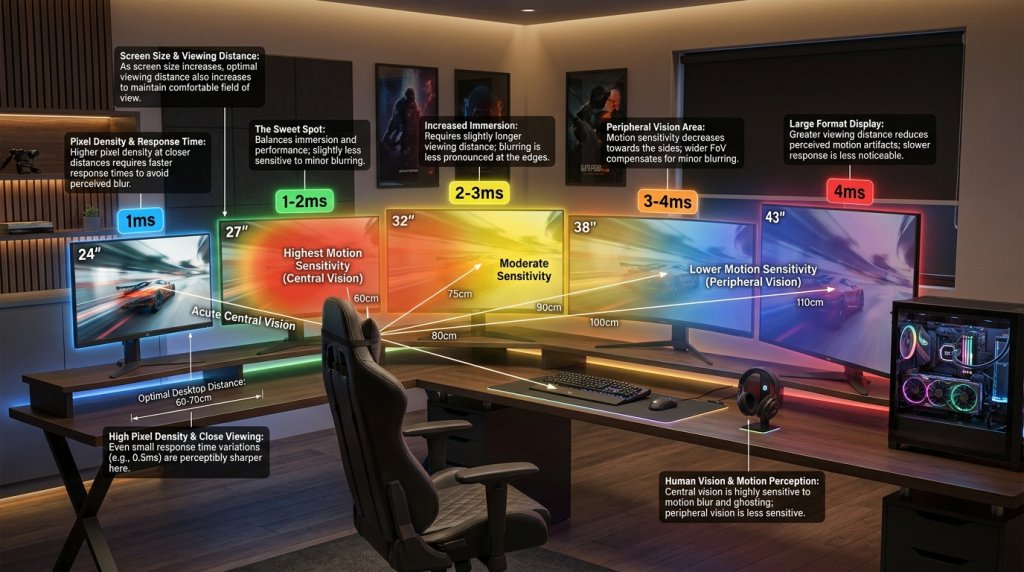
Display size significantly influences how response time affects perceived motion clarity. Understanding this relationship helps optimize your purchase for your specific setup and viewing distance.
Desktop Gaming: 24-27 Inches
At typical desktop viewing distances of 24-30 inches, compact 24-26 inch monitors make response time differences most noticeable. Your eyes can track the entire screen without movement, making any motion blur or ghosting immediately apparent.
This is why competitive players often choose smaller displays with the fastest available response times. The combination of minimal eye movement requirements and ultra-low response times creates optimal conditions for precision gaming.
Immersive Large Format: 32+ Inches
Larger displays, particularly ultra-wide 33+ inch monitors and massive 39+ inch screens, present unique response time considerations. Their expansive viewing areas mean different parts of the screen occupy peripheral vision, where motion blur becomes less noticeable.
However, when viewing content at the screen edges, the greater angular distance from center means motion artifacts can become more apparent if response times are insufficient. Modern large-format gaming displays address this through advanced pixel overdrive systems that maintain consistent response times across the entire panel.
Resolution and Response Time Trade-offs
Resolution choice interacts with response time in ways that significantly impact real-world gaming performance and should factor into your decision-making process.
1080p: Speed Without Compromise
Full HD 1080p displays offer the fastest response times across all panel technologies. The lower pixel count means less data to transition, allowing manufacturers to achieve the absolute minimum response times current technology permits.
This makes 1080p the preferred resolution for competitive gaming, where response time and refresh rate take priority over pixel density. Combined with powerful GPUs, these displays deliver hundreds of frames per second with zero motion blur.
1440p: The Balanced Sweet Spot
Quad HD resolution at 1440p represents an excellent compromise, with modern displays achieving 1-2ms response times while providing 78% more pixels than 1080p. This resolution works particularly well for versatile gaming setups that handle both competitive and immersive titles.
The additional pixel density creates noticeably sharper images without sacrificing the response time performance needed for fast-paced gaming, making 1440p increasingly popular among gamers who refuse to compromise.
4K: Premium Performance
4K gaming monitors have historically struggled with response times due to their massive pixel counts, but 2026’s displays have largely solved this issue. Modern 4K panels achieve 1-2ms response times through advanced manufacturing techniques and AI-enhanced pixel overdrive systems.
For single-player gaming where visual fidelity matters most, 4K displays with fast response times deliver stunning clarity without compromising motion performance. Emerging 5K ultra-wide options extend this capability to even more immersive formats.
Response Time Performance by Use Case
| Gaming Type | Recommended Response Time | Priority Level | Ideal Panel Type | Screen Size Range |
|---|---|---|---|---|
| Competitive Esports | 0.5-1ms | Critical | TN, OLED | 24-27″ |
| Action Gaming | 1-4ms | High | Fast IPS, OLED | 24-32″ |
| Story/RPG Gaming | 3-5ms | Moderate | VA, IPS, OLED | 27-43″ |
| Casual Gaming | 4-8ms | Low | Any | Any |
| Mixed Use | 1-4ms | High | Fast IPS | 27-32″ |
OLED: The Universal Solution
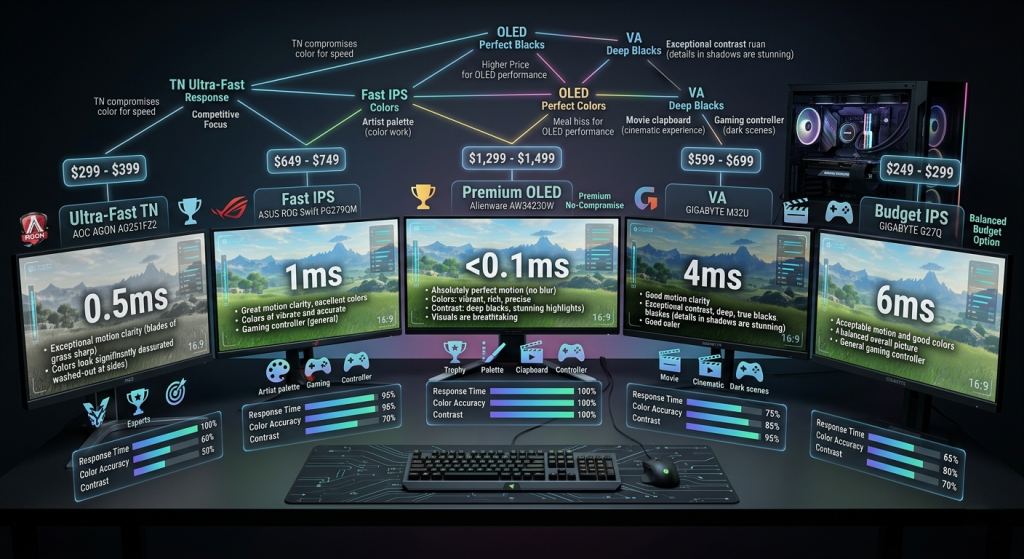
OLED gaming monitors have become increasingly viable in 2026, offering sub-0.1ms response times that effectively eliminate response time as a consideration. These displays excel across all gaming genres, from competitive esports to cinematic adventures.
The per-pixel illumination control of OLED technology delivers instant transitions, infinite contrast, and perfect blacks simultaneously. While premium-priced, OLED displays represent the ultimate “do-everything” solution for gamers unwilling to compromise.
Real-World Response Time Testing
Manufacturer specifications don’t always tell the complete story. In 2026, independent testing and user reviews have become essential for understanding real-world response time performance under various gaming conditions.
AI-powered review aggregation tools now analyze thousands of user experiences to identify displays that consistently deliver on their response time specifications across different content types, refresh rates, and overdrive settings. This democratization of testing data helps consumers make informed decisions beyond marketing claims.
Adaptive Sync and Response Time Synergy
Modern displays combine fast response times with adaptive refresh rate technologies for optimal gaming experiences. G-Sync compatible monitors and FreeSync displays adjust their refresh rates to match GPU output, eliminating screen tearing while working in concert with fast pixel response to minimize all forms of motion artifacts.
This combination has become standard in 2026, with even budget gaming displays featuring both fast response times and adaptive sync support. The synergy between these technologies creates smoother, more responsive gaming than either could achieve independently.
The AI Enhancement Factor
2026’s gaming displays incorporate sophisticated AI algorithms that optimize response time performance dynamically. These systems analyze frame content, predict motion paths, and adjust pixel overdrive voltages in real-time to minimize response time without introducing inverse ghosting.
This intelligent optimization means displays can maintain consistent motion clarity across varying content types, from slow-panning cinematic sequences to hyperactive combat scenes, automatically adapting their behavior for optimal results.
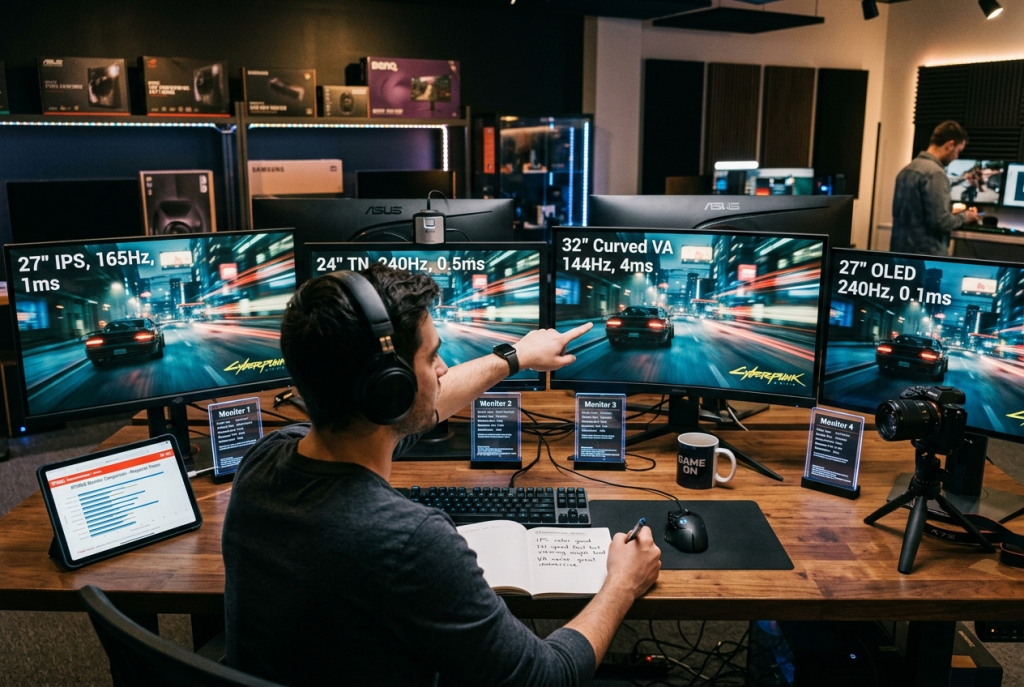
Making Your Response Time Decision
Choosing the right response time involves honest assessment of your gaming priorities and habits. If you spend most time in competitive multiplayer games, prioritize the fastest response times available. If story-driven single-player experiences dominate your library, excellent response times in the 1-4ms range allow you to also prioritize contrast, color, and HDR capabilities.
For versatile gamers who enjoy diverse genres, modern Fast IPS or OLED displays with 1-2ms response times provide exceptional performance across all scenarios without meaningful compromises.
The good news is that 2026’s gaming monitor market offers excellent options across all price points and use cases. Response time performance has improved dramatically across all panel technologies, meaning even budget displays deliver acceptable motion clarity for most gaming scenarios.
Beyond the Specification Sheet
Remember that response time represents just one element of overall gaming display quality. Consider it alongside refresh rate, resolution, color accuracy, contrast ratio, HDR capability, and adaptive sync support to find the optimal balance for your specific needs.
Test displays in person when possible, particularly with content similar to your primary gaming genres. The difference between 1ms and 3ms response times may be imperceptible to you in your preferred games, allowing you to prioritize other characteristics that create more meaningful improvements to your gaming experience.
The revolution in display technology means 2026’s gamers enjoy unprecedented choice and performance. Understanding how response time impacts your specific gaming scenarios empowers you to make informed decisions that maximize satisfaction and value.