

What Is a PCIe 5.0 SSD?
The 2026 Market: Competition Heats Up
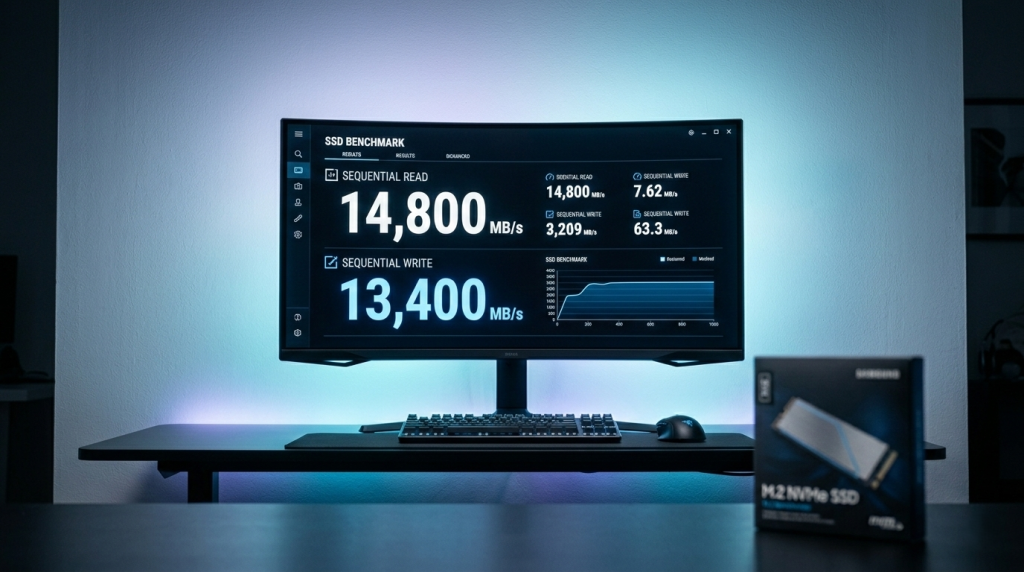
- Samsung 9100 PRO — reaching up to 14,800 MB/s read and 13,400 MB/s write, this drive sets a new benchmark for consumer sequential performance.
- WD Black SN8100 — recognized by reviewers as one of the fastest PCIe 5.0 drives available, and notably cool-running despite its class-leading speed.
- SK Hynix Platinum P51 — SK Hynix’s first consumer PCIe 5.0 entry, now available in the U.S., delivers up to 14,700 MB/s and brings strong brand competition to the high end.
- PNY CS3250 — powered by Phison’s E28 controller, it pushes up to 14,900 MB/s and starts at just $125.99 for 1 TB, marking a significant pricing milestone.
 The Heat Problem Is Largely Solved
PCIe 5.0 vs. PCIe 4.0: Which Do You Actually Need?
- Your primary uses are gaming, everyday productivity, and web browsing
- You want maximum storage capacity per dollar
- Your motherboard doesn’t support PCIe 5.0
- You edit 4K or 8K video and work with large RAW files daily
- You run 3D rendering, simulation, or AI/ML workloads
- You’re building a new high-end system from scratch
- You want a future-proof platform that won’t bottleneck emerging software
 What Performance Metrics Really Matter
- 4K Random Read IOPS: Determines boot speed, application launch time, and overall system responsiveness. Top PCIe 5.0 drives deliver 1.5 to 2 million IOPS here.
- 4K Random Write IOPS: Critical for virtual machines, databases, and large project saves. Aim for 1.4 million IOPS or higher on a premium drive.
- TBW (Total Bytes Written): Your endurance benchmark. For a 1 TB drive, 600 TBW or above is appropriate for heavy use.
- DRAM cache: Drives with onboard DRAM maintain consistent latency and better random I/O performance compared to DRAM-less alternatives.
 The NVMe Protocol Advantage