
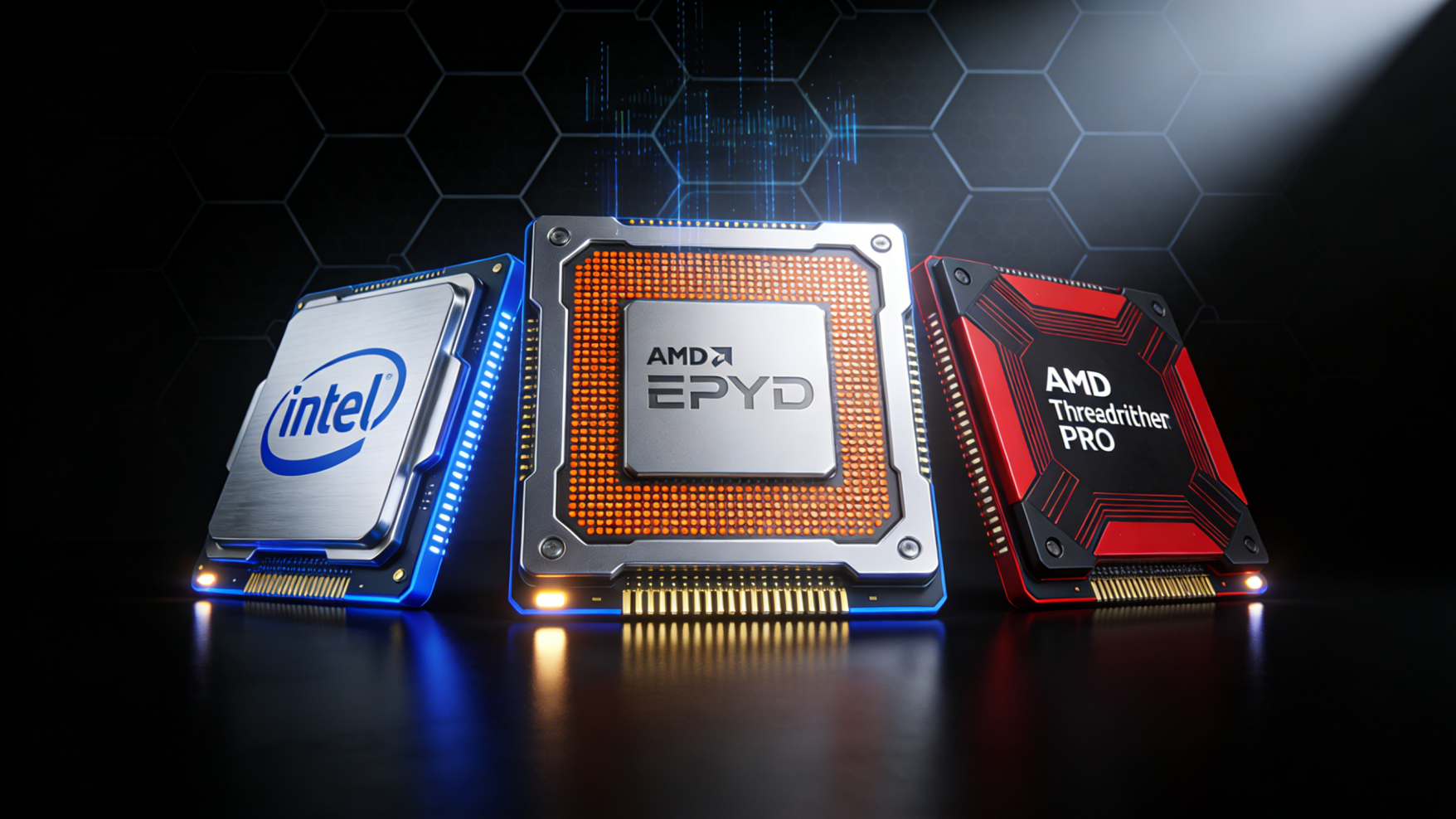
Choosing the right server-grade CPU can make or break your infrastructure investment. AMD EPYC, Intel Xeon, and AMD Ryzen Threadripper PRO each excel in different scenarios, but understanding which processor fits your workload is critical for maximizing performance and cost-efficiency. This guide breaks down the key differences across three demanding use cases: AI workloads, virtualization, and storage-intensive applications.
Core Architecture Comparison
Before diving into specific use cases, let’s examine the fundamental differences between these three processor families:
| Feature | AMD EPYC | Intel Xeon | AMD Threadripper PRO |
|---|---|---|---|
| Target Market | Enterprise datacenter | Enterprise datacenter | High-end workstation |
| Core Count | Up to 96 cores | Up to 56 cores | Up to 96 cores |
| Memory Channels | 12 (DDR5) | 8 (DDR5) | 8 (DDR5) |
| PCIe Lanes | Up to 128 PCIe 5.0 | Up to 80 PCIe 5.0 | Up to 128 PCIe 5.0 |
| ECC Support | Standard | Standard | Standard |
| TDP Range | 200-400W | 150-350W | 280-350W |
For those exploring server processor options, Newegg offers a comprehensive selection of Server CPU Processors across all platforms.
Which CPU for AI and Machine Learning?
AI workloads demand massive parallel processing capabilities, high memory bandwidth, and sustained computational throughput. Here’s how each platform performs:
AMD EPYC: The Memory Bandwidth Champion
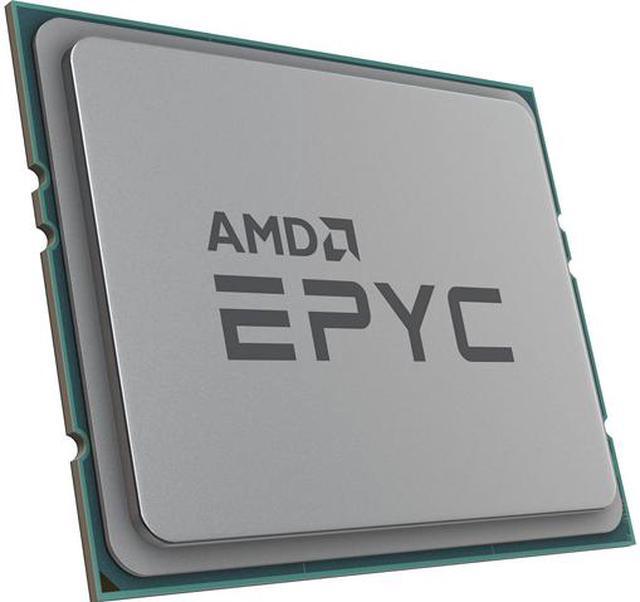
EPYC processors are best for large-scale AI training because they offer exceptional memory bandwidth and core density. The AMD EPYC 9554 64-Core processor provides 12 memory channels delivering up to 460 GB/s memory bandwidth, crucial for feeding data to GPU accelerators in multi-GPU AI training rigs. With 64 cores handling data preprocessing and orchestration, EPYC minimizes GPU idle time and maximizes training efficiency.
Intel Xeon: Optimized for AI Inference
Xeon processors excel in AI inference deployments where AVX-512 and DL Boost acceleration make a measurable difference. The Intel Xeon w9-3475X with its enhanced Intel Deep Learning Boost technology delivers superior per-core performance for inference workloads, particularly when running optimized frameworks like OpenVINO. For production AI serving environments requiring low-latency responses, Xeon’s single-threaded performance advantage becomes critical.
Threadripper PRO: Workstation AI Development
For AI researchers and small teams, Threadripper PRO bridges the gap between desktop and datacenter. The AMD Ryzen Threadripper PRO 7965WX offers 24 cores with 128 PCIe 5.0 lanes, perfect for workstation configurations with 2-4 GPUs. It’s the ideal choice for prototyping AI models before scaling to datacenter hardware.

Virtualization and Cloud Infrastructure: Maximizing VM Density
Virtualization workloads prioritize core count, memory capacity, and I/O throughput. Each platform takes a different approach:
EPYC: Maximum VM Density
AMD EPYC dominates in virtualization density. With up to 96 cores and support for up to 6TB of DDR5 memory per socket, EPYC servers can host significantly more virtual machines per physical server. The AMD EPYC 7262 provides an excellent entry point for mid-sized virtualization clusters, offering 8 cores with SMT for 16 threads at a competitive price point. For cloud service providers, the per-VM licensing cost reduction alone often justifies EPYC deployment.
Xeon: Enterprise Ecosystem Integration
Intel Xeon processors offer mature virtualization features with extensive ISV certification. Processors like the Intel Xeon E3-1230 V5 provide excellent single-socket virtualization performance for small to medium business environments running VMware vSphere or Microsoft Hyper-V. Intel’s VT-x and VT-d technologies, combined with decades of virtualization optimization, ensure compatibility with legacy enterprise applications that may exhibit issues on alternative platforms.
Threadripper PRO: Development and Testing
For development teams running local virtualization labs, the AMD Ryzen Threadripper PRO 5955WX delivers 16 cores with ECC memory support, enabling realistic testing environments without datacenter infrastructure costs.

Storage and NAS: PCIe Lanes and I/O Performance
Storage servers and network-attached storage systems require abundant PCIe connectivity for NVMe drives, RAID controllers, and network adapters.
EPYC and Threadripper PRO: PCIe Lane Leaders
Both EPYC and Threadripper PRO provide up to 128 PCIe lanes, making them ideal for dense NVMe storage arrays. A single EPYC system can directly connect 32 NVMe drives while maintaining dedicated lanes for 100GbE networking and GPU acceleration for storage analytics. For all-flash NAS builds targeting sustained 100+ GB/s throughput, this lane count is essential.
Xeon: Balanced Storage Performance
Intel Xeon platforms with 80 PCIe lanes suit most storage scenarios. The Intel Xeon E3-1230 V2 remains popular for budget-conscious NAS builds, offering reliable performance with lower power consumption. For enterprise SAN deployments where storage controller offload matters more than raw lane count, Xeon’s ecosystem support for high-end RAID cards provides proven reliability.

Decision Framework: Which Processor Should You Choose?
Choose AMD EPYC if you need maximum core density, memory bandwidth, or PCIe connectivity. It’s best for large-scale virtualization, AI training infrastructure, or massive parallel workloads where per-core cost matters.
Choose Intel Xeon if you require maximum single-threaded performance, need extensive ISV certification, or are deeply integrated into Intel-specific technologies. It’s ideal for latency-sensitive applications, AI inference, or enterprises with standardized Intel deployments.
Choose AMD Threadripper PRO if you’re building a high-end workstation that needs datacenter-class features like ECC memory and abundant PCIe lanes without the complexity of server platforms. It’s perfect for content creation studios, engineering workstations, or development environments.
For your next server or workstation build, explore the complete range of enterprise processors at Newegg’s Server CPU category, where you’ll find competitive pricing on EPYC, Xeon, and Threadripper PRO processors alongside compatible server components.
Key Takeaway: There is no universal “best” server CPU. AMD EPYC leads in multi-threaded throughput and I/O connectivity, Intel Xeon excels in single-threaded performance and ecosystem maturity, while Threadripper PRO delivers datacenter capabilities in a workstation form factor. Match your processor choice to your specific workload characteristics for optimal performance and value.