

When configuring a gaming laptop in 2026, most buyers focus immediately on the GPU. That instinct is reasonable — the graphics card handles the heaviest rendering workloads — but the CPU deserves equal scrutiny. The processor governs game physics simulation, AI-driven NPC behavior, background task management, streaming encoding, and a growing portfolio of AI-powered features that are becoming standard in Windows 11. The Intel versus AMD competition for gaming laptop market share has never been more technically competitive, and the platform differences now extend well beyond clock speed comparisons into efficiency architecture, dedicated AI silicon, and ecosystem advantages that affect daily use well beyond gaming sessions.
Intel Core Ultra 200H and 200HX: Arrow Lake Matures for Mobile
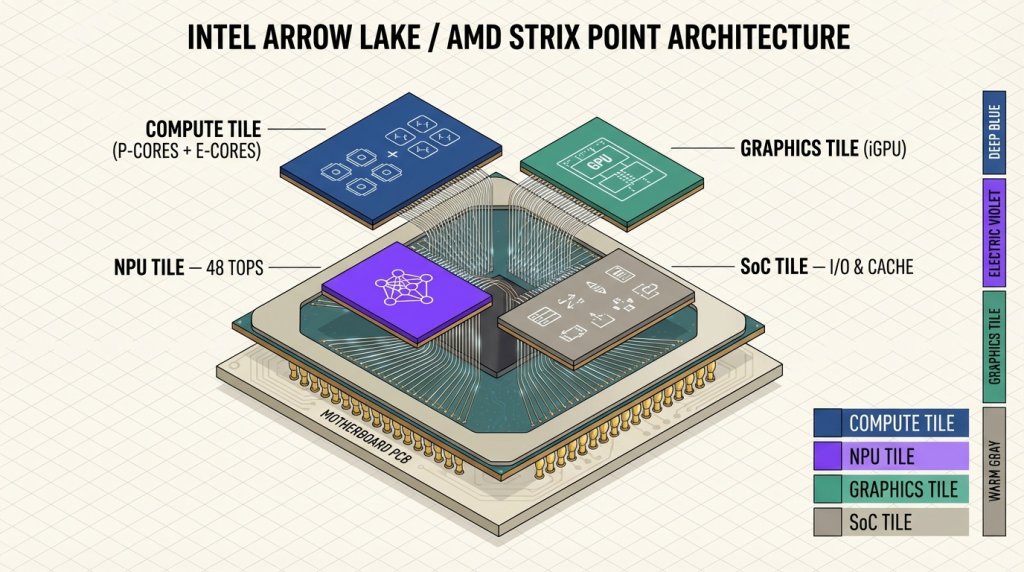
Intel’s 2026 gaming laptop flagship is the Core Ultra 200H and Core Ultra 200HX series, based on the Arrow Lake-H architecture. Moving away from the monolithic die approach of previous Core generations, Arrow Lake uses a chiplet-based design that combines a compute tile, graphics tile, and SoC tile manufactured on different process nodes — Intel 18A and TSMC 3nm — to optimize each function independently.
The Core Ultra 9 285HX is Intel’s top gaming laptop option, featuring 8 Performance-cores and 16 Efficient-cores for a 24-core total. Performance-core boost clocks exceed 5.5 GHz, and Intel’s third-generation Thread Director has improved how Windows assigns workloads across P-cores and E-cores, reducing situations where background processes interfere with foreground game thread performance. In competitive gaming titles that are highly single-threaded — League of Legends, Valorant, CS2, Rainbow Six Siege — Intel’s clock speed ceiling provides a measurable frame rate advantage over AMD alternatives in CPU-bound scenarios.
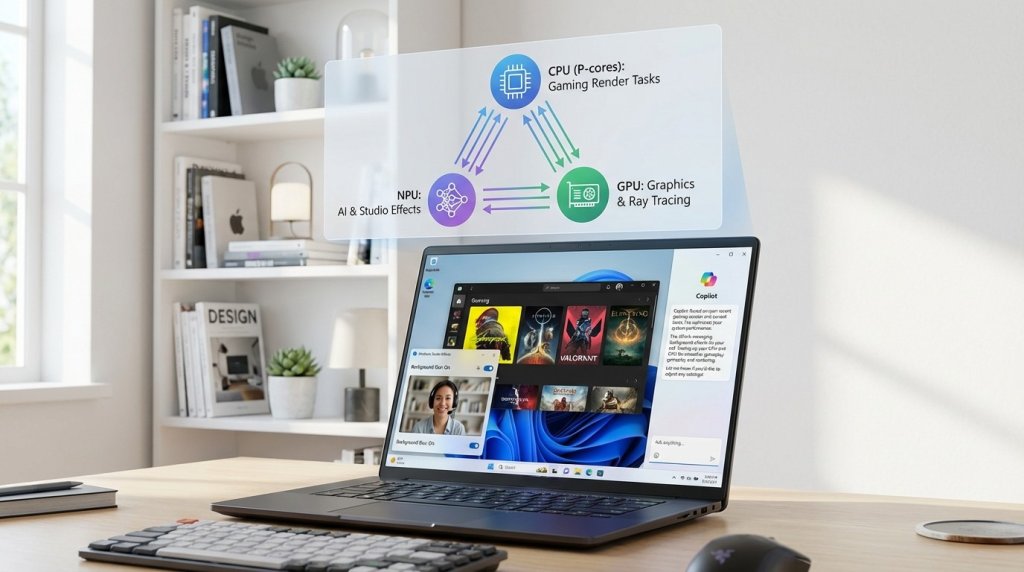
Intel’s Neural Processing Unit in the Core Ultra 200HX reaches 48 TOPS (Trillion Operations Per Second), qualifying every laptop built on this platform for Microsoft’s Copilot+ PC designation. This enables Windows Studio Effects with real-time background blur, live captions, and Cocreator image generation — all running locally on the NPU without taxing the CPU or GPU. Browse Intel gaming laptops at Newegg to compare Arrow Lake-H configurations and pricing.
 AMD Ryzen AI 300 Series: Strix Point Challenges on Every Front
AMD’s answer to Arrow Lake is the Ryzen AI 300 series, codenamed Strix Point, built on TSMC’s 3nm and 4nm node combination. The flagship Ryzen AI 9 HX 395 features 12 cores based on the Zen 5 and Zen 5c architecture, with peak boost clocks reaching 5.1 GHz. Zen 5’s wider execution pipelines deliver a meaningful increase in Instructions Per Clock (IPC) compared to Zen 4, narrowing Intel’s single-thread clock speed advantage in absolute performance terms.
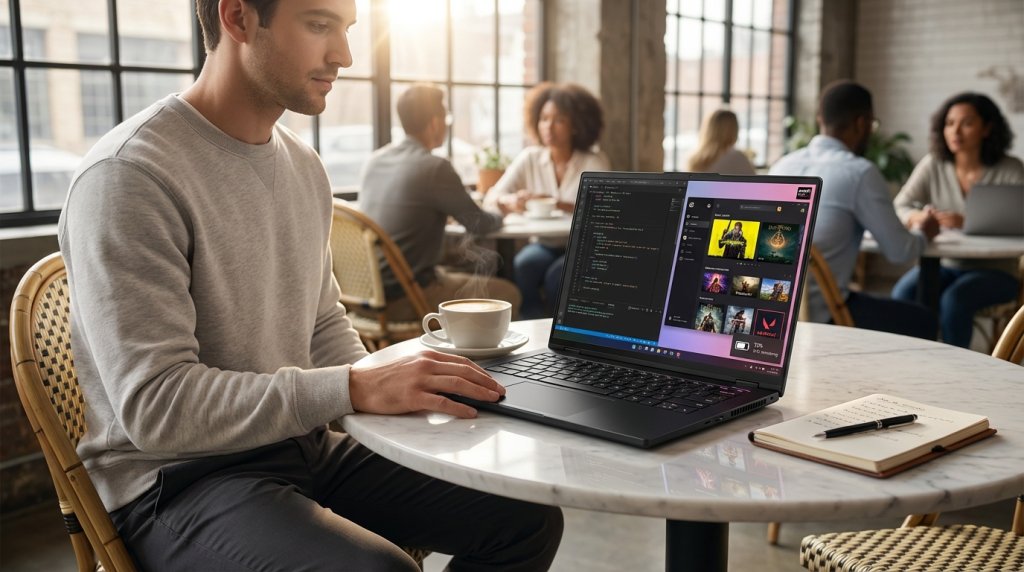
Where AMD’s Ryzen AI 300 pulls decisively ahead is in integrated graphics performance. The RDNA 3.5 iGPU in Strix Point handles light gaming, video playback, and accelerated creative workloads without engaging the discrete GPU, which directly extends battery life in mixed-use scenarios. Real-world battery life on Ryzen AI 300 gaming laptops in productivity and web browsing modes regularly exceeds 8 to 10 hours — a benchmark that Intel Core Ultra 200H configurations approach but rarely surpass. For professionals who use a gaming laptop as their primary work machine between gaming sessions, this battery longevity makes AMD’s platform substantially more practical for all-day use.
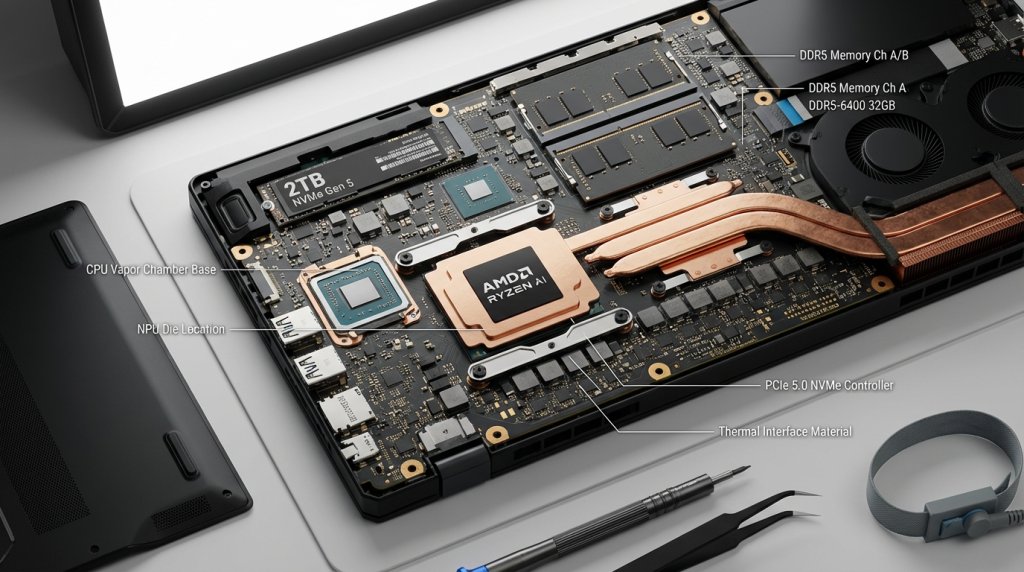
AMD’s NPU tops out at 50 TOPS in the Ryzen AI 300 series, slightly exceeding Intel’s specification and comfortably meeting Copilot+ PC requirements. In real-world AI feature performance, both platforms handle standard Windows Copilot+ workloads comparably, and the differentiation in AI compute matters more for specialized AI development tools than for consumer AI features. Explore AMD gaming laptops at Newegg to compare Ryzen AI 300 configurations with AMD Radeon and NVIDIA discrete GPU pairings.
 Gaming Performance: Where Each Platform Shines
In gaming benchmarks that represent real-world conditions, the performance picture is nuanced and depends significantly on the specific title and scenario.
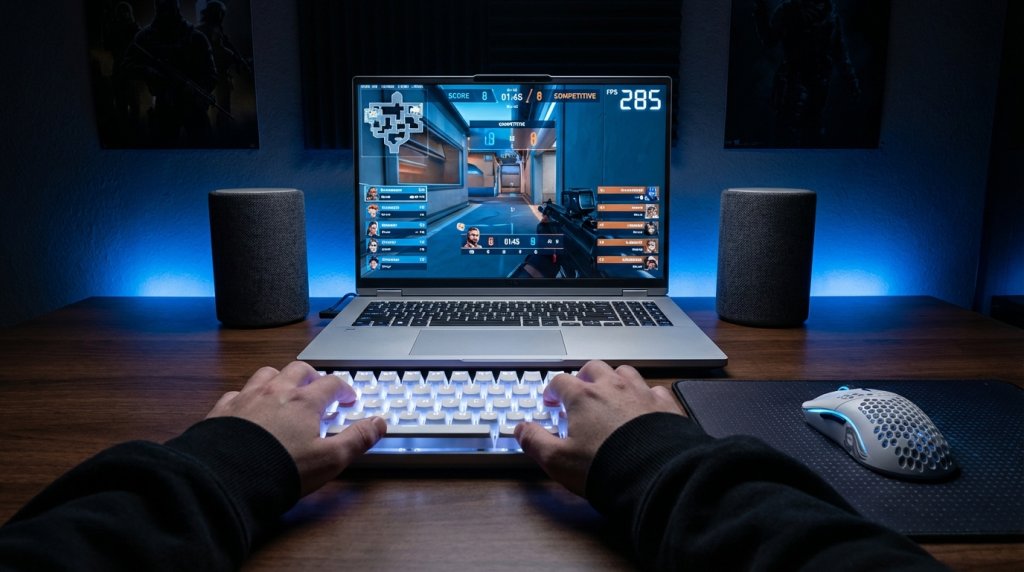
Intel Core Ultra 200HX platforms perform best in competitive titles with high frame rate targets at 1080p, where CPU frame time consistency directly impacts the perceived smoothness that matters in ranked play. Games like Counter-Strike 2, Apex Legends, and Overwatch 2 show Intel leading AMD by 5 to 12 percent in CPU-bound scenarios. For esports-focused buyers — particularly those playing at 240Hz or higher — this Intel advantage has tangible competitive value.
AMD Ryzen AI 300 demonstrates its strengths in open-world games and CPU-heavy simulations where multi-threaded workload distribution matters. Cyberpunk 2077, Microsoft Flight Simulator 2024, and strategy titles like Total War: Warhammer III run more smoothly on AMD’s higher core count and wider execution bandwidth. In creator and streaming workflows — running OBS while gaming, editing video after gaming sessions, or using AI image tools — AMD’s additional cores and superior integrated graphics together make it the more versatile all-day productivity platform.
 Memory and Storage: Getting the Foundation Right
Both Intel and AMD gaming laptop platforms in 2026 support LPDDR5X memory running at 8533 MT/s in their standard configurations, with bandwidth improvements that benefit gaming texture streaming, AI inference, and video editing workloads equally. Regardless of CPU platform, equipping a gaming laptop with sufficient RAM — at minimum 32GB in 2026 — ensures the operating system, active game, background applications, and AI model workloads can coexist without page file thrashing.
Storage speed has become equally critical. PCIe Gen 5 SSD support is standard in 2026 gaming laptop platforms from both Intel and AMD, enabling DirectStorage technology that streams game assets directly from NVMe storage to GPU VRAM, bypassing CPU decompression bottlenecks. Load times in DirectStorage-enabled titles like Forza Motorsport and Starfield drop from tens of seconds to under two seconds on Gen 5 NVMe, a quality-of-life improvement that becomes immediately obvious in daily use.
 AI Gaming Features: NPUs Enter the Mainstream
The integration of dedicated Neural Processing Units into gaming laptop CPUs marks a genuinely new capability in the 2026 product generation. Both Intel and AMD NPUs handle Microsoft Copilot+ features natively, but the applications extending into gaming are now emerging.
In-game AI upscaling pipelines, real-time voice modulation, and AI-powered cheating detection systems increasingly offload computation to the NPU to preserve GPU headroom for rendering. NVIDIA’s Broadcast platform and AMD’s FSR 4 upscaling can utilize CPU-side NPU resources for workloads that don’t require GPU Tensor Cores, extending the available compute budget for primary rendering workloads. This NPU integration is early-stage in gaming applications, but the trajectory is clear — buying a Copilot+ PC platform gaming laptop in 2026 is a forward-looking investment in features that will become standard over the next two years.
 Which CPU Platform Is Right for You in 2026?
The choice between Intel Core Ultra 200HX and AMD Ryzen AI 300 comes down to what you prioritize most. If your primary concern is maximum frame rates in competitive esports titles, Intel’s single-thread clock speed leadership gives you a genuine advantage. If you value battery life, versatile all-day productivity alongside gaming, and the flexibility of strong integrated graphics for light tasks, AMD’s Ryzen AI 300 platform is the stronger choice.
Both platforms support the full gaming laptop ecosystem at Newegg, where Intel and AMD gaming laptops are available from $799 to $2,999 across form factors from slim 15-inch ultraportables to 17-inch performance machines. Using Newegg’s Laptop Finder to filter by CPU brand, GPU tier, display size, and battery capacity allows side-by-side comparison of configurations that match your specific requirements — whether that’s a thin-and-light Ryzen AI 300 model for a mix of work and weekend gaming, or a Core Ultra 200HX beast for competitive play at 240Hz.