
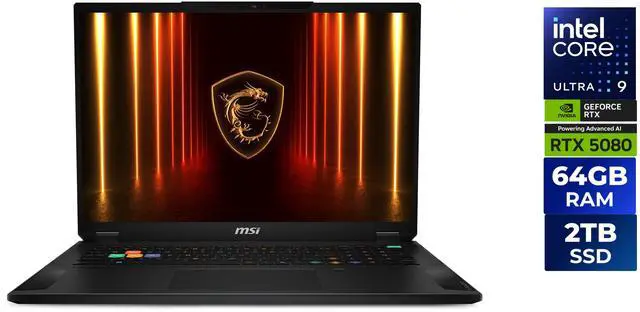
Gaming laptops have always chased one goal: bring desktop-class performance to a portable form factor. In 2026, that chase finally ends — not because gaming laptops have caught up to desktops, but because they have started doing things desktops cannot. The introduction of NVIDIA’s GeForce RTX 50 Series Blackwell architecture in laptop configurations, combined with dedicated AI processors, on-device neural rendering, and real-time frame generation, has fundamentally changed what it means to game on a laptop. Whether you’re a competitive esports player who needs raw frames or a creative professional who games on the side, the gaming laptop market in 2026 offers options that would have seemed impossible just two years ago.
NVIDIA GeForce RTX 50 Series: Blackwell Comes to Laptops
The most significant development in gaming laptop GPU history arrived in early 2026 when NVIDIA officially launched its GeForce RTX 50 Series mobile GPUs based on the Blackwell architecture. The RTX 5090 Laptop GPU leads the stack with 24GB of GDDR7 memory and a dramatically expanded CUDA core count compared to the previous Ada Lovelace generation. More importantly, Blackwell’s 5th-generation Tensor Cores and the new Transformer Engine enable AI-accelerated rendering at a scale desktop predecessors only began to explore.
DLSS 4 — now standard across all RTX 50 Series laptop configurations — uses a multi-frame generation model trained on billions of game frames. The system generates up to three additional frames for every one frame rendered natively, effectively quadrupling framerates in supported titles without the visual artifacts that plagued early frame generation implementations. At 1080p or 1440p, RTX 5080 and 5090 laptops routinely push 240 frames per second in competitive shooters and 120+ fps in graphically demanding open-world titles.
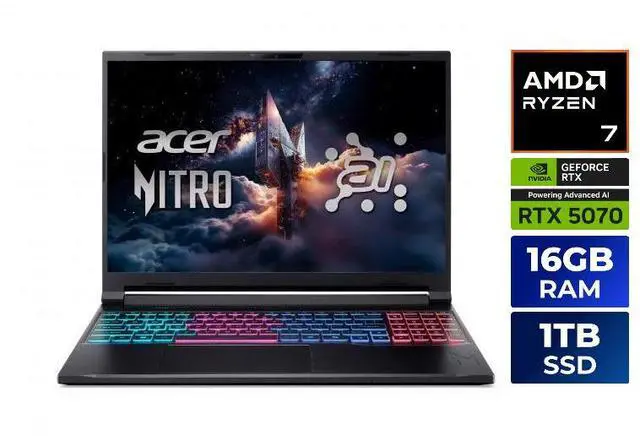
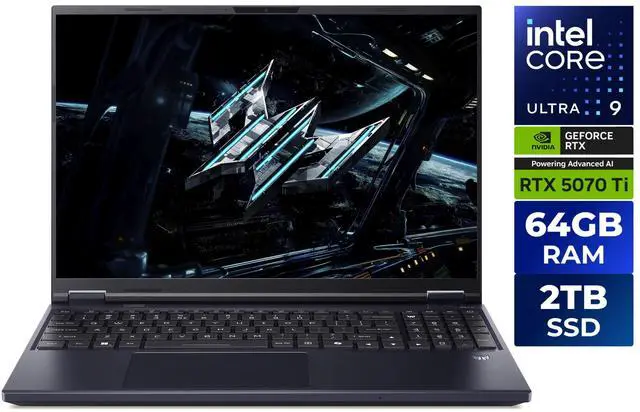
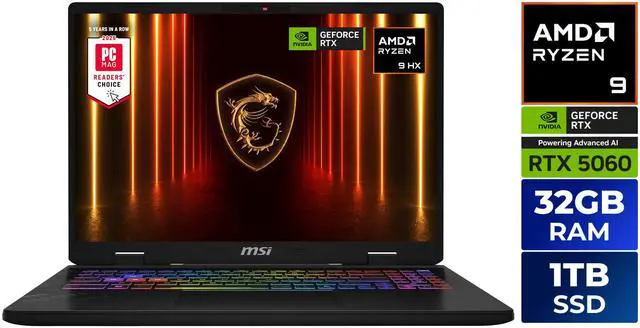
The RTX 5070 and 5070 Ti represent the sweet spot for most buyers. These GPUs deliver RTX 5080-class performance in traditional rasterized workloads while remaining within thermal and power budgets that allow thinner laptop designs. You can explore the full range of NVIDIA GeForce RTX 50 Series gaming laptops at Newegg to compare configurations across multiple brands.
 AMD Radeon RX 9000M: The Alternative for Value-Focused Gamers
Not every 2026 gaming laptop runs on NVIDIA silicon. AMD’s Radeon RX 9000M series, launched alongside its RDNA 4 desktop counterpart earlier this year, has made significant inroads in the mid-range gaming laptop segment. The RX 9070M and RX 9060M offer competitive rasterization performance to NVIDIA’s RTX 5060 and 5070 at lower price points, with AMD’s FidelityFX Super Resolution 4 (FSR 4) providing upscaling quality that now rivals DLSS in many supported titles.
AMD gaming laptops pair these GPUs with AMD Ryzen AI 300 series processors, creating a unified AMD ecosystem with high-bandwidth memory interconnects and shared AI processing resources. For buyers who prioritize cost-per-frame and longer battery life over absolute maximum performance, this combination is genuinely compelling.
The AI Revolution: Beyond Just Better Frames
The GPU improvements would be story enough for most years, but 2026’s gaming laptops have added another layer: dedicated Neural Processing Units (NPUs) that handle AI tasks independently of both the CPU and GPU. Intel’s Core Ultra 200HX series processors, found in many high-performance Intel gaming laptops, include NPUs capable of over 120 TOPS (trillion operations per second).
This NPU capacity powers Microsoft’s Copilot+ PC features on Windows 11. Gaming laptops certified as Copilot+ PCs run on-device AI features including real-time game commentary analysis, AI-assisted voice chat noise cancellation with zero cloud latency, and Recall — Microsoft’s AI-powered searchable screenshot history that makes it trivially easy to find that crafting recipe you saw three hours into your last session.
In-game, AI is transforming NPC behavior. Titles using NVIDIA’s ACE (Avatar Cloud Engine) technology can now run local AI inference on laptops powerful enough to support it, creating NPCs that respond to spoken conversation with coherent, context-aware dialogue rather than branching dialogue trees. Several major titles releasing in the second half of 2026 have announced ACE integration, making the RTX 50’s dedicated AI Tensor Cores a relevant feature rather than a marketing footnote.
 Memory and Storage: The Bottlenecks That No Longer Exist
GPU and CPU improvements only translate to real-world performance gains when memory and storage can keep pace. Gaming laptops in 2026 have largely solved the storage bottleneck. PCIe Gen 5 NVMe SSDs with sequential read speeds exceeding 14,000 MB/s are now common in premium configurations, reducing open-world asset streaming hitches to nearly zero. Games that once required 30-second loading screens in 2022 now load in under two seconds.
RAM configurations have also matured. LPDDR5X running at 8,533 MT/s is the baseline for flagship models, with DDR5-6400 in socketed configurations for desktops-replacement class machines. 32GB has become the practical minimum for a gaming laptop in 2026 — not because games require it, but because running a game alongside a browser with 40 tabs, a Discord overlay, and an AI assistant model running locally in the background demands that headroom.
 Thermal Design: Thinner, Quieter, Cooler
The engineering challenge NVIDIA’s maximum TGP (Total Graphics Power) specifications create for laptop OEMs is formidable. An RTX 5090 laptop GPU can draw up to 175 watts, and the accompanying CPU adds another 55 to 75 watts. Dissipating 250 watts of continuous heat in a chassis thinner than 25mm requires engineering creativity.
2026’s flagship models address this through vapor chamber cooling spanning the full chassis width, liquid metal thermal compounds between the CPU die and heat spreader, and AI-controlled fan profiles that predict thermal demand before performance spikes rather than reacting after temperatures rise. ASUS ROG, Razer, MSI, and Lenovo Legion have all introduced chassis designs this year with measurably better sustained performance compared to 2024 equivalents at the same noise levels.
Should You Buy a Gaming Laptop in 2026?
The case for buying a gaming laptop in 2026 is stronger than it has ever been. RTX 50 Series Blackwell architecture delivers generational performance improvements over Ada Lovelace. AI features have matured from novelty to productivity multipliers. Storage and memory bottlenecks are largely eliminated. Thermal designs are more sophisticated, enabling sustained performance without throttling.
Use Newegg’s Laptop Finder tool to filter by GPU tier, display resolution, price, and brand to narrow down the options that match your use case. If raw performance at competitive prices is the priority, check the Gaming Laptop category for current deals and bundle offers that frequently include storage upgrades and extended warranty options.
The era of “gaming laptop as compromise” is over. In 2026, a well-chosen gaming laptop is simply a great computer.