SSD Lifespan Decoded: Understanding NAND Types and Write Endurance in 2026
By Landon Pierce|March 5, 2026|Updated October 7, 2026
An SSD is not simply a faster hard drive. It's a sophisticated storage device built around a technology called NAND flash memory — and how that memory is engineered directly determines how long your drive will last, how consistently it performs, and how much it costs. In 2026, consumers have more options across more NAND tiers than at any previous point. This guide explains what's under the hood so you can buy smarter.
How SSD Storage Actually Works
Unlike a traditional hard drive, which stores data on spinning magnetic platters read by a moving mechanical arm, an SSD stores data in NAND flash memory cells. Each cell is a tiny transistor that holds an electrical charge representing binary data. The critical design variable is how many bits of data each cell stores:
SLC (Single-Level Cell): 1 bit per cell
MLC (Multi-Level Cell): 2 bits per cell
TLC (Triple-Level Cell): 3 bits per cell
QLC (Quad-Level Cell): 4 bits per cell
PLC (Penta-Level Cell): 5 bits per cell — emerging in research, not yet in consumer products
More bits per cell means higher storage density, lower manufacturing cost, and greater capacity in a smaller footprint. The tradeoff is increased write stress on each cell, higher latency per operation, and reduced overall endurance. Understanding this tradeoff is the foundation of smart SSD shopping.
TLC NAND: The Consumer Sweet Spot in 2026
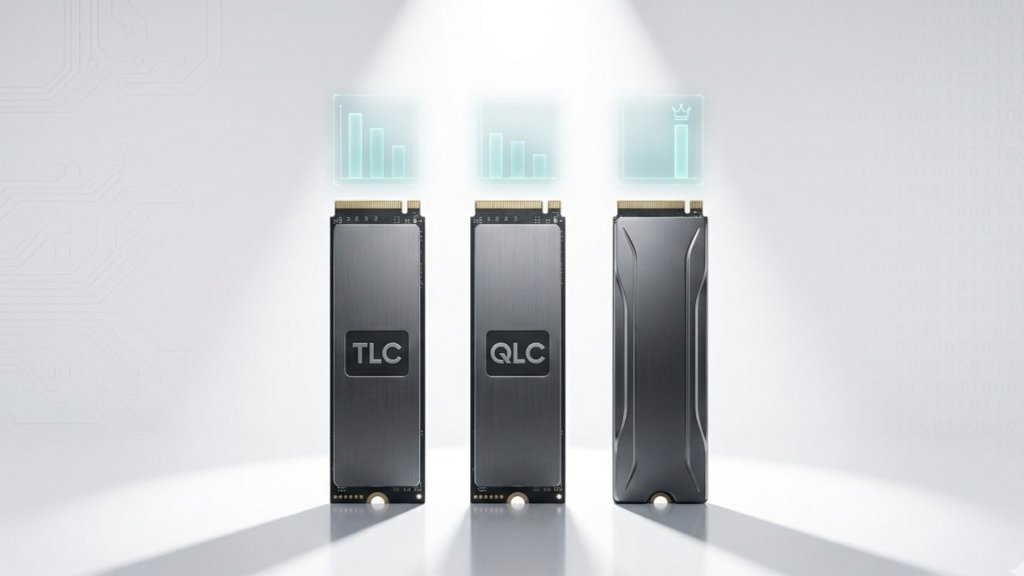
TLC NAND is the dominant technology in today's consumer SSDs, and it has earned that position. A quality TLC-based NVMe drive typically endures between 1,500 and 3,000 program/erase (P/E) cycles per cell, translating to a TBW (Total Bytes Written) rating of 300 to 1,200 TBW for a 1 TB drive.For the average home or office user, this endurance is more than sufficient. Someone writing 50 GB per day — already a heavy workload — would take between 16 and 65 years to exhaust a quality 1 TB TLC drive's rated endurance. In practice, drives are retired for other reasons long before their NAND wears out.Top TLC drives in 2026 include the Samsung 9100 PRO, WD Black SN8100, and the Crucial T705. These drives pair TLC NAND with onboard DRAM caches and advanced controllers to deliver both strong sequential performance and reliable long-term endurance. Newegg's internal SSD lineup carries these and dozens of other well-reviewed TLC options across every price tier.
QLC NAND: A Major 2026 Breakthrough
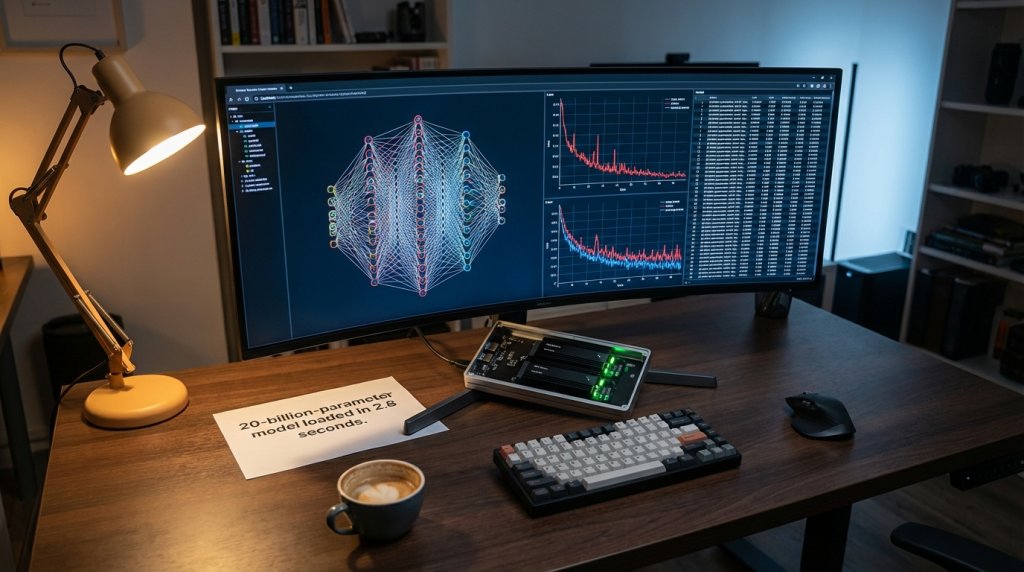
QLC NAND packs four bits per cell, enabling significantly higher density and lower cost per terabyte. The traditional criticisms of QLC — lower endurance, slower sustained write speeds once the SLC cache fills, and inconsistent performance under mixed workloads — have historically limited its appeal to budget and high-capacity niches.In 2026, however, QLC NAND has taken a significant step forward. SK Hynix recently began mass production of 321-layer QLC NAND flash featuring 2 Tb per die — the industry's first 300+ layer QLC implementation. The company achieved this using a proprietary "3-Plug" process that stacks three separate vertical memory cell structures. Compared to previous-generation QLC products, the new NAND delivers doubled data transfer speeds and up to 56% improved write performance, while increasing the number of independent operation units from four to six for greater parallelism.On the client SSD front, Micron launched the 3610 — the industry's first PCIe Gen 5 QLC client SSD, built on 276-layer 3D NAND with 2 Tb QLC dies, available in 1 TB, 2 TB, and 4 TB capacities. Remarkably, this drive can load a 20-billion-parameter AI model in under three seconds and improves performance-per-watt by 43% compared to prior Gen 4 TLC equivalents. This positions QLC not just as a budget storage option, but as a genuinely capable platform for AI-adjacent workloads.
Enterprise QLC: The Scale of What's Possible
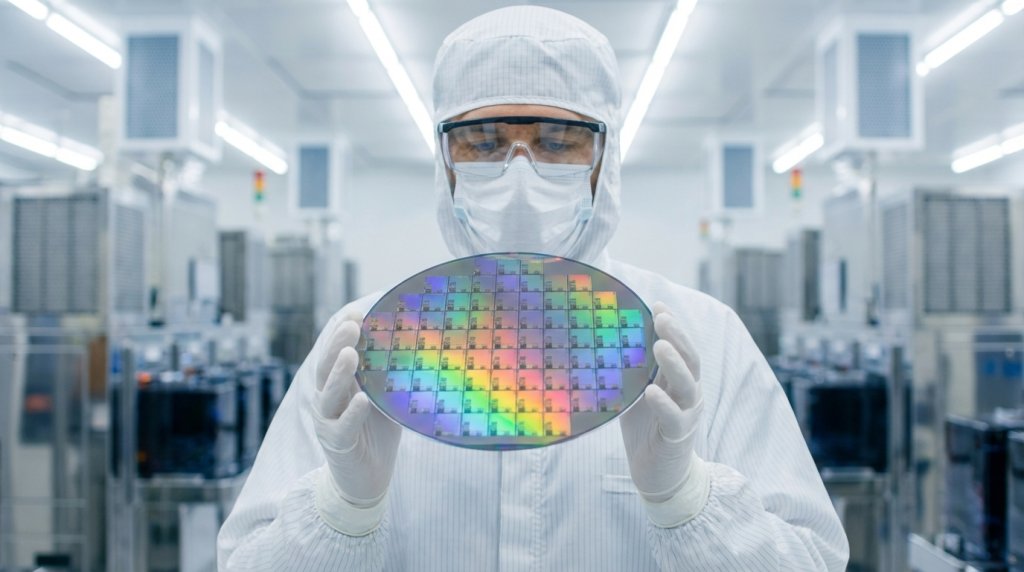
The enterprise segment illustrates just how far QLC technology has come. SanDisk recently unveiled UltraQLC NVMe SSDs using 2 Tb BiCS8 3D QLC NAND chips, with 256 TB and 128 TB models shipping in the first half of 2026. These drives feature direct QLC writes that bypass pseudo-SLC caching entirely, dynamic frequency scaling for roughly 10% performance gains, and optimized data-retention profiles that reduce refresh cycles by approximately one-third.For businesses managing large-scale data storage, these capacities are transformative. Newegg's enterprise SSD section covers high-capacity and data-center-grade options for organizations that need enterprise-tier endurance and reliability.
Understanding 3D NAND and Layer Counts
Both TLC and QLC drives today use 3D NAND architecture, where memory cells are stacked in vertical layers rather than spread across a single horizontal plane. Early 3D NAND used 32 to 64 layers. The 321-layer milestone from SK Hynix in 2026 represents a landmark moment — one that took years of engineering innovation to reach.More vertical layers deliver:
Lower cost per bit through higher density per die
Better performance from improved cell design at each generation
Higher capacity in smaller footprints, enabling 2 TB or more per single die
Consumer drives will benefit from 300+ layer NAND within the next 12–18 months as production scales and costs normalize.
Reading TBW Ratings: A Quick Reference
Every reputable SSD ships with a TBW specification that estimates how much data you can write over the drive's lifetime before NAND wear begins to affect data integrity. Here's a practical reference:
Capacity
Acceptable TBW (TLC)
Strong TBW (TLC)
500 GB
150–300 TBW
300+ TBW
1 TB
300–600 TBW
600+ TBW
2 TB
600–1,200 TBW
1,200+ TBW
4 TB
1,200–2,400 TBW
2,400+ TBW
Always verify TBW before purchasing, especially for drives handling large write workloads like video production, database hosting, or virtualization.
The Role of DRAM Cache in Longevity and Performance
Beyond NAND type, the presence or absence of onboard DRAM cache significantly affects both performance and endurance. A DRAM cache stores the FTL (Flash Translation Layer) mapping — a directory of where data physically lives on the NAND chips. Without DRAM, the controller must query this mapping directly from the NAND, creating latency spikes, increasing write amplification, and adding unnecessary wear cycles.Premium drives with dedicated DRAM deliver more consistent latency, better sustained random I/O, and longer functional lifespans. For a system or application drive, DRAM is worth the modest price premium. For bulk archival storage used primarily for sequential reads, DRAM-less options are a reasonable cost-saving tradeoff.
How to Choose for Long-Term Value
The right SSD for endurance and longevity comes down to matching NAND type to your workload:
TLC — Best for system drives, gaming, creative work, and general high-performance use. Strong endurance, consistent performance, broad availability.
QLC — Best for high-capacity secondary storage, media archives, and budget-focused builds. New 300+ layer implementations have substantially improved its performance and endurance floor.
TBW rating — Match this to your actual daily write habits. Heavy users should prioritize higher TBW drives.
DRAM cache — Essential for system drives. Optional for bulk storage.
Five-year warranty — The industry standard. Don't accept less from a reputable brand.
Explore the complete SSD catalog on Newegg to compare TBW ratings, NAND types, and pricing across dozens of models. With the right framework, choosing a drive that will last is straightforward.
 TLC NAND: The Consumer Sweet Spot in 2026
 Enterprise QLC: The Scale of What's Possible
 Reading TBW Ratings: A Quick Reference
 How to Choose for Long-Term Value