Valve's Steam Machine has been reaching buyers since the end of June 2026, when Valve started sending order invitations, and it's one of the nicest-looking pieces of PC hardware I've seen in a while. It's a small, quiet cube that runs SteamOS and sits under a TV like a console. The reviews have been kind about the design and much cooler on the value.
That made me think about the question I'd actually face if I wanted a living-room gaming PC: buy the Steam Machine, or build something small myself? Here's how I'd weigh it.
The Contenders
Valve Steam Machine. Valve lists a semi-custom AMD Zen 4 CPU with six cores and 12 threads, a 28-compute-unit RDNA 3 GPU, 16GB of DDR5 plus 8GB of GDDR6 video memory and a 512GB or 2TB NVMe SSD. It measures 152 x 162.4 x 156mm, which works out to under 4 liters, with the power supply built in. Valve sells it through Steam using a reservation queue, so new sign-ups go to the back of a waitlist.
A DIY small form factor build. For comparison, I specced out a build around the Fractal Design Terra case, which Fractal rates at 10.4 liters, the kind of machine you could still tuck into a TV cabinet.
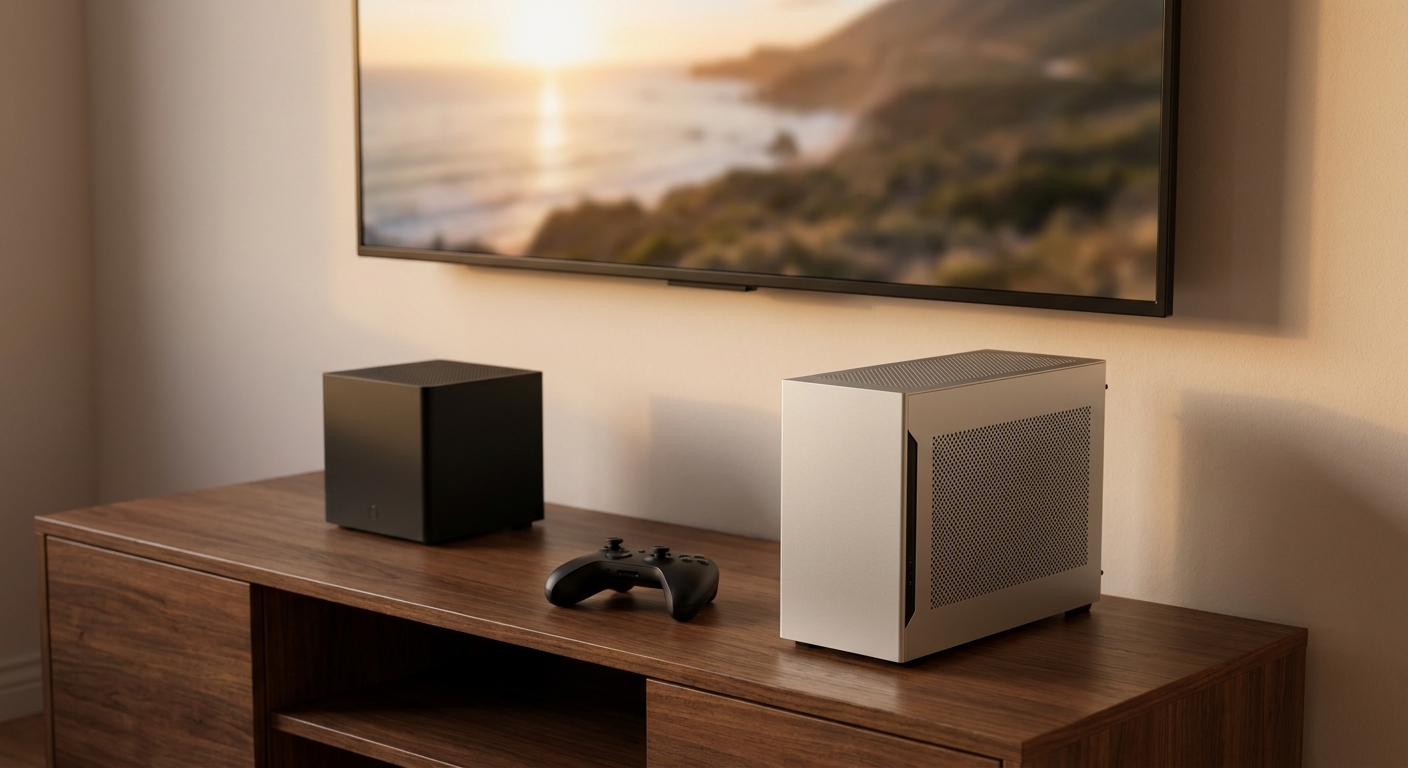
Side-by-Side
| Steam Machine | DIY Terra Build | |
|---|---|---|
| Size | Under 4 liters | 10.4 liters (Fractal's rating) |
| CPU | 6-core Zen 4, up to 4.8GHz | 8-core Ryzen 7 9700X (Zen 5) |
| GPU | RDNA 3, 28 CUs, 8GB GDDR6 | Radeon RX 9060 XT, 16GB GDDR6 |
| Memory | 16GB DDR5 | 32GB DDR5-6000 |
| Storage | 512GB or 2TB NVMe, plus microSD | 2TB NVMe, second M.2 slot free |
| Display output | HDMI 2.0, DisplayPort 1.4 | Set by the graphics card |
| Operating system | SteamOS (Windows drivers available) | Windows or SteamOS |
| Upgrades | RAM and SSD; CPU and GPU can't be upgraded | Everything |
The Steam Machine Up Close
What Valve got right is the experience. Club386 found idle noise below its meter's 30 dBA floor and a 34 dBA peak, Engadget called it whisper-quiet, and PC Gamer said it runs cool and quiet. It's tiny, it boots straight into a controller-friendly interface, and it supports HDMI-CEC for TV control.
Performance is the sticking point. Digital Foundry placed the GPU between a Radeon RX 6600 and an RX 7600. The Verge found PS5-class performance, with the PS5 producing sharper images in its tests. PC Gamer's verdict was blunt: "Regular gaming PCs make much more sense." Upgradeability is limited too. The SSD sits behind a back cover, but the CPU and GPU can't be upgraded, and Tom's Hardware called reaching the memory, which means removing the heatsink, "more of a repairability compromise."
The DIY Build Up Close
The Terra holds a Mini-ITX board, an SFX or SFX-L power supply up to 130mm and a graphics card up to 322mm long, and its movable spine trades CPU cooler height against GPU thickness. In the max-GPU layout, it takes coolers up to 48mm tall.
Here's what I'd put inside:
- Motherboard: GIGABYTE B850I AORUS PRO, Mini-ITX with Wi-Fi 7, 2.5GbE and two M.2 slots.
- CPU: AMD Ryzen 7 9700X, eight Zen 5 cores at a 65W TDP, which matters in a case this size.
- Cooler: Noctua NH-L9a-AM5, 37mm tall, so it fits even in the max-GPU layout.
- Graphics: ASUS Dual Radeon RX 9060 XT 16GB, 202mm long and 2.5 slots thick with a 550W recommended PSU. It fits with the Terra's spine in the max-GPU layout, where the 37mm Noctua still clears the 48mm cooler limit.
- Memory: CORSAIR Vengeance 32GB DDR5-6000 CL30.
- Storage: Team Group T-FORCE G50 2TB PCIe 4.0 NVMe, up to 5,000MB/s reads.
- Power: Corsair SF850, 80 Plus Platinum, fully modular and 125mm long.

I chose a Radeon card on purpose. Valve says SteamOS 3.8 can run on your own living-room PC but only supports AMD GPUs, and it still lists AMD desktop graphics cards as beta support. That means this build can boot into the same couch-friendly SteamOS interface as the Steam Machine, or run Windows if you want Game Pass, anti-cheat games that don't support Linux or mods that need it.

The trade-offs are real. It's more than twice the volume, you have to build it, and getting a small case quiet takes some fan-curve tuning. Tom's Hardware's advice for Mini-ITX builds still applies: triple-check compatibility before you order.

Winner by Category
- Smallest and simplest: Steam Machine. Nothing I can build matches it at under 4 liters with zero assembly.
- Quiet out of the box: Steam Machine. Reviewers call it whisper-quiet, and a small DIY build usually needs fan tuning to match.
- Performance: the DIY build. An RX 9060 XT with 16GB is a clear step above a GPU that reviewers place between an RX 6600 and RX 7600.
- Flexibility and lifespan: the DIY build, because every part can be swapped later.
If the box needs to disappear and you mostly play lighter games, the Steam Machine makes sense. If you care about frame rates in new releases on a big TV, I'd build the small PC and install SteamOS on it. You get most of the couch experience and a lot more headroom.
Frequently Asked Questions
How powerful is the Steam Machine? Valve lists a six-core Zen 4 CPU and a 28-compute-unit RDNA 3 GPU with 8GB of GDDR6. Digital Foundry placed its graphics performance between a Radeon RX 6600 and an RX 7600, and The Verge described it as PS5-class.
Can you upgrade the Steam Machine? Partly. The SSD is accessible behind a back cover and the memory is a removable module, though reaching it means removing the heatsink. The CPU and GPU can't be upgraded.
Can I install SteamOS on my own PC? Valve says SteamOS 3.8 can run on your own living-room PC, but only AMD graphics cards are supported, and Valve still lists them as beta support. That's why a Radeon card such as the RX 9060 XT is the safer choice for a DIY SteamOS build.
Does the Steam Machine run Windows? Valve released Windows 11 drivers for the Steam Machine in July 2026, but dual booting alongside SteamOS isn't supported yet, so it's one or the other. It ships with SteamOS.
How big is a small form factor gaming PC compared with the Steam Machine? The Steam Machine measures 152 x 162.4 x 156mm, under 4 liters. A Mini-ITX case like the Fractal Design Terra is rated at 10.4 liters, more than twice the volume, but it fits an SFX or SFX-L power supply up to 130mm and a graphics card up to 322mm long.
Read More
- Tom's Hardware: Valve Steam Machine Review -- Benchmarks, teardown notes and a full spec breakdown.
- Digital Foundry: Steam Machine Review -- How the Steam Machine's GPU compares with desktop cards and consoles.
- The Verge: Steam Machine Review -- Living-room usability and how it stacks up against a PS5.
- Tom's Hardware: The Best Mini-ITX PC Cases -- Tested small cases and compatibility advice for compact builds.
- Valve: Steam Machine -- Valve's official specs, ordering details and FAQ.