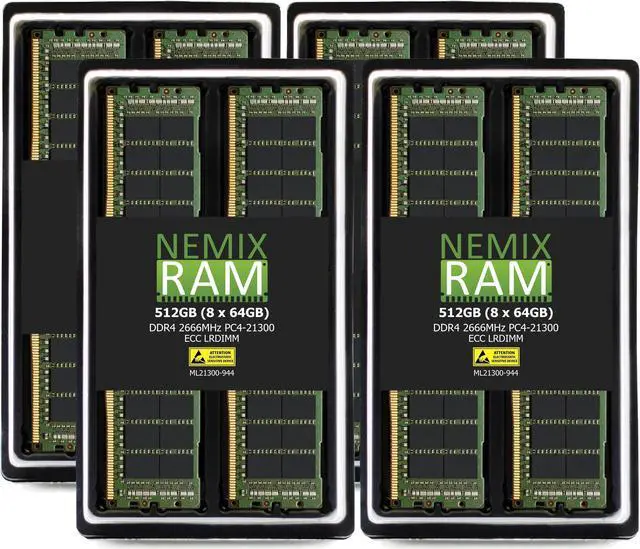
The NEMIX RAM 512GB kit is eight 64GB DDR4-2666 ECC load-reduced DIMMs designed for server memory expansion in the ASUS KNPA-U16 EPYC 7000 Series motherboard; it suits compatible systems that need high-capacity, error-correcting memory.
Recommended For
- Server administrators expanding an ASUS KNPA-U16 / AMD EPYC 7000 system for virtualization or running multiple memory-hungry services; the eight 64GB LRDIMMs provide 512GB across the board’s eight-channel memory configuration.
- Enterprise and hosting teams building memory-heavy server infrastructure, where 512GB of ECC load-reduced memory fits workloads that need substantial capacity alongside server management and storage expansion.
- HPC or technical-computing operators running memory-intensive workloads such as large simulations or data analysis on a compatible EPYC server; ASUS positions the KNPA-U16 platform for HPC and high-bandwidth enterprise applications.
- Administrators who want to populate all eight memory channels with 64GB modules in one step, rather than build capacity gradually from smaller DIMMs.
Real-World Use Scenarios
- When consolidating several virtual machines on one EPYC host, an administrator can assign more memory to guests at once; if memory was the bottleneck, this can reduce pressure to swap and help keep more workloads running together.
- For a Proxmox or VMware home lab used to test operating systems, network setups, or cybersecurity environments, the added memory can support more or larger lab VMs on one server, subject to the host’s CPU and storage capacity.
- For database servers with large working sets or several concurrent database VMs, the capacity can let more data and memory buffers stay in RAM; it does not by itself improve database performance if CPU or storage is the limiting factor.
- For parallel scientific or engineering jobs that need a large in-memory working set, the extra capacity can allow larger datasets or more simultaneous jobs to fit in system memory, provided the application and CPU can use them.
- For enterprise web or application hosting with multiple memory-hungry services, the kit can provide room to keep more service instances active on one compatible server, rather than reducing their memory allocations to fit.




 here!