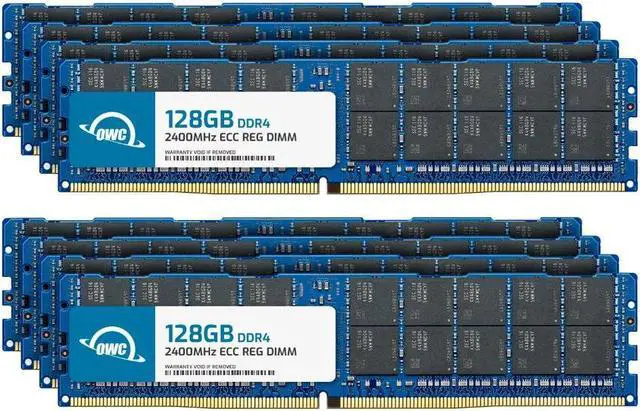
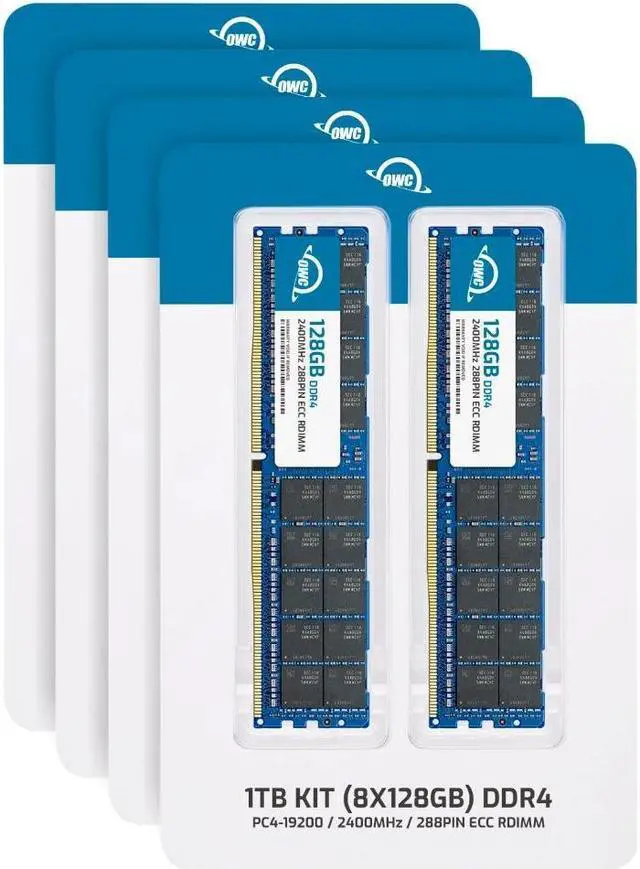
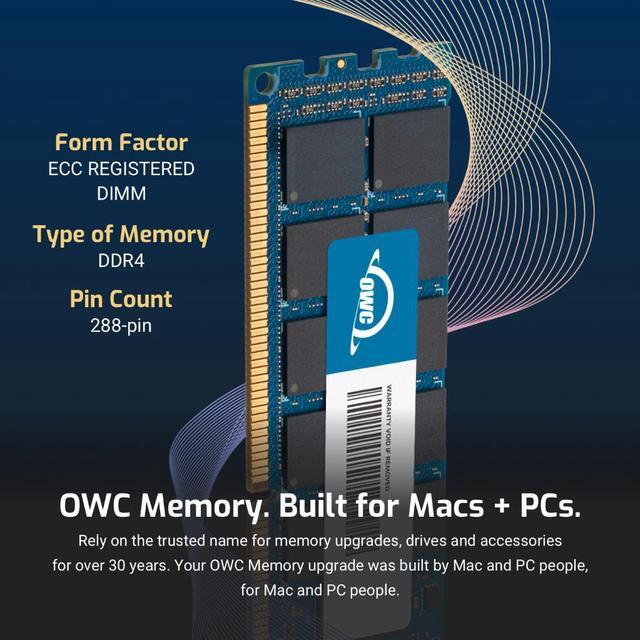
The OWC 1TB DDR4-2400 ECC Registered RDIMM kit includes eight 128GB modules for compatible servers and workstations that need high-capacity memory; it is designed for systems that support registered ECC DIMMs, not standard desktops or unbuffered memory.
Recommended For
- Operators of compatible DDR4 servers who need to expand memory for multiple virtual machines or host consolidation; the kit supplies 1TB across eight 128GB registered ECC DIMMs. Confirm the server supports this DIMM type, capacity, and population layout.
- Database or analytics server teams whose working sets are memory-limited and whose platform supports 128GB DDR4-2400 RDIMMs; the kit is intended to add capacity, not to increase memory speed beyond its rated 2400MHz.
- Workstation owners running memory-intensive, sustained workloads who need ECC registered memory—provided the workstation’s motherboard and processor explicitly support 128GB 4Rx4 DDR4 RDIMMs.
- Homelab or infrastructure teams expanding a compatible server for memory-heavy virtualized services; the eight-DIMM kit suits a planned capacity increase, but the server’s manual should be checked before purchase.
Real-World Use Scenarios
- On a compatible server used as a virtualization host, adding memory can let administrators assign more RAM to existing VMs or run more memory-hungry VMs at once, when host memory is the limiting resource.
- For a compatible VDI host serving multiple virtual desktops, additional memory can support more concurrent sessions or give each desktop more room to run, depending on the users’ workloads and the host’s other limits.
- On a compatible database server, extra RAM can give a database such as SQL Server more room to cache frequently used data pages; this may reduce disk reads when memory pressure is currently limiting the workload.
- For in-memory analytics or other data-heavy jobs on a compatible server, added capacity can keep a larger working set in RAM, potentially reducing reliance on slower storage when the job is constrained by memory.
- For memory-intensive scientific computing or HPC workloads, a compatible server with more RAM can accommodate larger datasets or simulations in memory; the benefit depends on whether the application is memory-capacity-bound.




 here!