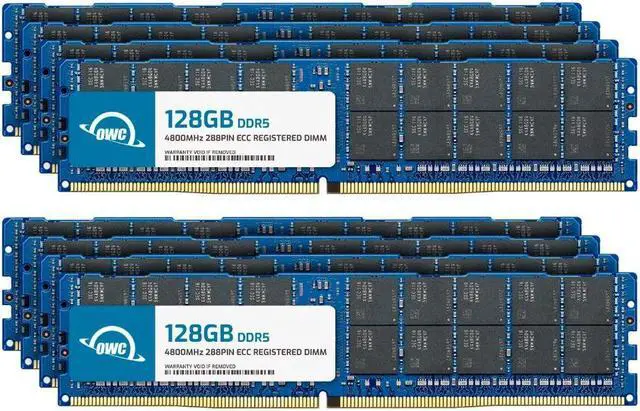
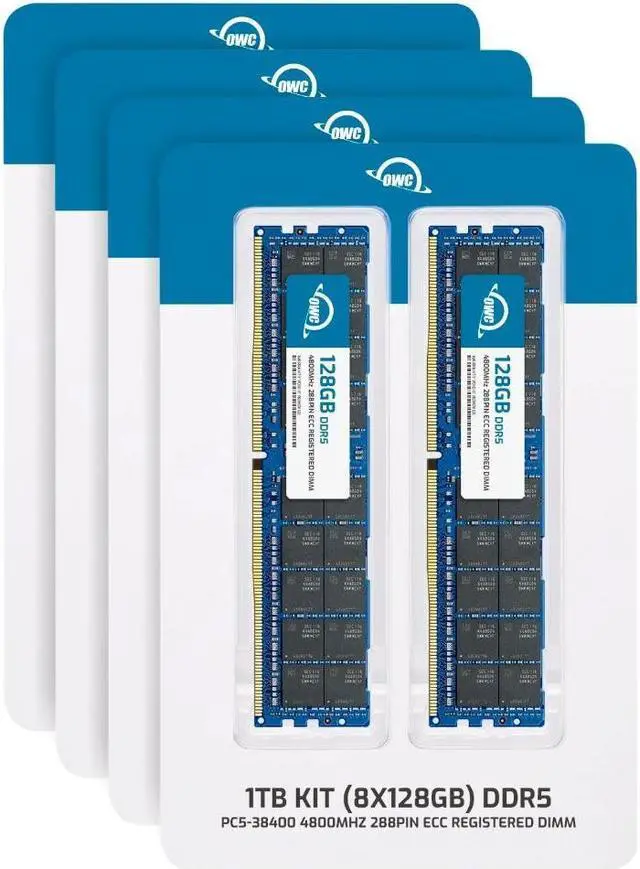
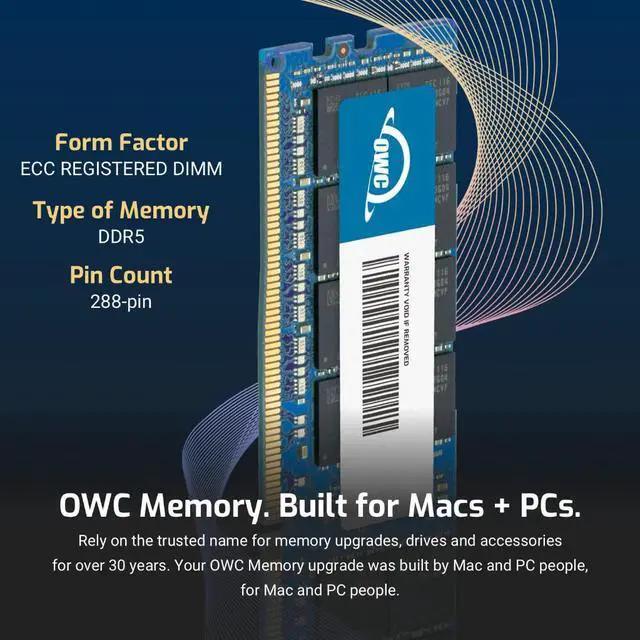
The OWC 1TB DDR5-4800 ECC Registered RDIMM kit includes eight 128GB modules for compatible servers and workstations that need high-capacity memory; it is designed for registered-memory systems, not standard desktop PCs.
Recommended For
- Server administrators consolidating multiple memory-heavy virtual machines on one host, when the server supports eight 128GB DDR5-4800 ECC RDIMMs and the planned 1TB capacity.
- Database teams running large in-memory or high-concurrency workloads that benefit from keeping a substantial working set in system RAM; confirm that the database and server configuration call for approximately 1TB.
- Professional workstation builders using a platform designed for ECC RDIMMs and large memory configurations, such as supported Xeon W systems, for compute-intensive work that needs high memory capacity.
- IT teams upgrading a compatible server or workstation with a matched eight-module kit and seeking ECC registered memory for data-integrity needs; verify the system’s supported DIMM type, rank, capacity, and population rules first.
Real-World Use Scenarios
- On a compatible virtualization host, an administrator can allocate memory across many virtual machines instead of forcing active workloads to compete for a smaller memory pool; the practical benefit depends on how much RAM those VMs actually need.
- For a memory-hungry analytics or database server, adding capacity can let more working data stay in RAM and reduce pressure to retrieve it from storage; actual query improvements vary with the database, processor, and workload.
- A team running in-memory databases or real-time analytics can use a high-capacity server configuration to keep more of its working dataset in memory, potentially avoiding capacity-related slowdowns when the workload would otherwise exceed available RAM.
- For memory-intensive scientific simulations, researchers can run larger datasets or jobs that were limited by system RAM; the memory upgrade will not remove CPU, bandwidth, or software bottlenecks.
- On a compatible server used for memory-bound AI model work, additional system RAM can provide room for larger in-memory workloads; it does not replace GPU memory, and training speed depends on the full system and workload.




 here!