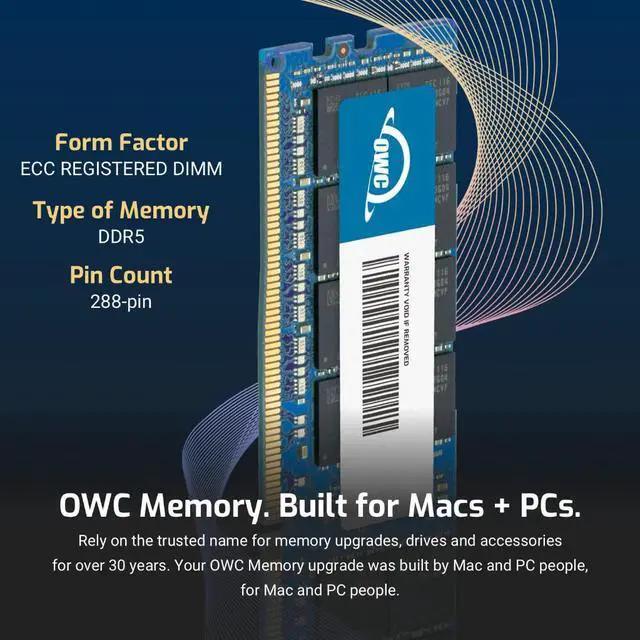
The OWC 1TB DDR5-5600 ECC Registered RDIMM kit includes eight 128GB modules for compatible workstations and servers that need high-capacity memory; confirm your system supports 128GB DDR5 RDIMMs before upgrading.
Recommended For
- Server operators consolidating many virtual machines or containers who need a compatible system to address a high memory ceiling; the kit provides eight 128GB ECC registered DIMMs for supported servers.
- Workstation users running memory-intensive simulations or other large-data jobs who need more capacity than a typical desktop memory configuration and have a platform qualified for 128GB 4Rx4 DDR5 RDIMMs.
- NAS or storage-server builders whose supported workload and memory configuration call for very high capacity; OWC positions this kit for compatible NAS systems as well as servers and workstations.
- IT teams upgrading a compatible DDR5 server or workstation that supports 1TB total capacity and this DIMM type, and that want a single eight-module kit rather than sourcing modules separately.
Real-World Use Scenarios
- On a compatible virtualization host, an IT team can assign more memory to several VMs running databases, application servers, or test environments. The added physical capacity can reduce memory contention when those workloads are active together, provided the host and hypervisor are sized correctly.
- For an appropriately sized in-memory database server, the additional RAM can keep a larger working set of tables and indexes in memory and leave room for query computations. The actual usable database capacity depends on the database configuration and workload.
- When a server runs memory-intensive analytics across large tables, extra RAM can provide more room for data and temporary query results, including when several complex queries run concurrently. The benefit depends on the dataset, query patterns, and application memory requirements.
- For a compatible HPC server running memory-heavy simulations or other data-intensive jobs, the larger capacity can accommodate bigger in-memory working sets or more concurrent workloads before available RAM becomes a constraint. It does not by itself make a compute-bound job faster.
- On a properly configured VDI host, added memory can support more desktop sessions or larger per-user memory allocations before the host runs short of physical RAM. The achievable session count depends on user activity, applications, and the memory reserved for the host.




 here!