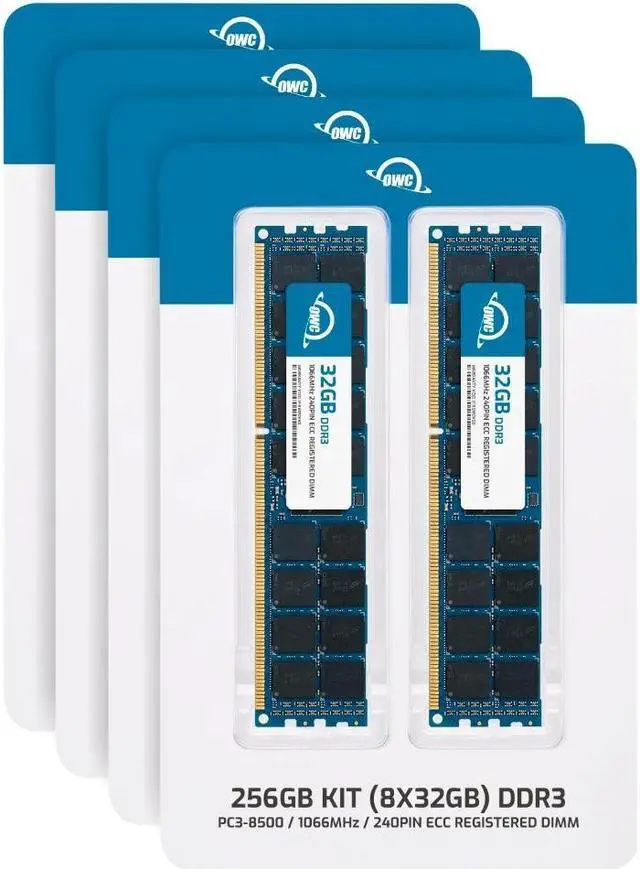
The OWC 256GB DDR3L-1066 ECC Registered DIMM kit includes eight 32GB modules for compatible workstations and servers that support 240-pin 4Rx4 RDIMMs; it is intended for registered-memory systems, not standard desktops or systems using unbuffered memory.
Recommended For
- Administrators upgrading a supported older DDR3L ECC-RDIMM server who need a large memory increase for consolidated services or multiple virtual machines; confirm the system supports 32GB 4Rx4 modules and an eight-DIMM population.
- Homelab operators maintaining a compatible Xeon-era server or workstation who want to expand capacity for several self-hosted services or test environments; community discussions commonly identify older PowerEdge systems and Xeon workstations as DDR3 RDIMM use cases.
- Workstation users with a verified DDR3 ECC-RDIMM platform who need more memory headroom for large datasets or other memory-intensive professional workloads, rather than a newer memory generation or higher DIMM speed.
- Operators seeking to refresh an older server with a matched eight-module kit, provided the system’s manual confirms support for the kit’s capacity, rank, voltage, speed, and DIMM count.
Real-World Use Scenarios
- On a compatible DDR3 RDIMM server, adding this kit can give a virtualization host more room for several VMs to run at once, reducing the need to squeeze guest memory or move workloads to another machine; CPU and storage capacity still set limits.
- For a home lab or development server, the added capacity can accommodate more concurrently running test systems and services—such as separate Linux and Windows VMs—without having to shut down one environment to make room for another.
- When a compatible server runs a database or other memory-intensive application, extra RAM can let a larger active working set stay in memory rather than being pushed to storage; the benefit depends on the software and workload.
- For an older ECC-capable server that runs continuously, this upgrade can support long-running services while ECC helps detect and correct certain memory errors; it does not by itself guarantee uninterrupted operation.




 here!