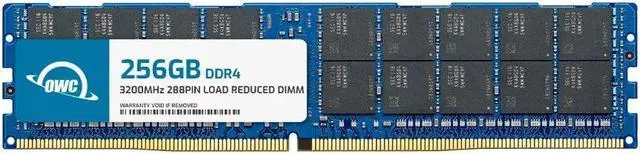
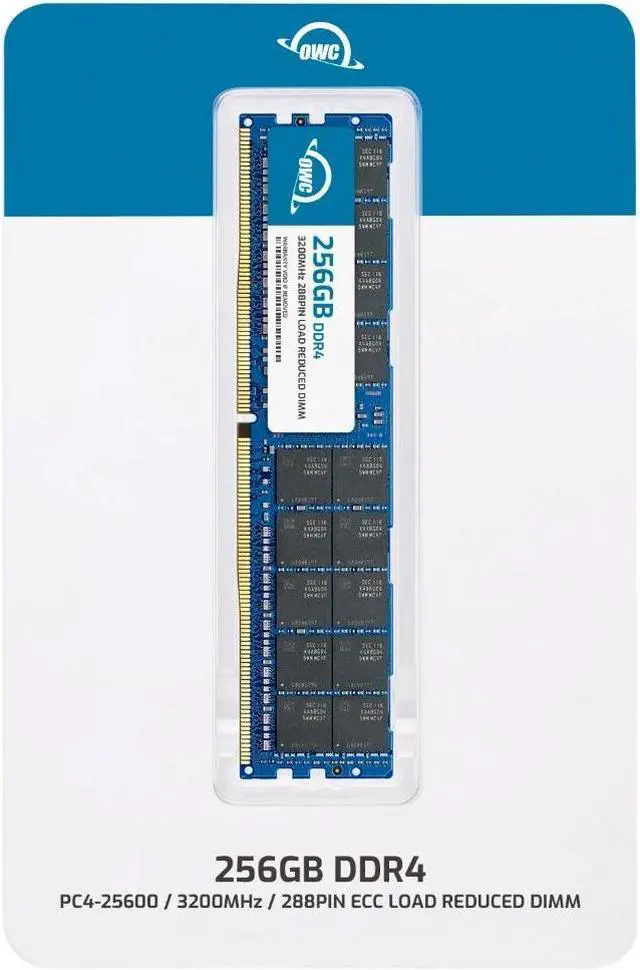
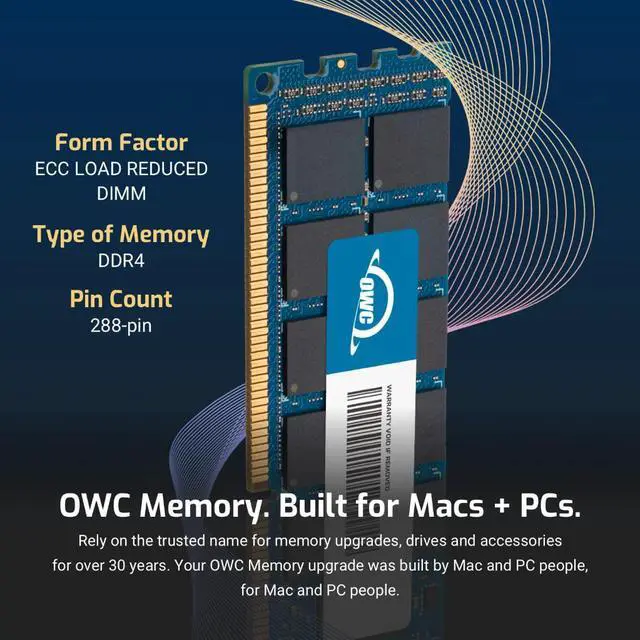
The OWC 256GB DDR4-3200 ECC Load-Reduced LRDIMM is a server and workstation memory upgrade for systems that support this memory type, including systems compatible with the listed HP part numbers.
Recommended For
- Operators upgrading a compatible HPE DDR4 server for virtualization or cloud workloads that need more memory per DIMM; this 256GB LRDIMM is aimed at capacity expansion, not desktop upgrades.
- Database and analytics teams whose server workloads benefit from fitting large working sets in memory, provided the server supports 256GB DDR4 LRDIMMs and its memory population rules.
- Admins replacing a failed or matching 256GB HPE DDR4 LRDIMM in a supported server, who need to match the module type and confirm the host’s qualified configuration.
- Teams running memory-intensive data processing or virtualization servers where high capacity per module is more important than using ordinary desktop memory.
Real-World Use Scenarios
- When a compatible virtualization host is running out of memory for its guests, adding this module can provide room for more VMs or larger VM allocations; CPU capacity and the server’s DIMM configuration still determine how many workloads it can handle.
- For a memory-constrained database server, this upgrade can give a larger frequently used dataset or more database virtual machines room in RAM, helping avoid memory capacity being the immediate limit; actual database performance depends on the full server and workload.
- In a homelab used for Proxmox or similar platforms, a supported server with more memory can run a broader mix of test VMs and services at once, such as separate development and infrastructure environments, without memory limits forcing the user to shut guests down.
- For memory-heavy analytics or HPC jobs, adding capacity can let a compatible server keep a larger working set in RAM during processing, which is useful when memory—not CPU or storage—is limiting the job size.
- When extending the life of an older server or NAS, this module can add memory capacity for supported server workloads; it is not a desktop upgrade, and the host must support LRDIMMs and the relevant module configuration.




 here!