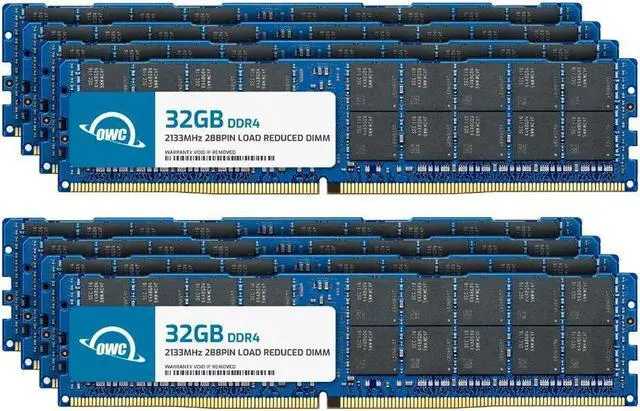
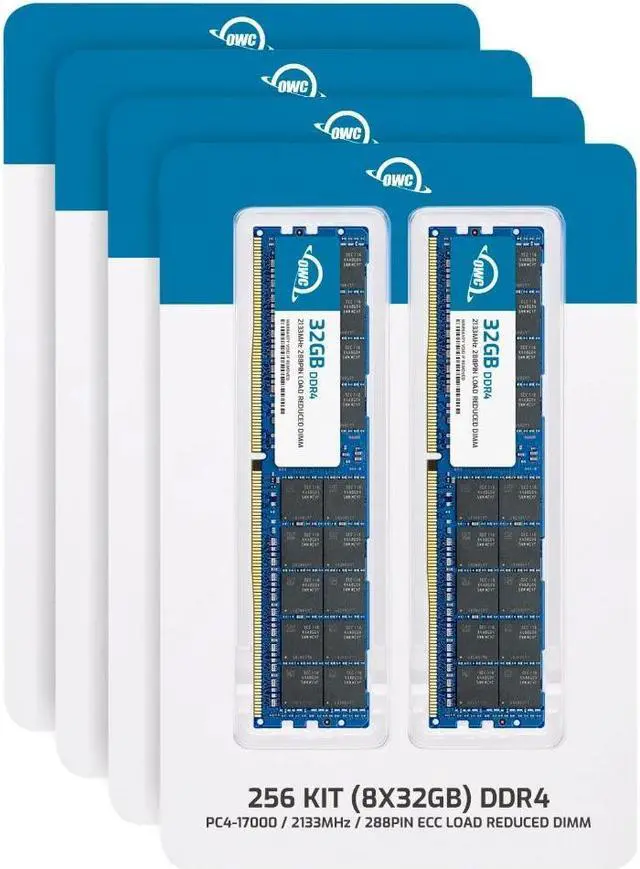
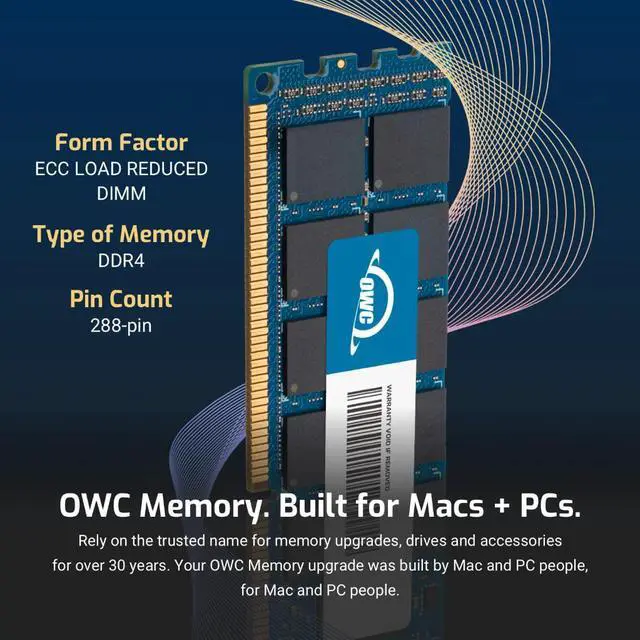
The OWC 256GB DDR4-2133 ECC LRDIMM kit includes eight 32GB modules for compatible servers and workstations that support 4Rx4, registered load-reduced memory; it is not intended for standard desktop PCs or systems using unbuffered memory.
Recommended For
- Operators upgrading a compatible DDR4 server from a smaller memory configuration to 256GB with eight 32GB ECC LRDIMMs, after checking the server’s supported DIMM type and population rules.
- Homelab and virtualization users running several virtual machines on a server that supports LRDIMMs and can use the added memory capacity.
- Server or NAS owners who need ECC memory for a compatible system and want an eight-module kit rather than sourcing individual DIMMs.
- Workstation users with a motherboard and memory controller that explicitly support 32GB 4Rx4 DDR4 LRDIMMs and need to expand system memory for larger files or multitasking workloads.
Real-World Use Scenarios
- On a compatible server running Proxmox, VMware, or another hypervisor, an administrator can allocate memory across more or larger virtual machines; this is most useful when the host is currently short on RAM, since adding memory alone does not remove CPU or storage bottlenecks.
- When consolidating lab or development services onto one server, the added memory can make room for several test VMs and their workloads, reducing the need to split them across separate hosts if RAM is the limiting resource.
- For a database server whose active data or cache is constrained by available RAM, adding memory can let the database use a larger in-memory working set; any reduction in disk reads or query time depends on the database configuration and workload.
- For memory-heavy analytics or HPC jobs on a supported server, more installed RAM can keep a larger dataset or working set in memory, which may reduce the need to process it in smaller batches when memory was the constraint.
- In a server hosting a mix of virtualized applications, databases, and other services, the added capacity can give administrators more room to consolidate workloads; the practical benefit depends on whether those workloads are actually competing for memory.




 here!