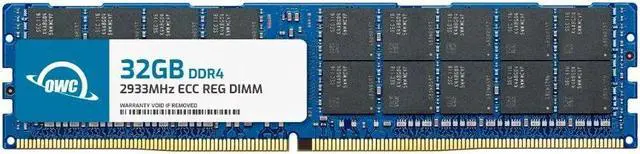
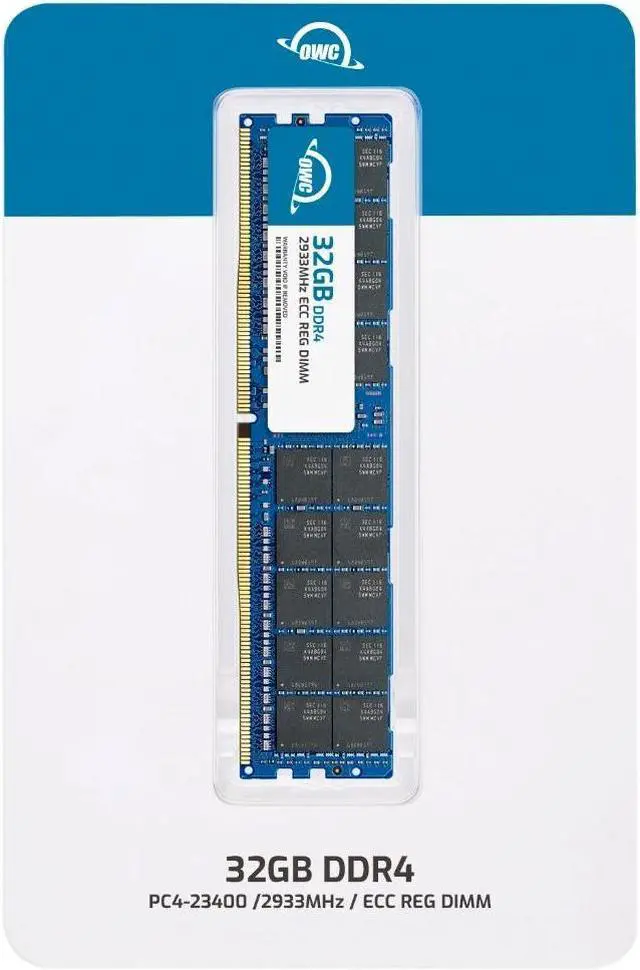
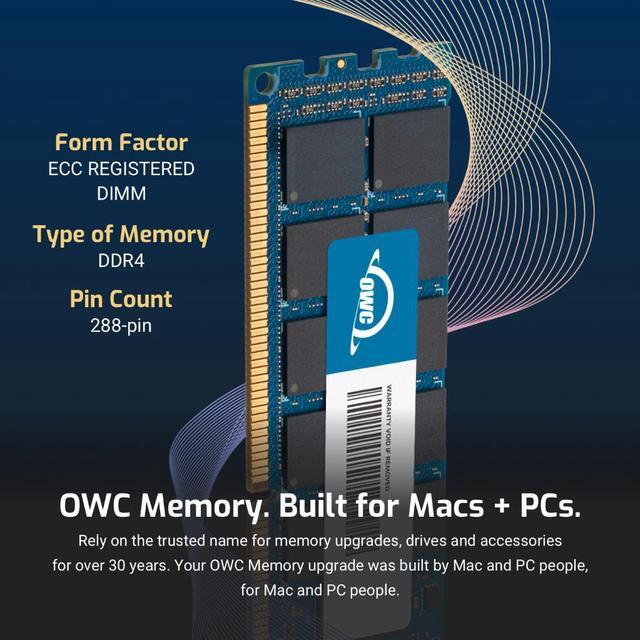
The OWC 2R9D42R432GB is a 32GB DDR4-2933 ECC registered RDIMM for servers and workstations that support 288-pin, 2Rx4 registered memory. It matches the specifications of Kingston KTH-PL429/32G and KTD-PE429/32G.
Recommended For
- Server administrators expanding memory in a DDR4 system that specifically supports 32GB, 2Rx4 ECC registered DIMMs at 2933MHz; check the system’s memory population rules before adding a module.
- Homelab operators building or upgrading virtualization, storage, or other server workloads on a motherboard and processor that support ECC RDIMMs; this is server/workstation memory, not a universal desktop upgrade.
- Owners of compatible professional workstations who need to expand memory for large projects or sustained memory-heavy work, provided the workstation supports registered ECC DDR4 and the module’s rank and speed.
- 2019 Mac Pro owners whose processor configuration and existing memory arrangement support 32GB DDR4 ECC RDIMMs at 2933MHz and follow Apple’s DIMM population guidance.
Real-World Use Scenarios
- When a compatible server is short on memory for its virtual machines, adding this module can increase host RAM capacity, giving administrators more room to run or size VMs—provided the server supports this RDIMM type and speed.
- For a memory-constrained database server, adding capacity can let a larger portion of the database or its working set stay in memory, which may reduce reliance on storage during some workloads; the result depends on the database and system configuration.
- When upgrading a compatible server or workstation that uses 32GB DDR4-2933 ECC registered modules, this OWC module can serve as a replacement or added capacity; confirm the system’s supported DIMM type, rank, speed, and population rules before installation.
- For a homelab running a hypervisor alongside services such as file sharing or test environments, more compatible server memory can provide additional capacity for those workloads without immediately replacing the host.
- In a supported NAS or workstation used for memory-intensive services, this module can add RAM capacity; users are most likely to notice a benefit when their existing workload is constrained by available memory, rather than as a general speed boost.




 here!