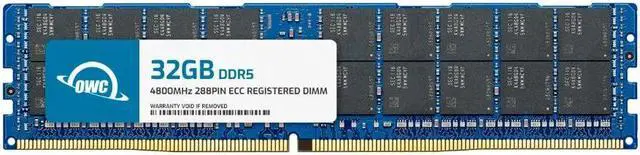
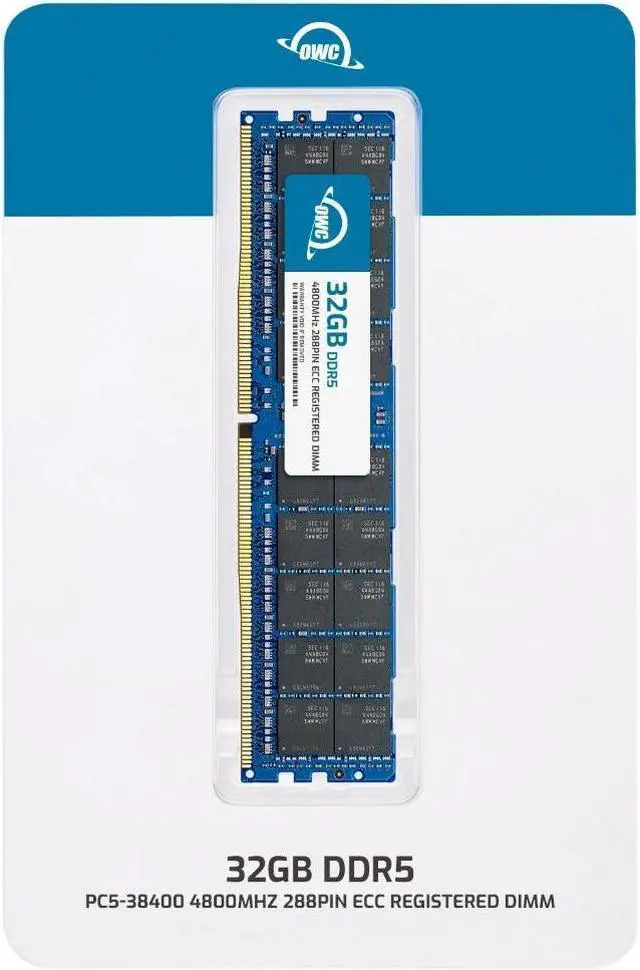
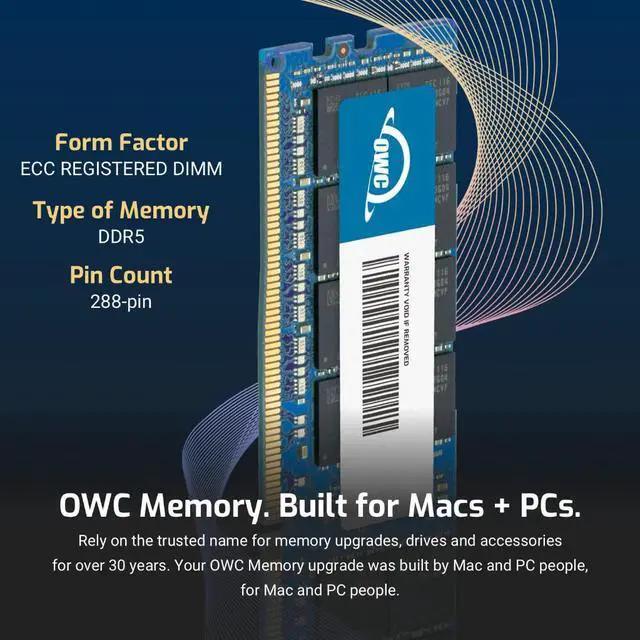
The OWC 32GB DDR5-4800 ECC Registered RDIMM is a server memory module for compatible servers and workstations that use 288-pin registered DIMMs. It runs at CL40 and 1.1V, and is listed as a replacement for Micron MTC20F2085S1RC48B and MTC20F2085S1RC48BR modules.
Recommended For
- Server administrators adding 32GB to a DDR5 system that specifically supports ECC registered DIMMs (RDIMMs), after checking the server’s compatibility list and memory-population rules.
- Workstation owners running compatible DDR5 RDIMM platforms who need a replacement or an incremental memory upgrade for professional workloads.
- IT teams maintaining an existing server with a matching Micron module specification who want a 32GB replacement; verify the exact system and module compatibility before installation.
- Homelab builders using a server or workstation board that supports DDR5 ECC RDIMMs and who need a single 32GB module for a compatible build or upgrade.
Real-World Use Scenarios
- On a compatible virtualization host, add memory to give several virtual machines more room to run; the host may be able to allocate more RAM to guests or ease memory pressure, depending on total capacity and configuration.
- For a compatible database server, add memory when its workload is constrained by available RAM; the added capacity can give the database more room for its working data, though actual response-time changes depend on the system and workload.
- In a compatible workstation used for video editing or 3D rendering, add memory when large projects or multiple open applications are pressing against the current RAM limit; this can provide more working room, rather than guaranteeing faster rendering.
- For a compatible server or NAS that runs several services, add memory to increase available capacity for those workloads; the practical benefit depends on the system’s supported memory configuration and how much RAM the services use.
- When maintaining a compatible server or workstation, use the module as a replacement for a failed or aging DIMM if the platform supports its DDR5 ECC Registered type and configuration; matching the system’s requirements helps avoid an incompatible-memory upgrade.




 here!