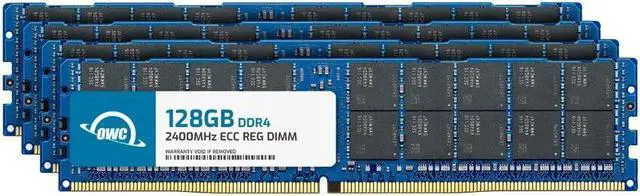
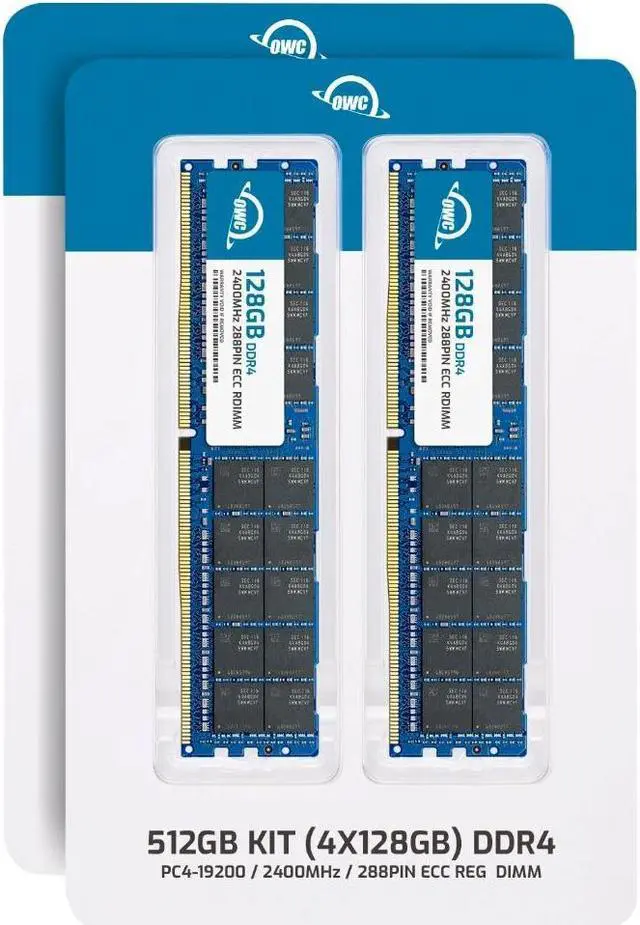
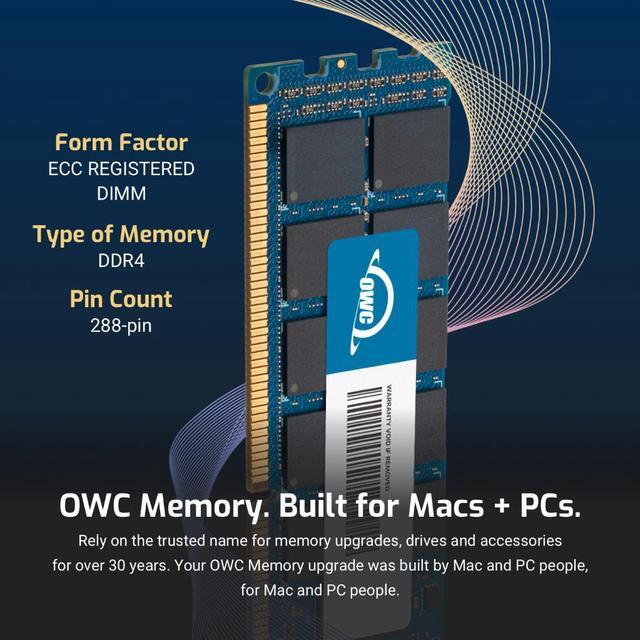
OWC 512GB DDR4 ECC Registered RDIMM memory is a four-module kit of 128GB, 2400MHz, CL17 server RAM for servers and workstations that support compatible 4Rx4 registered DIMMs.
Recommended For
- Server operators upgrading a compatible DDR4 platform that needs 512GB of ECC memory in four 128GB modules—for example, to give memory-hungry virtual machines or large in-memory datasets more room.
- Workstation or server users whose documented platform supports 128GB DDR4-2400 ECC registered DIMMs and who want to add capacity while retaining four memory slots for future expansion.
- IT teams maintaining an existing DDR4 server or workstation that needs ECC memory and specifically supports this kit’s capacity, rank, speed, and registered DIMM type.
- Small-business or homelab administrators with a compatible server who need a four-module memory upgrade for consolidation or other workloads that benefit from a large memory pool.
Real-World Use Scenarios
- When expanding a virtualization host, an administrator can allocate memory across more VMs or give existing VMs larger memory allocations, reducing the need to trim workloads just to stay within the host’s RAM capacity. The result depends on leaving enough memory for the hypervisor and matching CPU and storage capacity to the workload.
- For a server running memory-intensive database VMs, the added capacity can make it possible to assign larger memory reservations or keep more database working data in RAM. Whether that improves query performance depends on the database workload and configuration; RAM alone does not guarantee faster results.
- In a development or test lab, an operator can keep more isolated VMs running at once—for example, separate test environments for different operating systems or application builds—rather than shutting down one environment to free memory for another.
- For workloads that process large datasets in memory, such as analytics or scientific computing, a server with sufficient platform support can keep a larger working set in RAM instead of repeatedly fetching it from storage. The practical benefit depends on whether the application is memory-bound and whether the server’s processor and memory configuration support the workload.
- In a homelab or self-hosted server, the capacity can support several always-on services and VMs on one machine, such as storage, network services, and application testing. It is most useful when those workloads actually need the memory; small services may use only a fraction of the installed capacity.




 here!