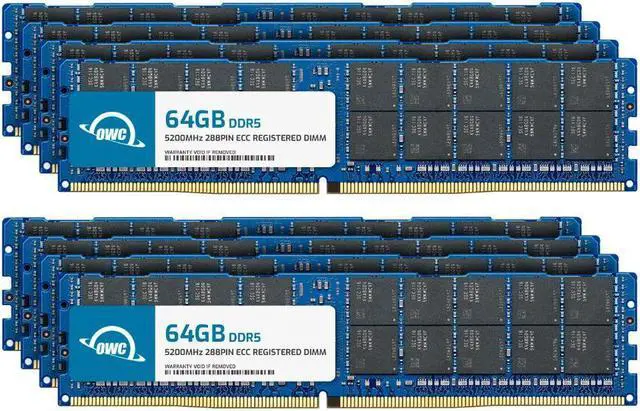
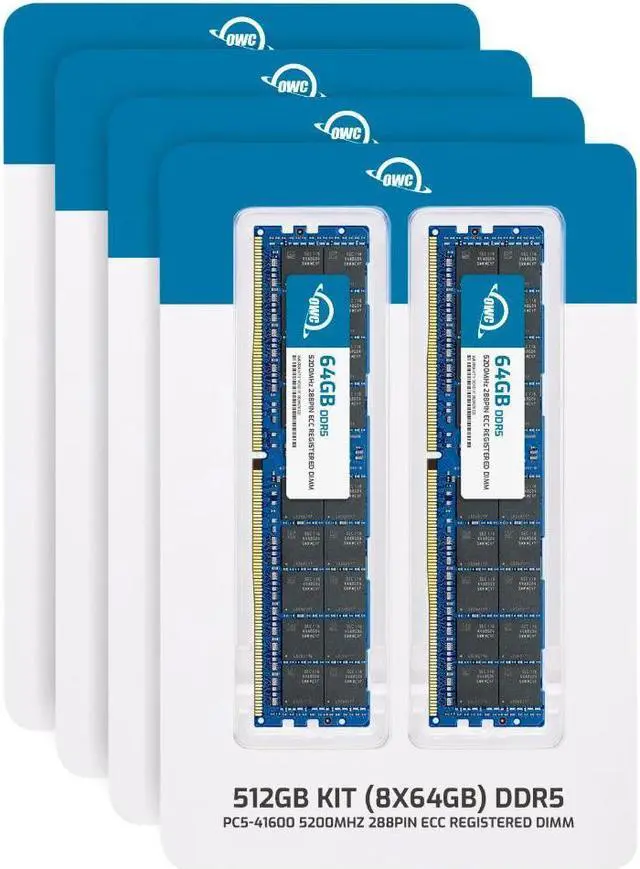
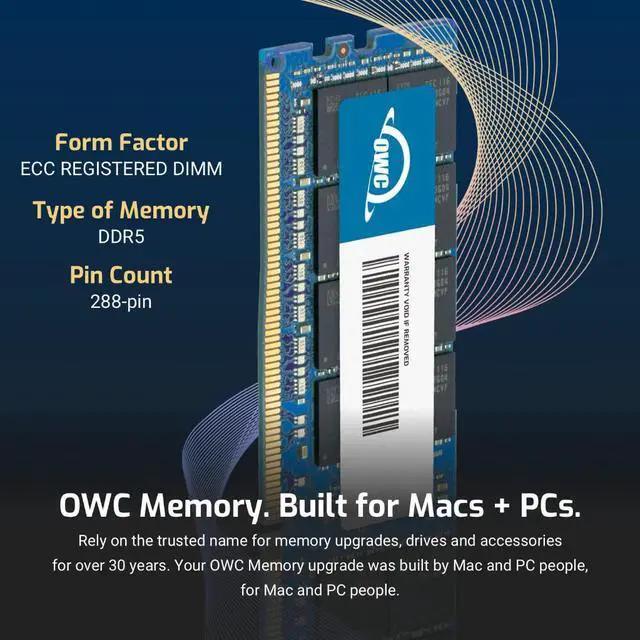
The OWC 512GB DDR5-5200 ECC Registered RDIMM kit includes eight 64GB modules for select servers and workstations that support 288-pin, 2Rx4 registered memory. It offers ECC error correction and is intended for systems configured for RDIMMs, not standard desktops.
Recommended For
- Server operators expanding a compatible host for virtualization or private-cloud workloads, where 512GB of system memory can support more resident virtual machines and reduce pressure to move active data to storage.
- Workstation builders running large in-memory datasets, simulations, or data-science workloads on a platform that supports ECC RDIMMs and can use all eight modules.
- Database or analytics administrators whose compatible server needs a large active working set in RAM, such as for in-memory databases, caching, or data consolidation.
- Owners of compatible Xeon W or Threadripper PRO workstations upgrading to a 512GB memory configuration for professional projects with unusually large datasets or memory footprints.
Real-World Use Scenarios
- On a compatible virtualization host, an IT team can assign memory to more virtual machines at once; this can reduce the need to overcommit RAM when several guests run memory-heavy services.
- For a database or cache that keeps a large working set in memory, adding capacity can let more data stay in RAM instead of being paged or read from storage, provided the workload is currently memory-limited.
- When running CPU-based scientific simulations or engineering models with large memory requirements, a 512GB configuration can help keep a larger problem in system memory and avoid slowdowns or errors caused by insufficient RAM.
- In a homelab or test server, an operator can run multiple operating-system and service VMs together for development or troubleshooting; the extra capacity is useful only if those workloads actually need it.
- For memory-intensive workstation calculations, such as large datasets or simulations, additional RAM can reduce reliance on disk paging when the existing system runs out of memory; it will not necessarily make a workload faster if memory is not its bottleneck.




 here!