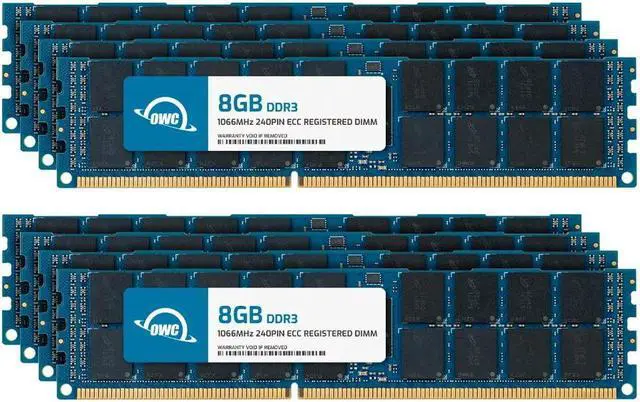
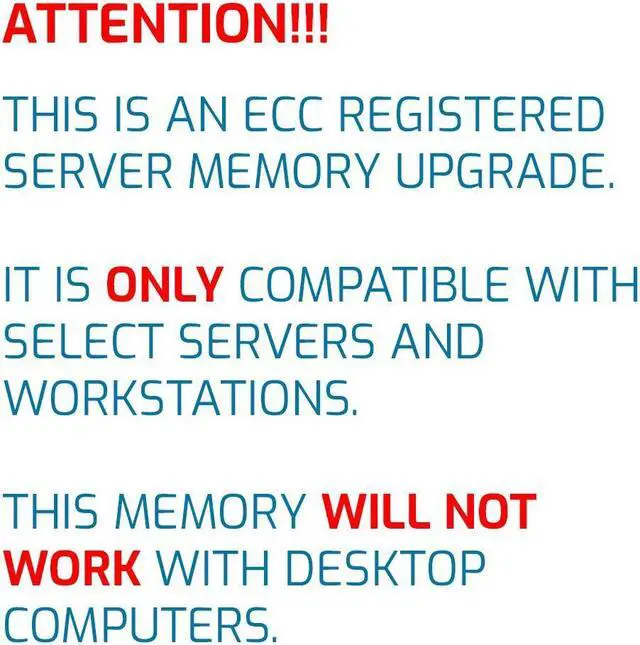
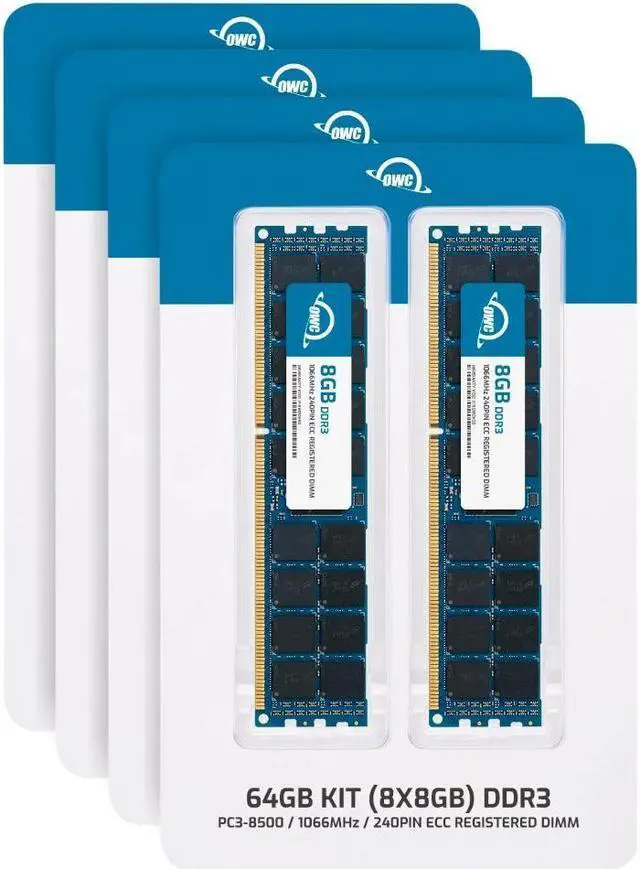
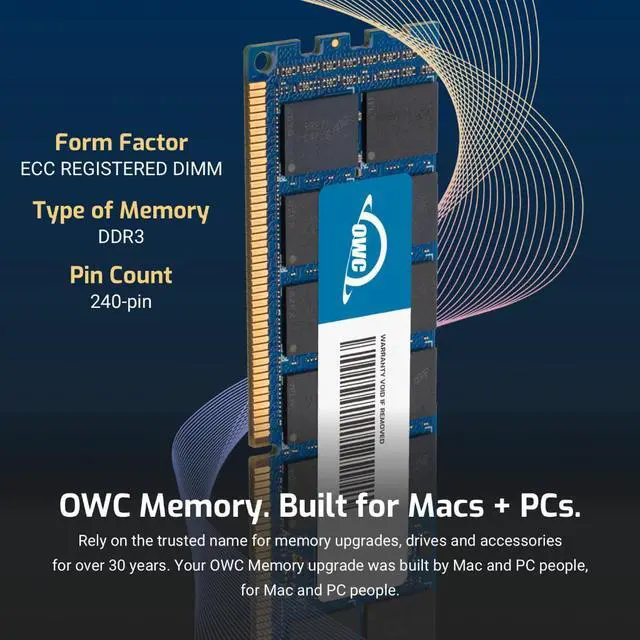
The OWC 64GB DDR3-1066 ECC Registered RDIMM kit includes eight 8GB modules for compatible workstations or servers that need a memory-capacity upgrade; it uses 240-pin, 1.5V modules and is not intended for standard desktops or systems using unbuffered memory.
Recommended For
- Operators upgrading a legacy DDR3 server or workstation whose manual supports 240-pin 1066 MHz ECC RDIMMs and this kit’s 4Rx8 rank; the eight-module, 64GB kit is intended for a compatible platform, not a universal memory upgrade.
- Homelab or small-server owners consolidating several services or virtual machines on a compatible DDR3 platform who need more memory and ECC support; confirm the system supports registered DIMMs and the kit’s rank and speed.
- Workstation users running memory-intensive technical tasks on a board and processor that support DDR3 ECC RDIMMs, when their priority is adding compatible memory capacity rather than moving to a newer memory generation.
- Maintainers extending the service life of older infrastructure that already uses compatible DDR3 RDIMMs and can use the full 64GB kit.
Real-World Use Scenarios
- On a compatible older Xeon server that is running short on memory, an upgrade can give a Proxmox host more room to run Windows or Linux virtual machines and containers at the same time; the number it can handle still depends on each workload and the server’s CPU and storage.
- For a home-lab server used to consolidate services, containers, and small VMs, adding memory can reduce the need to split workloads across several machines when RAM is the limiting factor.
- In a compatible TrueNAS or ZFS file server, extra system RAM can provide more space for the frequently accessed-data cache, which may help repeated reads; the benefit depends on the dataset and workload, and ECC is an added memory-error protection rather than a substitute for backups.
- For a memory-limited professional workstation, additional RAM can help keep large projects or several memory-heavy applications open without running out of working memory; it will not necessarily make CPU- or GPU-limited tasks finish faster.




 here!