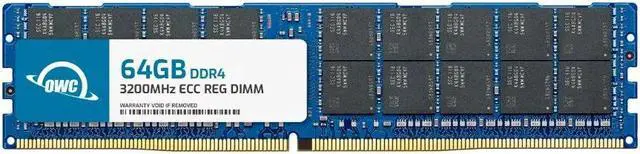
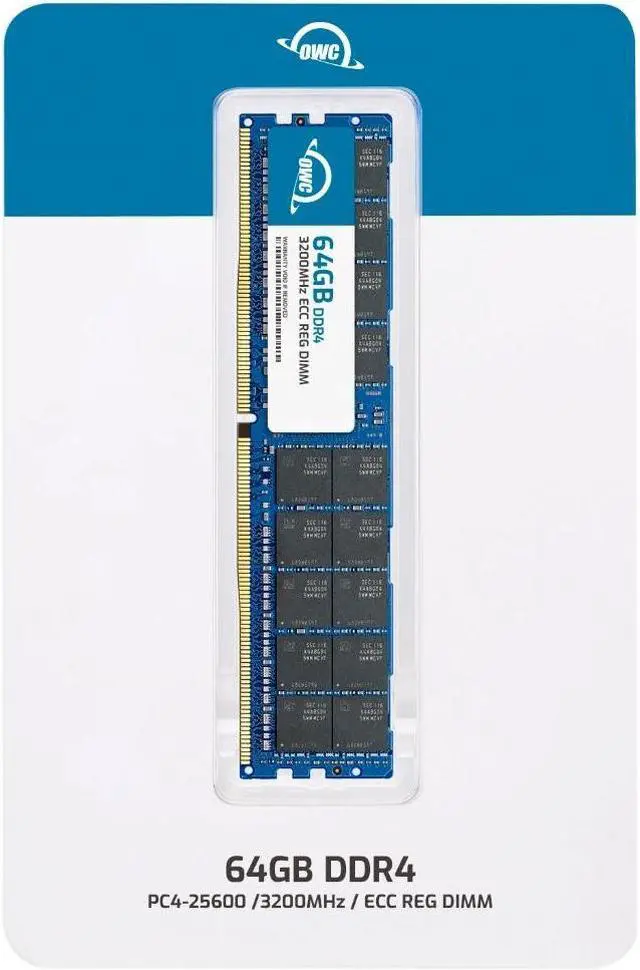
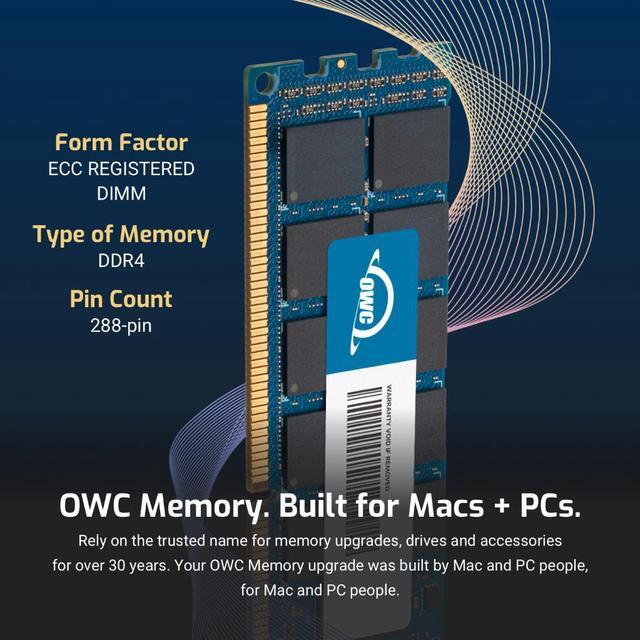
The OWC 3R2D42R464GB is a 64GB DDR4-3200 ECC registered RDIMM for compatible servers and workstations, with 2Rx4 organization, CL22 timing, and 1.2V operation; it matches the listed specifications of Hynix HMAA8GR7AJR4N-XN and HMAA8GR7CJR4N-XN modules.
Recommended For
- Server administrators adding memory to a system whose manufacturer specifies DDR4 ECC registered RDIMMs and supports this module’s capacity, rank, and speed.
- Workstation users with an RDIMM-compatible platform who need to expand memory for large projects or data-heavy professional workloads; confirm the workstation’s supported DIMM type and population rules first.
- Homelab operators running server-class hardware who want to add capacity for memory-intensive services or multiple virtual machines, provided their board and CPU support 64GB DDR4 RDIMMs.
- IT teams replacing a matching Hynix HMAA8GR7AJR4N-XN or HMAA8GR7CJR4N-XN module in a compatible system, after checking the system’s memory support and installation rules.
Real-World Use Scenarios
- When a compatible DDR4 server or workstation is running short on memory, adding this module can increase the capacity available to applications and help reduce memory pressure; it requires a system that supports ECC registered RDIMMs, not a standard desktop that uses unbuffered memory.
- For a virtualization host running several memory-hungry virtual machines, adding capacity can let the operator allocate more RAM to existing VMs or run additional VMs, if the server has enough CPU and memory capacity.
- When consolidating several services or workloads onto one compatible server, extra memory can give those workloads more room to run together and may reduce the need to spread them across multiple hosts.
- For a database server whose working set is constrained by available RAM, additional memory can support a larger in-memory allocation and improve responsiveness; the result depends on the database workload and server configuration.
- For a compatible NAS or storage server running file services alongside other applications, extra memory can provide more headroom for concurrent workloads, though it does not by itself guarantee faster disk or network transfers.




 here!