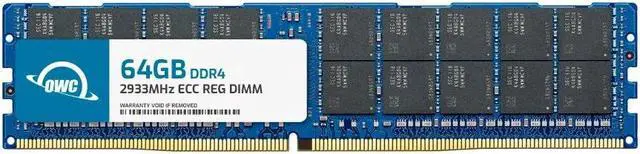
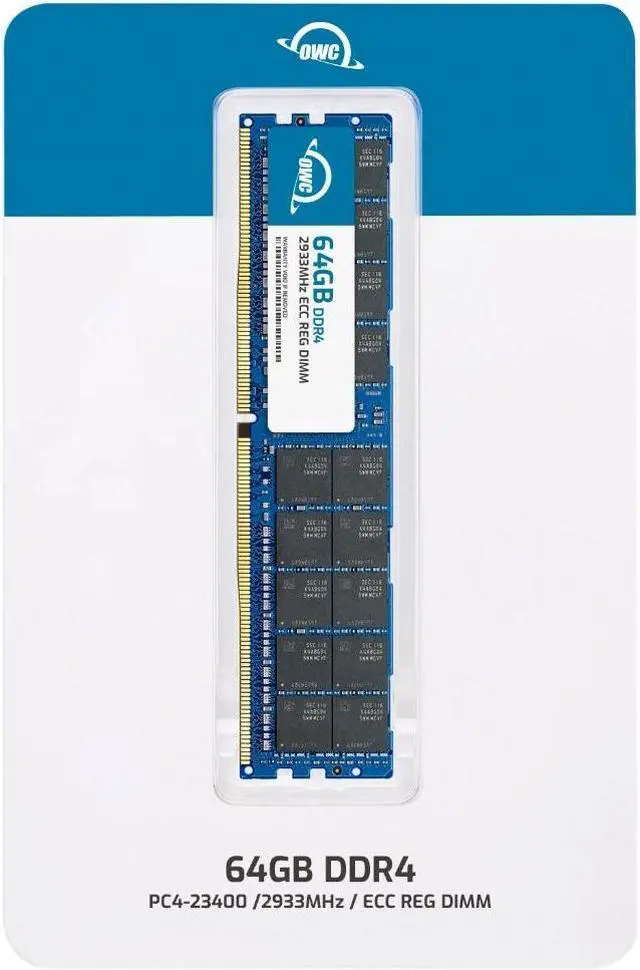
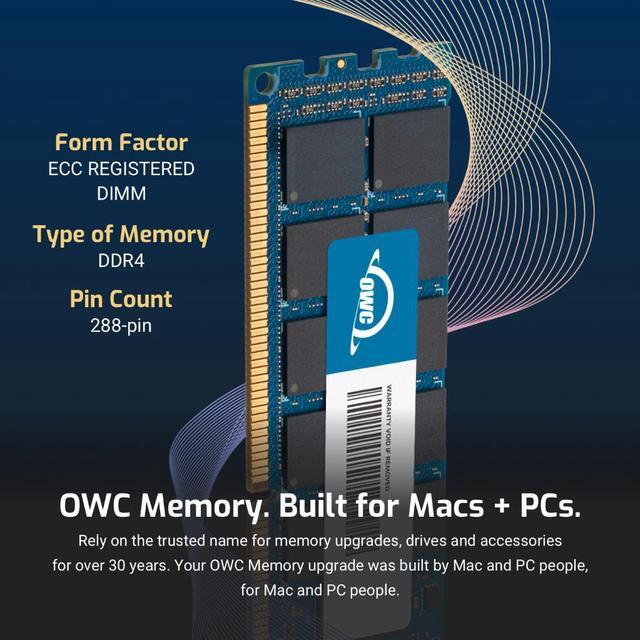
The OWC 2R9D42R464GB is a 64GB DDR4-2933 ECC registered RDIMM for servers and workstations that support 288-pin 2Rx4 memory; it is a replacement for Hynix HMAA8GR7AJR4N-WM and HMAA8GR7MJR4N-WM modules.
Recommended For
- Operators upgrading a supported DDR4 server that needs more memory for virtual machines or other memory-resident services, and whose platform accepts 64GB 2Rx4 ECC RDIMMs at the supported speed.
- Workstation owners maintaining a DDR4 ECC-RDIMM system—such as a compatible Mac Pro or Xeon workstation—who want to add a 64GB module for memory-intensive professional work. Confirm the exact system’s supported capacity, DIMM type, and population rules before buying.
- Server and workstation maintainers replacing or matching a Hynix HMAA8GR7AJR4N-WM or HMAA8GR7MJR4N-WM module, provided the system supports this DDR4-2933 64GB 2Rx4 registered configuration.
- Homelab builders extending an existing DDR4 RDIMM server for additional services or test workloads, when they have verified the motherboard and CPU support the module’s capacity, rank, speed, and registered ECC type.
Real-World Use Scenarios
- When a compatible virtualization host is running short on memory, adding this module as part of a supported upgrade can give its virtual machines more room to run and reduce memory pressure; the host and each VM still need to be sized for their workloads.
- For a TrueNAS SCALE server that handles file sharing alongside apps or virtual machines, a compatible memory upgrade can provide more RAM for those services and read caching, helping the system manage more concurrent work.
- In a home or test lab, an upgraded server can keep more test VMs running at the same time—for example, to try different operating systems or server configurations—provided the system has enough memory for the host as well as the guests.
- For a server running a memory-intensive database or other in-memory workload, this module can contribute to a larger supported memory pool. That may ease memory constraints, but the result depends on the application’s needs and the server’s total configuration.