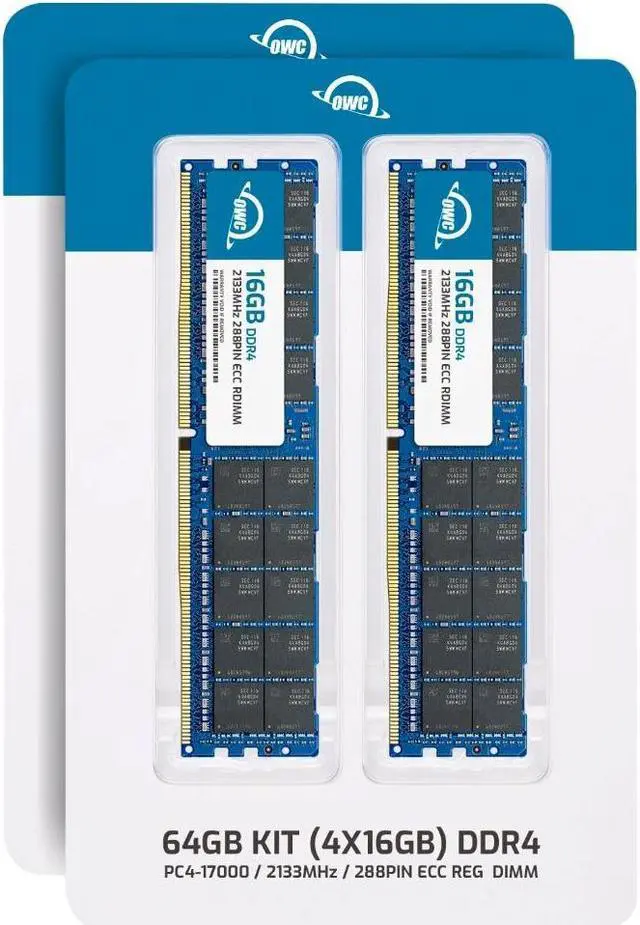
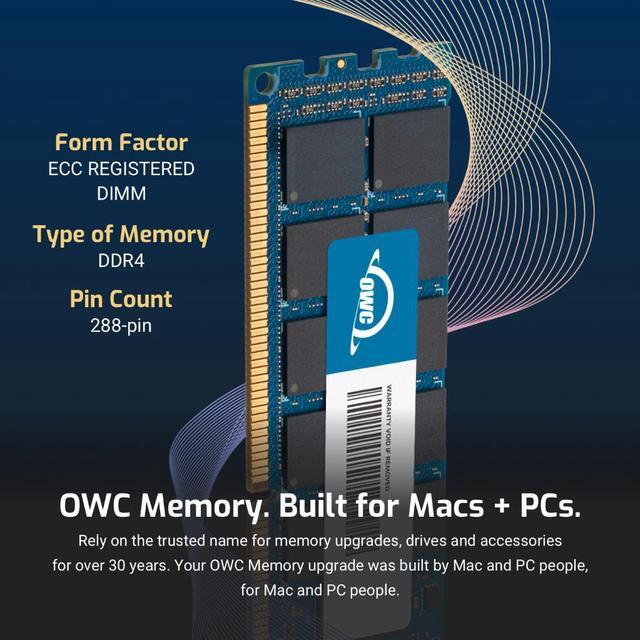
The OWC 64GB DDR4-2133 ECC Registered RDIMM kit includes four 16GB modules for servers or workstations that support 288-pin DDR4 RDIMM memory, offering ECC error correction for compatible systems.
Recommended For
- Owners of a DDR4 server that supports 16GB 2Rx4 ECC registered DIMMs and DDR4-2133 who want to add 64GB using four modules; confirm the server’s supported memory list and slot-population rules first.
- Homelab builders expanding a compatible DDR4 server for virtual machines, containers, or multiple self-hosted services, when 64GB of added memory fits the system’s workload and configuration.
- Operators upgrading an older server platform that accepts DDR4-2133 RDIMMs and can use a four-module kit; the modules may run below 2133 MT/s if the system’s processor or other installed memory sets a lower speed.
- Workstation owners whose motherboard and processor specifically support DDR4 ECC registered memory and whose applications benefit from adding system memory; verify RDIMM support rather than relying on ECC support alone.
Real-World Use Scenarios
- When a compatible DDR4 server is running short of memory, installing this 64GB kit can give its existing services more room to run and may help extend the server’s useful life, provided the platform supports this RDIMM type and speed.
- For a memory-constrained virtualization host, the added capacity can let more virtual machines run at once or give existing VMs more memory; it will not resolve CPU, storage, or network bottlenecks.
- In a home lab used for testing virtual machines or self-hosted services, this kit can provide more memory for concurrent workloads, as long as the server motherboard and processor support DDR4 ECC RDIMMs.
- For a small or moderate database service on a supported server, additional memory can give the database more room for its working set and reduce memory pressure when RAM is the limiting resource; results depend on the database and workload.
- For an always-on server, ECC memory can help detect and correct certain memory errors when supported by the system, offering an additional safeguard for long-running workloads—not a substitute for backups or other data-protection measures.




 here!