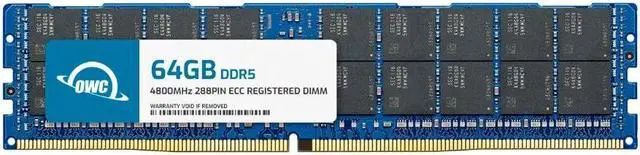
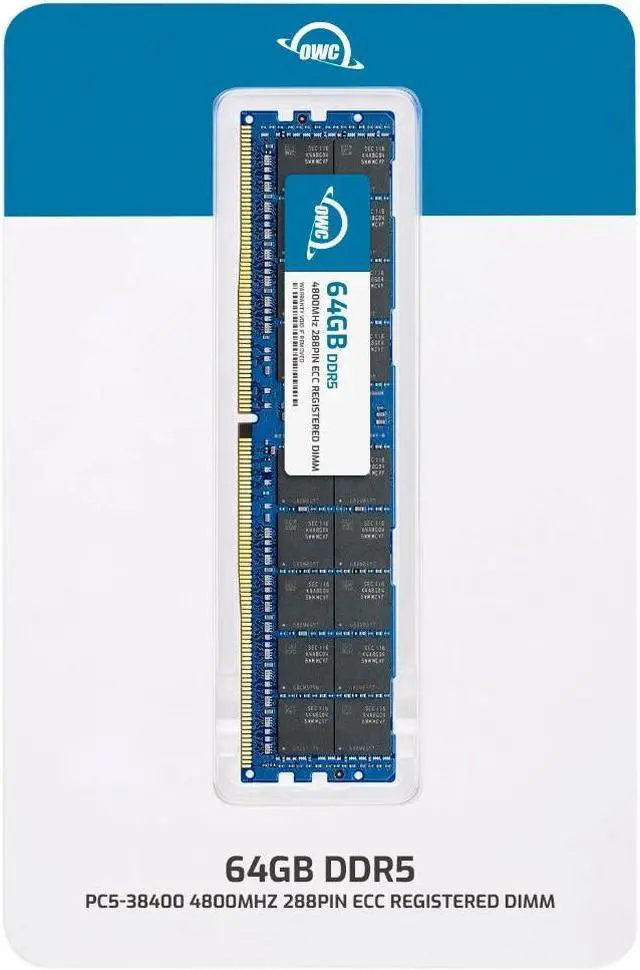
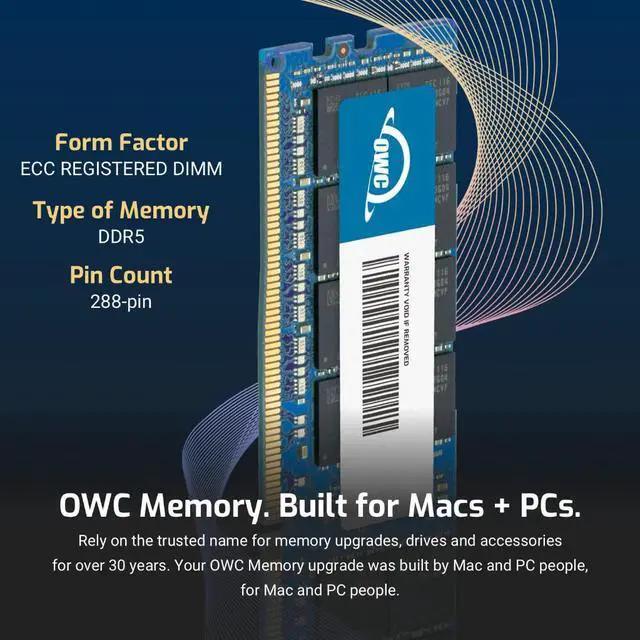
The OWC 64GB DDR5-4800 ECC Registered RDIMM is a server and workstation memory upgrade for systems that support 288-pin DDR5 RDIMMs, offering 2Rx4, CL40 operation at 1.1V.
Recommended For
- Server administrators expanding memory for virtualization or consolidated services, when the server supports 64GB DDR5 ECC RDIMMs and this module’s configuration.
- Database and data-service operators adding memory for larger in-memory working sets, provided their server platform supports this 64GB DDR5 RDIMM and its required configuration.
- Workstation users running memory-intensive simulation, rendering, engineering, or design projects on a system that specifically supports DDR5 ECC registered memory.
- NAS or home-lab operators upgrading a system whose motherboard and processor documentation explicitly calls for DDR5 ECC RDIMMs; check the exact supported capacity, rank, and speed before buying.
Real-World Use Scenarios
- A virtualization host is running several VMs for business services or a home lab, and the operator needs more memory to allocate across them; in a compatible server, adding this module increases available capacity, subject to the host’s memory configuration limits.
- A server is being expanded to host more databases or a larger active dataset; added memory can provide more room for database working data, though the benefit depends on the application and the rest of the system.
- A home-lab or small-business server runs storage services alongside other workloads, and the owner wants more memory headroom for file-system caching and applications; the actual cache use and benefit depend on the storage software and workload.
- An IT team is consolidating services onto fewer physical servers and needs capacity for a mix of virtual machines, databases, and backup tasks; this module can contribute memory capacity when the server supports this RDIMM type and its memory rules.
- A technical team uses a server for analytics or other memory-intensive processing and wants to keep more working data available in memory; extra capacity may help when the workload is memory-bound, but it does not guarantee faster results.




 here!