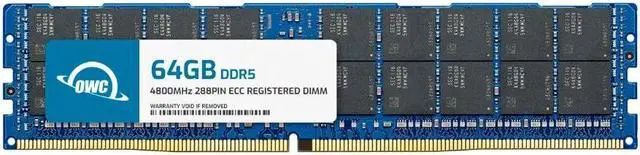
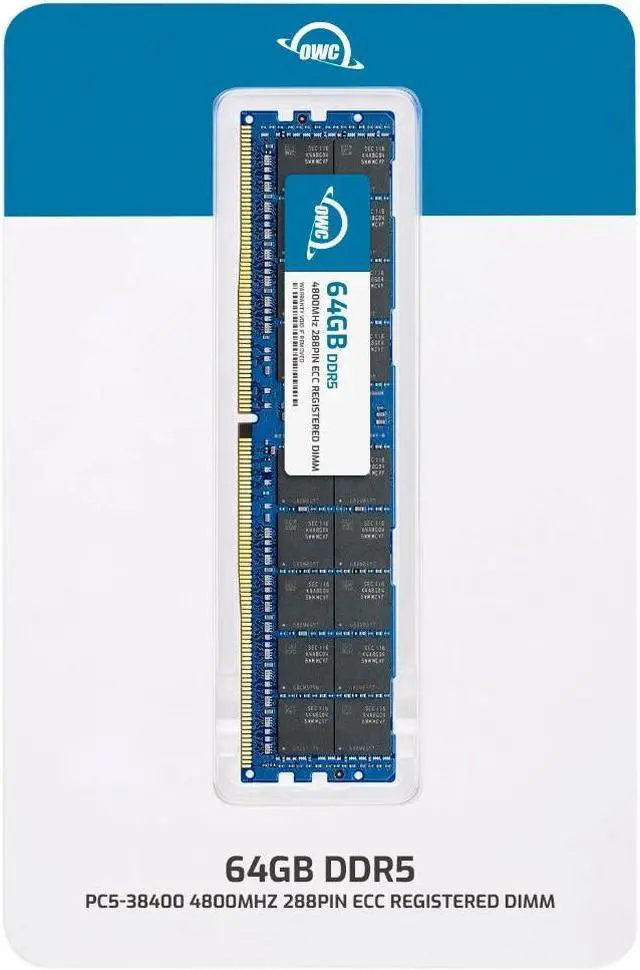
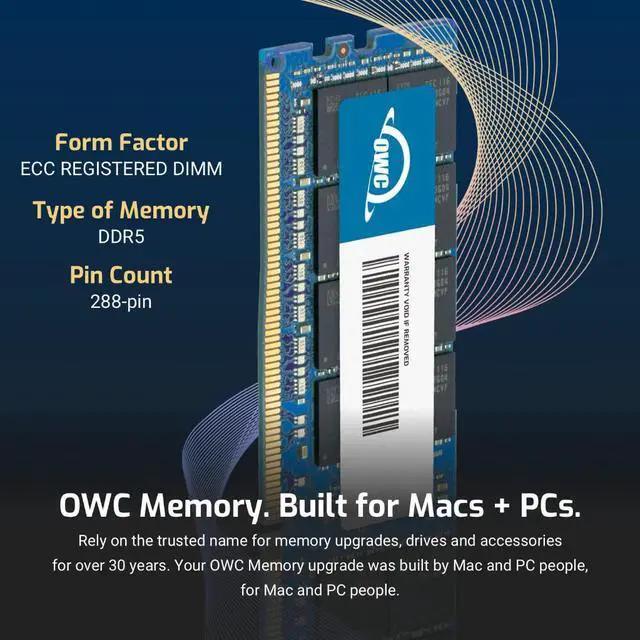
The OWC 64GB DDR5-4800 ECC Registered RDIMM is a server and workstation memory upgrade for compatible systems that use 288-pin registered memory, with support for the listed Hynix replacement part numbers.
Recommended For
- Server operators adding memory to a DDR5-4800 system that supports 64GB ECC registered RDIMMs, such as for expanding a virtualization host or other memory-intensive services.
- Workstation owners whose motherboard and processor explicitly support DDR5 ECC RDIMMs, including compatible Threadripper PRO systems, and who need a 64GB module for memory-heavy professional workloads.
- IT teams replacing a compatible Hynix 64GB DDR5-4800 ECC RDIMM with an OWC module listed as a replacement for the specified Hynix part numbers.
- NAS administrators upgrading a NAS model that specifically accepts 64GB DDR5 ECC RDIMMs; confirm the NAS’s supported memory type and configuration before buying.
Real-World Use Scenarios
- When a compatible server is running short on memory for virtual machines, adding this RDIMM can increase the capacity available to the hypervisor; the practical benefit depends on the server’s supported configuration and how much memory each VM needs.
- For a database server whose working set or cache is outgrowing available RAM, adding memory can provide more room for frequently used data to stay in memory; the actual performance change depends on the database and system configuration.
- When processing large analytics datasets on a compatible server, additional memory can give in-memory tools more space for data and intermediate results, reducing pressure to move working data between memory and storage.
- For engineering or scientific workloads that work with large simulation datasets, expanding memory on a supported workstation or server can provide more room for those datasets to remain available during computation; results still depend on the application and total system configuration.
- In a server that runs continuously, ECC memory can correct certain memory errors automatically, helping the system keep operating through correctable errors; it cannot prevent every memory fault or replace monitoring and maintenance.




 here!