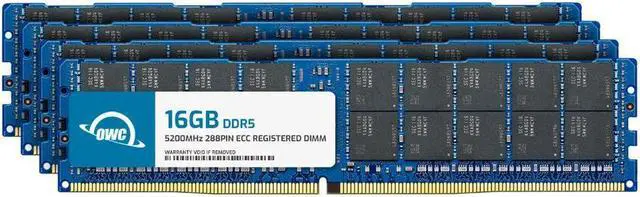
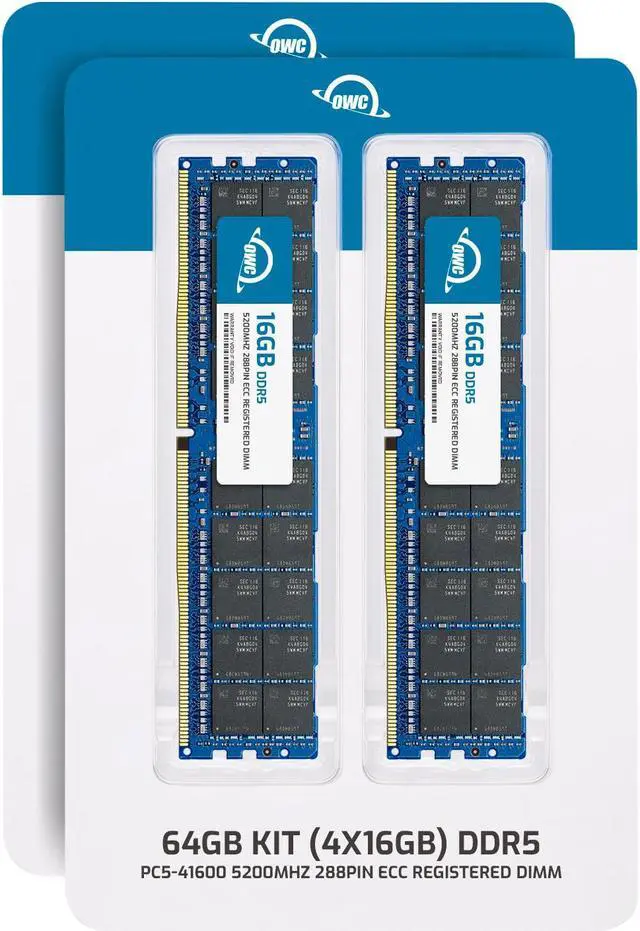
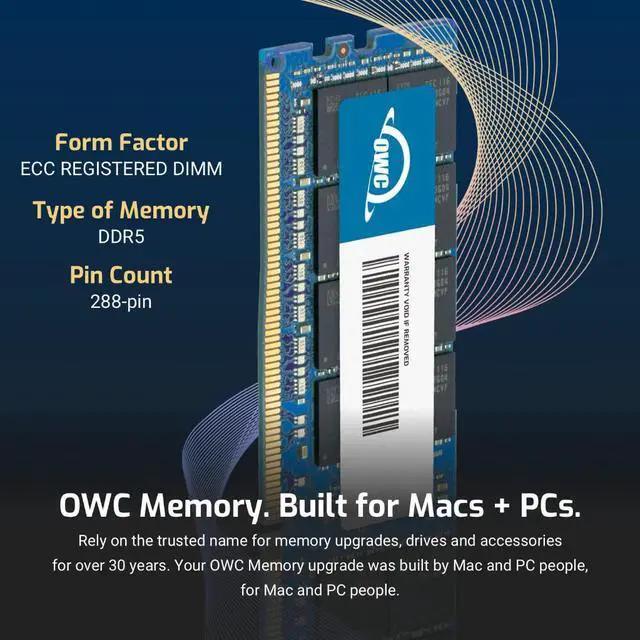
The OWC 64GB DDR5-5200 ECC Registered RDIMM kit includes four 16GB modules for compatible workstations and servers that use registered memory; it is not intended for standard desktop systems.
Recommended For
- Owners of a DDR5 server with verified support for 16GB ECC RDIMMs who want to add 64GB across four modules for server workloads.
- Operators of compatible servers or NAS systems intended to run continuously, where ECC memory’s error-correction features suit always-on workloads.
- Workstation users whose CPU and motherboard support DDR5 ECC RDIMMs and who need registered memory for professional computing workloads.
- Administrators expanding a compatible RDIMM system in a four-module configuration, provided the platform’s memory population rules and supported speed are checked first.
Real-World Use Scenarios
- On a compatible virtualization host that is short on memory, adding this 64GB kit can give guest VMs and the host more RAM to share, reducing pressure to rely on slower swap when memory demand is the bottleneck. The number of VMs it can support depends on their workloads and memory allocations.
- For a compatible database or analytics server that is paging under its current workload, adding memory can provide more room for active data and database processes to stay in RAM; the benefit depends on the database’s memory needs and the system’s existing configuration.
- In a compatible workstation used for memory-heavy projects and several large files at once, the additional RAM can give applications more working space and reduce slowdowns caused by memory pressure, if the current system is running short of RAM.
- For a small server hosting several services or test environments, extra memory can help keep more of those workloads resident at once instead of forcing the host to reclaim memory or swap. The outcome depends on each service’s demand and the server’s total installed memory.
- In a compatible server or workstation running long or unattended jobs, ECC memory is relevant when correcting certain memory errors matters; it does not guarantee that every error or system failure will be prevented.




 here!