

 here!
I’m your shopping assistant for PC builds, upgrades, and everything tech.
Got questions? Ask away!
Start a conversation
here!
I’m your shopping assistant for PC builds, upgrades, and everything tech.
Got questions? Ask away!
Start a conversation




Any questions? Ask CelesteSM will help you find out quickly.
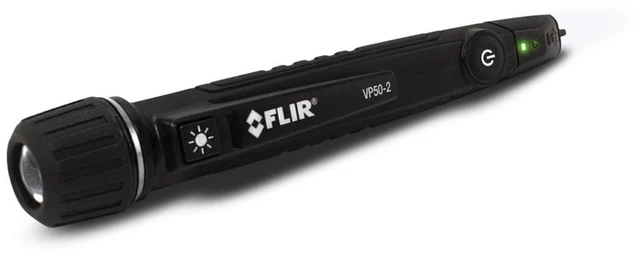
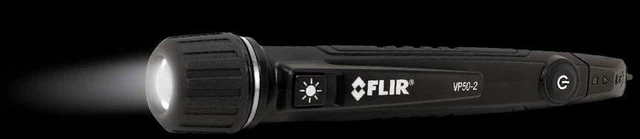
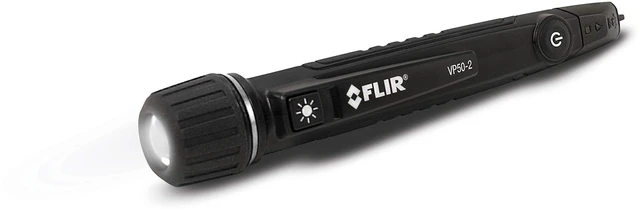
The FLIR VP50-2 is a non-contact voltage detector with a default AC voltage range of 90 to 1000 V on a solid green light, a high-sensitivity mode of 24 to 1000 V on solid amber, a frequency range of 45 to 65 Hz, and a CAT IV-1000 V category rating with cULus certification. The two modes matter more than the listing currently suggests. The default range is set high enough to ignore the induced voltage that appears on almost any conductor near a live one - the effect that makes a too-sensitive detector alarm on everything and teaches its user to stop trusting it. The high-sensitivity mode drops the threshold to 24 V for control wiring, low-voltage lighting and signal circuits, where a 90 V threshold would find nothing. Being able to switch is what makes one instrument usable on both. The alarms are sound, flashing LED and vibration together. Vibration is not a convenience feature. In a mechanical room, next to a running motor, wearing hearing protection, a beeper is inaudible and a flashing tip is competing with a work light - and the alarm you feel in your hand is the one that gets through. There is a flashlight and a tip light, two AAA alkaline batteries with around 5 hours continuous run time with the flashlight off, an operating range of -10 to 50 C (14 to 122 F), a 3 m (9.8 ft) drop test, dimensions of 158.5 x 26 x 29 mm and a weight of 59 g with batteries. Ideal For: checking outlets, switches and lighting circuits before work begins, tracing live conductors in a panel, electrical and HVAC service calls, and control and signal wiring on the high-sensitivity setting - the first check made on arriving at an unfamiliar installation. One thing no non-contact detector can do: prove a circuit is dead. A negative indication is not the same as a proven de-energized state, and shielded cable, screened conduit and certain configurations can prevent detection. Follow your own safe isolation procedure.