




 here!
I’m your shopping assistant for PC builds, upgrades, and everything tech.
Got questions? Ask away!
Start a conversation
here!
I’m your shopping assistant for PC builds, upgrades, and everything tech.
Got questions? Ask away!
Start a conversationShipped by GUANGZHOU PINTECH CO LTD




Any questions? Ask CelesteSM will help you find out quickly.


| Input Impedance: | 1000MO |
| Attenuation Rate: | 1000:1 |
| Test Voltage (DC): | 0~± 40kV |
| Test Voltage (AC): | 1~ 28kV(50/60Hz) |
| Polarities: | Positive/negative can be measured |
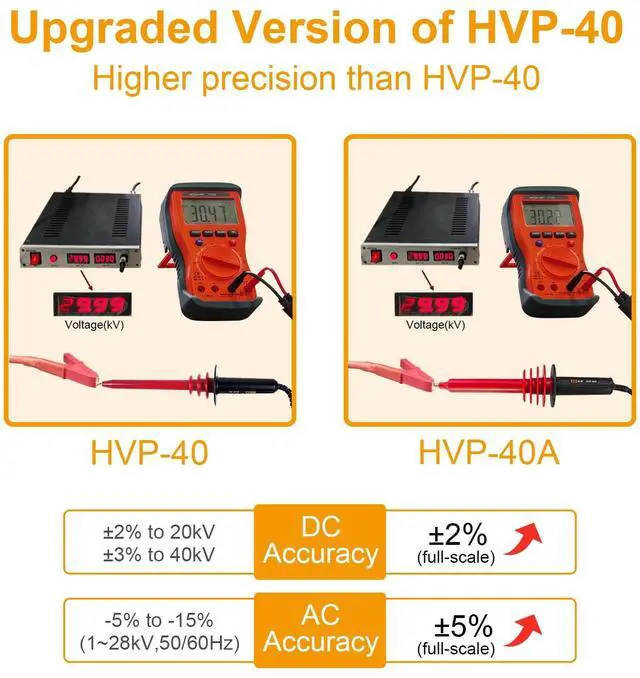
| DC Accuracy: | ± 2% |
| AC Accuracy: | ± 5% |
| Temperature Coefficient: | ? 200ppm /? |
| Load Current (max): | ? 40µA ( at 40kV DC ) |
| Load Power (max): | ? 1.6 watt |
| Operating Temperature | 0? ~ +50? |
| The Specified Connection: | DMM with 10MO input impedance |
| Meter Output Indication: | x1000 bits,1000V?1V,10kV?10V |
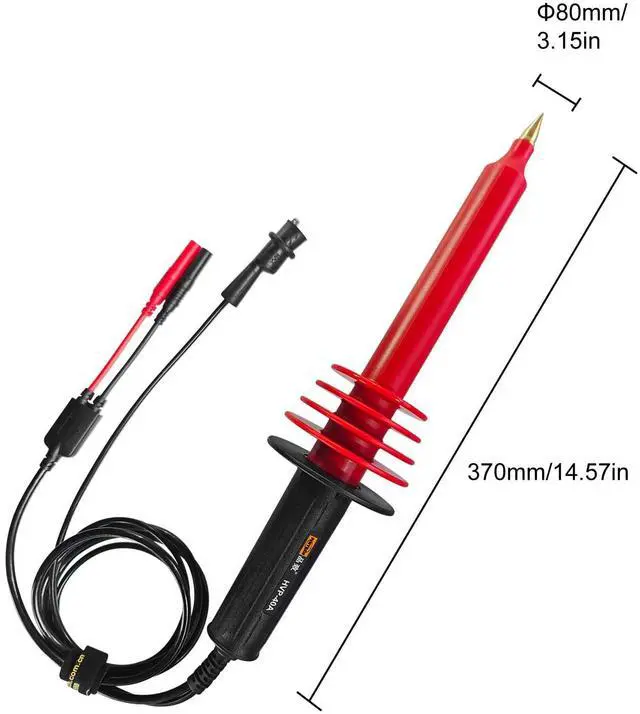
| Weight: | 398g/0.88lb |
MODEL: HVP-40A
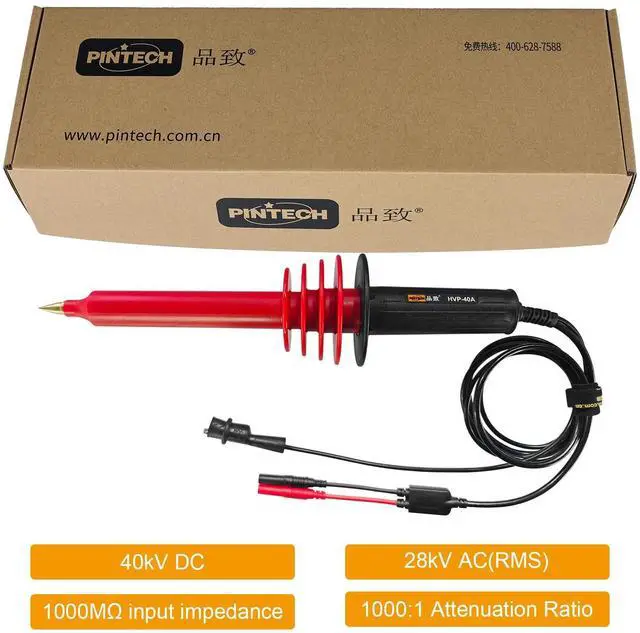
Input Impedance: 1000M
Attenuation Rate: 10001
Test Voltage (max): DC 0~ ± 40kV, AC 1~ 28kV(50/60Hz)
Polarities: Positive/negative can be measured
Accuracy: DC±2%(full-scale), AC: ±5% (full-scale)
Temperature Coefficient: 200ppm /
Load Current (max): 40A ( at 40kV DC )
Load Power (max): 1.6 watt
Operating Temperature: 0 ~ +50
The Specified Connection: DMM with 10M input impedance
Meter Output Indication:x1000 bits1000V1V10kV10V
Weight: 398g/0.88lb
In addition to the input impedance of 10M, the accuracy of the selected meter should be within ±0.5%, otherwise the attenuation ratio will be seriously affected.
| Brand | PINTECH |
| Power Source | Corded Electric |
| Style | Classic |
| Color | Black |
| Specification Met | CE |
| Upper Temperature Rating | 50 Degrees Celsius |
| Manufacturer | PINTECH |
| Package Dimensions | 17 x 7 x 5 inches |
| Item Weight | 1.8 pounds |
| Item model number | HVP-40A |
| Date First Available | October 22, 2025 |
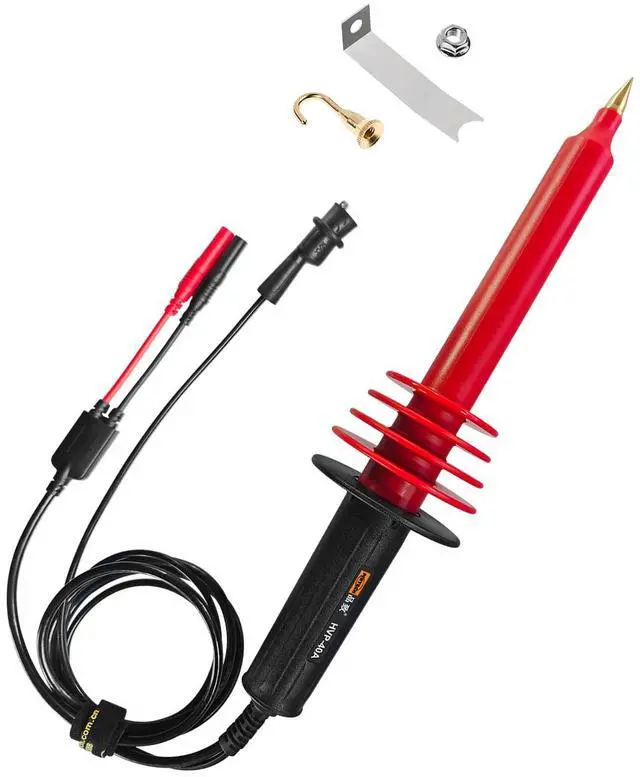
The PINTECH HVP-40A is a 40kV high-voltage probe for multimeters, designed for technicians, engineers, and advanced electronics users who need to measure high DC voltages up to 40kV or AC up to 28kV with a 1000:1 attenuation ratio and an insulated safety handle.
| Attribute | Value |
|---|---|
| Best For | High-voltage measurements with a handheld multimeter — DC up to 40 kV and AC 1–28 kV (50/60 Hz); intended for use with a multimeter that has a 10 MΩ input and uses 1000:1 attenuation |
| Measurement Range | DC up to 40 kV; AC 1–28 kV (50/60 Hz) |
| Accuracy And Attenuation | 1000:1 attenuation ratio; ±2% full-scale DC accuracy and ±5% full-scale AC accuracy; meter readout scaled by X1000 (e.g., 1 V = 1000 V, 10 V = 10 kV) |
| Input And Load | Attenuation and readings assume a multimeter input impedance of 10 MΩ and meter output indication set to X1000 |
| Safety And Design | Extra-long insulated handle to keep hands away from live parts during high-voltage measurements |
| Package Contents | Includes one high-voltage probe plus one set of accessories and one manual |
| Model Identifiers | HVP-40; HVP-40A (upgraded HVP-40) |
| Standards/Certifications | FDA Class VI Seats |
Q: Should I buy the PINTECH HVP-40A or a Fluke 80K-40 high voltage probe?
A: Choose the PINTECH HVP-40A if you want the core 40 kV DC / 28 kV AC measurement range and a 1000:1 attenuation probe for occasional bench, repair, or hobby use with a 10 MΩ multimeter. Choose the Fluke 80K-40 if you want a widely documented reference model with established manuals, service documentation, and stronger brand validation for professional workflows. On paper, both target the same use case: extending a multimeter to measure high voltage through a 1000:1 divider.
Q: Is a 40 kV high voltage probe worth it over a lower-range 30 kV probe?
A: Buy the PINTECH HVP-40A over a 30 kV-class probe if your work can approach CRT anode, power supply, or test fixture voltages near the upper end of high-voltage multimeter measurement. The main advantage is extra headroom: 40 kV DC and 28 kV AC coverage reduces the need to work close to the probe's limit. A 30 kV probe is the better fit when your measurements stay clearly below that range and you do not need the added margin.
Q: Should I use this high voltage probe with a multimeter or buy an oscilloscope high-voltage probe instead?
A: Choose the PINTECH HVP-40A if you need voltage magnitude readings on a standard multimeter and your priority is simple DC or mains-frequency high-voltage measurement. Choose an oscilloscope high-voltage probe if you need waveform detail, transient behavior, or higher-frequency signal analysis. The trade-off is straightforward: a multimeter probe is better for numerical voltage checks, while an oscilloscope probe is better for signal shape and time-domain troubleshooting.
Q: Is the PINTECH HVP-40A better than using a DIY voltage divider or generic low-cost HV probe?
A: Choose the PINTECH HVP-40A if you want a ready-made 1000:1 probe designed for high-voltage measurement with known range, stated accuracy, and insulated handling. A DIY divider or very generic probe may still work for experienced users, but it usually requires more validation around resistance, meter compatibility, insulation, and safe physical construction. The practical advantage of the PINTECH model is convenience and a clearer starting point for measurement setup with a 10 MΩ meter.
Q: Will this work with any multimeter, or does it require a specific type?
A: It is only a good fit if your multimeter has a 10MΩ input impedance. This probe is a 1000:1 divider designed for that meter load, so the displayed reading is scaled correctly only with a compatible DMM. It is better suited to bench or professional handheld multimeters than to unknown or low-cost meters with unclear input specs.
Q: Who is this probe actually suitable for?
A: This probe is suitable for technicians, engineers, and experienced electronics users who need to measure high DC voltage up to 40kV or AC up to 28kV at 50/60Hz with a standard multimeter. It is not a casual DIY accessory. The main reason to buy it is extending a 10MΩ DMM into high-voltage measurement at lower cost than a dedicated HV meter, with the trade-off that safe use depends heavily on user skill and the test setup.
Q: Is this a good choice if I need better measurement accuracy?
A: It is a practical choice for general high-voltage checks, but not the best option for precision-focused work. The stated accuracy is ±2% full-scale on DC and ±5% full-scale on AC, which is acceptable for confirming approximate HV levels but less suitable than higher-end alternatives when tighter uncertainty matters. Buyers choosing between budget and premium probes should view this model as value-oriented rather than metrology-oriented.
Q: What are the main trade-offs versus a more expensive high-voltage probe?
A: The main trade-off is cost versus confidence. This PINTECH model offers the common 40kV DC, 28kV AC, 1000:1, 1000MΩ format at a lower entry cost, but premium probes from established test-equipment brands typically offer stronger documentation, clearer safety compliance details, and in some cases tighter DC accuracy. If your priority is occasional HV measurement on a budget, this type makes sense; if your priority is traceability, specs, and brand-backed safety documentation, a premium alternative is the safer buy.
Q: Can I use this for everyday household or automotive electrical work?
A: No. This is a specialized high-voltage probe, not a general-purpose multimeter accessory for normal household or car diagnostics. It is intended for measuring much higher voltages than standard appliance, outlet, or automotive systems, and it should only be used where a high-voltage divider probe is specifically required and the user understands the safety limits of both the probe and the meter.
Q: Will this high-voltage probe work with a regular multimeter?
A: Usually yes, if the multimeter has a 10 MΩ input impedance. This probe is a 1000:1 divider and is intended to be used with a 10 MΩ meter. It is a practical fit for users who need to extend a standard DMM into high-voltage measurement, but it is not a standalone meter and readings can be off if the connected meter does not match the expected input impedance.
Q: Who is this probe suitable for?
A: It is best suited to electronics repair, lab, and HV hobbyist users who already understand high-voltage measurement practice and need to check DC up to 40 kV or AC mains-frequency high voltage with a DMM. It is less suitable for beginners who want a simple plug-and-go tool, because safe use depends on correct meter pairing, careful handling, and understanding probe limits.
Q: Is a 40 kV, 1000:1 probe like this worth buying instead of building your own divider?
A: For most buyers, yes, if the goal is occasional or routine HV measurement with less setup risk than a DIY divider. Community discussion around high-voltage measurement repeatedly centers on using purpose-built 1000:1 probes rather than improvised dividers for safer, more predictable use. The trade-off is that a budget probe is still a basic accessory: accuracy is limited to the stated spec, and it does not replace higher-end HV instrumentation.
Q: What are the main trade-offs of this kind of high-voltage probe?
A: The main trade-offs are meter dependency, limited use case, and frequency range. This type of probe is mainly for high-voltage measurement with a compatible DMM, not for fast transients or oscilloscope-style waveform analysis. It is better for checking steady DC or 50/60 Hz AC high voltage than for capturing spikes, and users often compare it with more capable but more expensive specialty probes.



