




 here!
I’m your shopping assistant for PC builds, upgrades, and everything tech.
Got questions? Ask away!
Start a conversation
here!
I’m your shopping assistant for PC builds, upgrades, and everything tech.
Got questions? Ask away!
Start a conversationShipped by GUANGZHOU PINTECH CO LTD




Any questions? Ask CelesteSM will help you find out quickly.
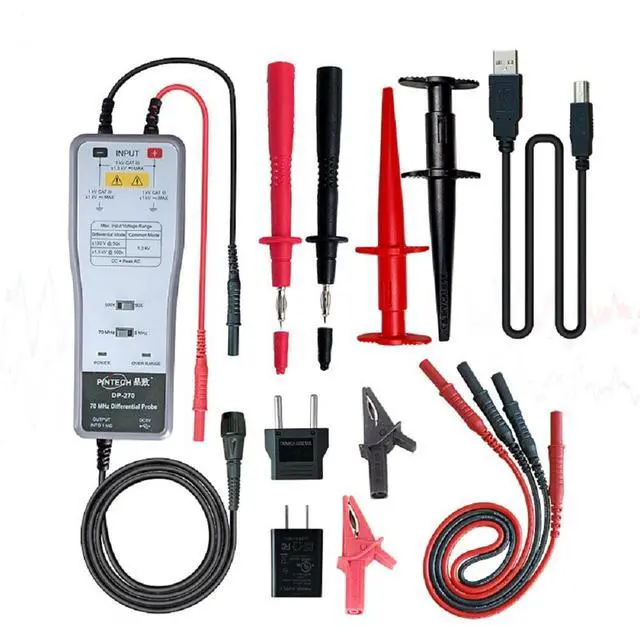
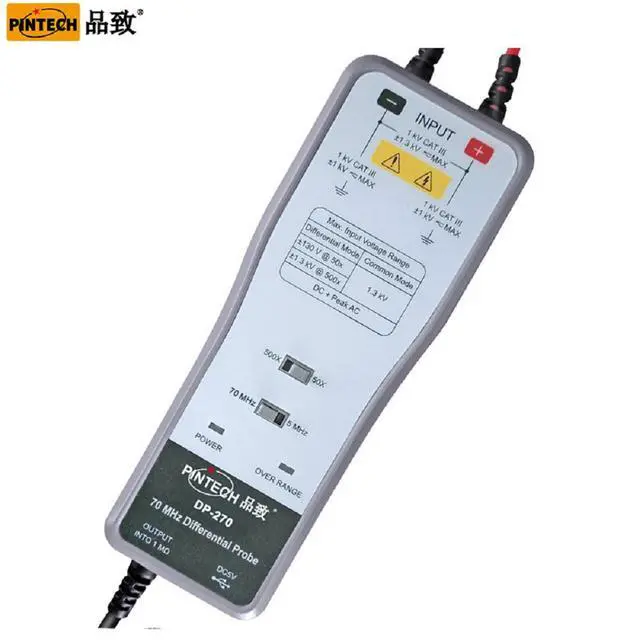
MODEL: DP-270
Bandwidth (-3dB): DC-70MHz
Input Impedance: Between the two ends: 10M//1pF , Single-ended to ground: 5M//2pF
Attenuation Rate: 50X/500X
Rising Time: 5ns
Input Voltage Range: ±130V (DC + AC peak) at 50X; ±1300V (DC + AC peak) at 500X
Maximum Input Voltage: ±1300V(DC+AC peak)
Accuracy: ±2%
RMS value: 919V
Output Voltage: ±2.6V
Output Impedance: 50 (In an oscilloscope system with 1M input impedance)
CMRR: 60Hz:>60Hz:>80dB; 100Hz:>60dB; 1MHz:>50dB
Noise RMS: 50X: 200mV; 500X: 400mV
Power Supply: Specify an external 5V DC power
5MHz Bandwidth Limited: Switchable: FULL/5MHz
Weight: 285g/0.63lb
Dimension(LxWxH): 175x68x28 mm
The PINTECH DP-270 is a high-voltage differential active oscilloscope probe with 2600V range, 70MHz bandwidth, and 50X/500X attenuation, suited for engineers, technicians, and lab users measuring motor drives, power electronics, and other high-voltage circuits with standard BNC oscilloscopes.
| Attribute | Value |
|---|---|
| Best For | Differential high-voltage oscilloscope measurements and motor-circuit testing; converts two-point signals to a ground-referenced signal for oscilloscopes and data acquisition equipment |
| Model Identifiers | DP-270 differential probe sold individually |
| Physical And Dimensional | Probe body dimensions 175 x 68 x 28 mm |
| Accuracy And Performance | Typical measurement accuracy ±2% |
| Availability And Listing | First listed on Newegg March 03, 2026 |
Q: Should I choose the PINTECH DP-270 or a 70MHz 50X/500X probe like the Siglent DPB5150?
A: Choose the PINTECH DP-270 when you want a BNC differential probe with a familiar 70MHz, 50X/500X class spec and a higher stated peak differential voltage range of 2600V p-p. Choose a model like the Siglent DPB5150 when you value a more fully documented mainstream option with published datasheet details such as overload alarm behavior, input impedance, and accessory ecosystem. In practice, both fit general high-voltage oscilloscope work, but the stronger decision point is whether you prioritize stated voltage headroom or the depth of vendor documentation and support.
Q: Is the PINTECH DP-270 a better fit than a lower-voltage differential probe?
A: Yes, the DP-270 is the better fit when your measurements can exceed the range of entry-level differential probes. A lower-tier model is usually the better choice only when you work on lower-voltage designs and want either more sensitivity at smaller signals or a lower purchase cost. For motor drives, offline power electronics, and other floating high-voltage nodes, the DP-270's 2600V p-p positioning makes more sense than an 800V to 1500V class probe.
Q: Should I buy the PINTECH DP-270 or move up to a higher-bandwidth differential probe from Micsig, Siglent, or Tektronix?
A: Buy the DP-270 if your main need is high-voltage differential measurement in power electronics where 70MHz is enough. Move up to a 100MHz-and-higher probe when you need cleaner visibility into faster edges, switching transitions, and timing details, or when lower probe loading and stronger published CMRR performance are part of the buying decision. Higher-tier probes are commonly positioned for more demanding lab work, while a 70MHz class probe is typically the practical choice for general inverter, motor, and SMPS troubleshooting.
Q: For motor drives and power supplies, is the PINTECH DP-270 more useful than a standard passive probe?
A: Yes. The DP-270 is the more appropriate tool when you need to measure the voltage difference between two non-ground-referenced points, which is common in motor circuits, half-bridge nodes, and offline power stages. A standard passive probe remains the better choice for ground-referenced, lower-voltage measurements because it is simpler and often introduces less setup overhead. The real trade-off is not portability or convenience, but whether the circuit under test requires true differential high-voltage measurement.
Q: Would a community-favorite probe like the Micsig DP10013 make more sense than the PINTECH DP-270?
A: Choose a probe like the Micsig DP10013 when you want a model that has been discussed and tested more widely in reviews and on YouTube, especially if you value real-world calibration, noise, and usability commentary before buying. Choose the DP-270 when its simpler 70MHz, high-voltage, BNC-based positioning matches your measurement range needs and you do not need the same level of third-party coverage. The trade-off is between broader external validation and a straightforward voltage-and-bandwidth fit.
Q: Who is this probe suitable for?
A: This probe is best suited for bench testing high-voltage differential signals in power electronics, such as motor drives, switching power supplies, inverters, and floating measurements. It is a fit for technicians and engineers who need a BNC-output differential probe with moderate bandwidth and high-voltage capability. It is less suitable for low-voltage general-purpose oscilloscope work, where a standard passive probe is simpler and cheaper.
Q: Will it work with my oscilloscope?
A: Usually yes, if your oscilloscope has a standard BNC input and can use an external powered probe. The main compatibility point is not the brand of scope but the connection and setup: you will need to apply the correct probe factor on the oscilloscope channel and power the probe correctly. As with comparable 70 MHz differential probes, BNC output makes it broadly compatible across scope brands.
Q: What is the practical trade-off between the 50X and 500X settings?
A: The 50X setting is better when you need more sensitivity for lower-voltage measurements, while the 500X setting is the safer choice for much higher voltages. The trade-off is that higher attenuation reduces the signal level reaching the oscilloscope, so small signals are easier to see at 50X, but high-voltage measurements typically require 500X. This is a common decision point across comparable differential probes with 50X/500X switching.
Q: Is 70 MHz enough, or should I buy a higher-bandwidth differential probe?
A: 70 MHz is generally enough for many power electronics and motor-drive troubleshooting tasks, including switching supplies and inverter-related measurements. A higher-bandwidth probe is the better choice if you need cleaner visibility into faster edges, more detailed transient analysis, or work on higher-speed designs. For routine high-voltage bench work, 70 MHz is often the practical value option, but it is not the best choice for advanced high-speed analysis.
Q: Is this a good value compared with major-brand alternatives?
A: It can be a reasonable value if your priority is high-voltage differential measurement with standard BNC compatibility, 50X/500X switching, and around 70 MHz bandwidth. The trade-off versus major-brand alternatives is usually not the basic function, but the ecosystem around it: premium brands more often offer stronger documentation, broader service support, calibration options, and higher-bandwidth upgrade paths. Buyers focused on cost and core capability may find this class of probe sufficient, while labs that need formal support or premium validation may prefer established brands.
Q: Who is this type of high-voltage differential probe actually suitable for?
A: A 70 MHz, 2600 V differential probe like the DP-270 is mainly suitable for bench work where you need to measure voltage between two non-ground-referenced points, especially in power electronics, motor drives, mains-related circuits, and other high-voltage switching circuits. It is less suitable if your work is mostly low-voltage digital debugging, where a lower-noise or lower-attenuation probe may be a better fit.
Q: Is this a good choice if I need to measure mains, inverter, or motor-drive waveforms safely on a standard oscilloscope?
A: Yes, this kind of probe is designed for that use case. Its main value is letting a standard BNC-input oscilloscope measure high common-mode or floating voltages without tying one side of the measurement directly to scope ground. That makes it a more appropriate choice than a standard passive probe for mains-referenced or motor-drive measurements, as long as the voltage stays within the probe's rating.
Q: Can this probe still work for lower-voltage signals, or is it only for very high voltage?
A: It can work on lower-voltage signals, but it is not optimized for very small signals. With 50X and 500X attenuation, the measured signal is reduced a lot before it reaches the oscilloscope, so modest voltages are still usable, but low-level signals can become harder to view cleanly. This makes it reasonable for medium-voltage differential measurements, but not ideal when you need high sensitivity on sub-volt signals.
Q: What are the main trade-offs of buying this kind of probe instead of a regular oscilloscope probe?
A: The trade-off is capability versus sensitivity and simplicity. A high-voltage differential probe gives safer measurement of floating or high common-mode signals and works with standard BNC oscilloscopes, but it usually adds attenuation, can be noisier than probes intended for low-voltage work, and is a more specialized tool. If you mostly test grounded low-voltage circuits, a standard probe is usually simpler and more practical.



