




 here!
I’m your shopping assistant for PC builds, upgrades, and everything tech.
Got questions? Ask away!
Start a conversation
here!
I’m your shopping assistant for PC builds, upgrades, and everything tech.
Got questions? Ask away!
Start a conversationShipped by GUANGZHOU PINTECH CO LTD




Any questions? Ask CelesteSM will help you find out quickly.
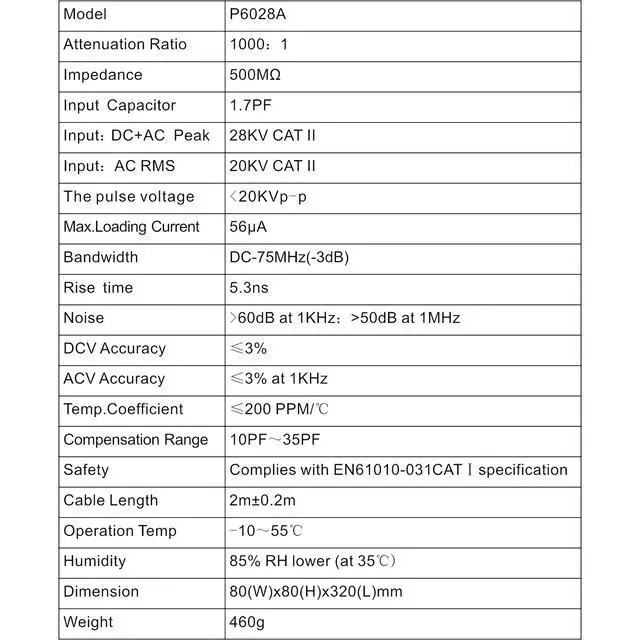
MODEL: P6028A
Input Impedance: 500M
Input Capacitance: 1.7pF
Attenuation Rate: 1000:1
Bandwidth: DC-75MHz(-3dB)
Max.DC+AC peak: 28kV/30 sec
Max.AC RMS: 20kV/30 sec
Rise Time: 5.3ns
DCV Accuracy: 3%
ACV Accuracy: 3% at 60Hz(0-10kV rms), 5% at 60Hz(10-20kV rms)
Max. Loading Current: 56A
Noise: >60dB at 1kHz; >50dB at 1MHz
Size: 80 x 80 x 320 mm
Weight: 460g/1lb
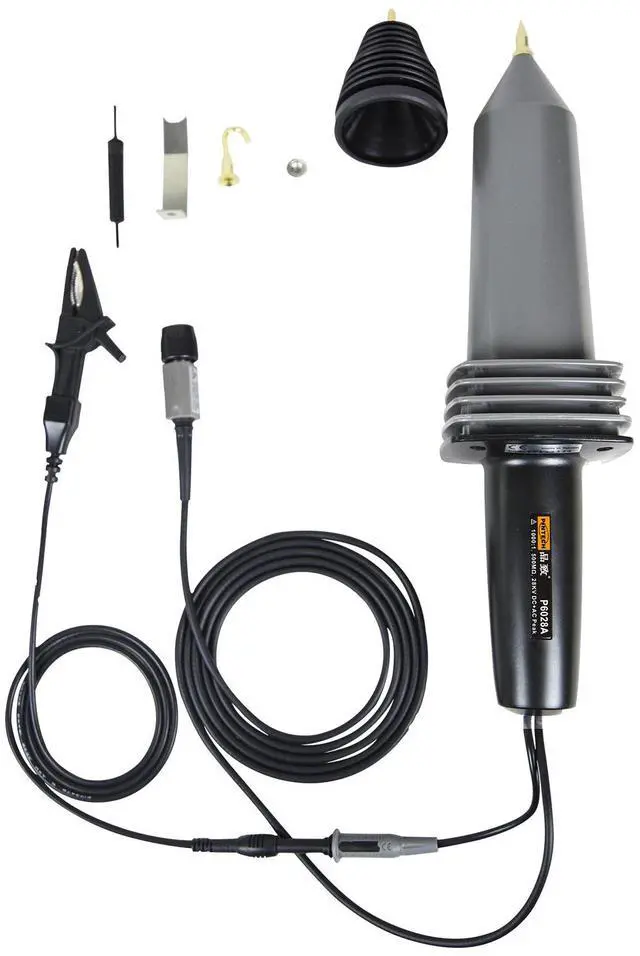
The PINTECH P6028A is a high-voltage oscilloscope probe with 1000:1 attenuation, built for technicians, electronics labs, and service users who need to measure high-voltage DC signals up to 28kV and AC signals up to 20kV with a standard BNC oscilloscope setup.
| Attribute | Value |
|---|---|
| Best For | High-voltage electrical testing and measurement up to 28 kV DC and 15 kV AC |
| Electrical Ratings | Rated for up to 28 kV DC and 15 kV AC |
| Accuracy And Performance | ±3% measurement accuracy |
| Physical | External dimensions 80 x 80 x 320 mm |
| Packaging And Unit | Packaged as one unit (1 Pack); sold individually |
| Compliance And Certifications | CE certified |
| Model Identifiers | PINTECH P6028A |
Q: Should I buy the PINTECH P6028A or a Tektronix P6015A high-voltage probe?
A: Choose the PINTECH P6028A if you want the same basic class of probe behavior as the Tektronix P6015A: 1000:1 attenuation, 75 MHz bandwidth, and roughly 20 kV AC / 28 kV DC capability. Choose the Tektronix P6015A if you prioritize a widely documented reference model with stronger official documentation, established service information, and broader mention in lab workflows. For buyers focused on core voltage range and oscilloscope compatibility, the P6028A fits the same general use case. For buyers who value long-established documentation and support history, the P6015A is the safer comparison point.
Q: Is the P6028A better than a standard 10:1 oscilloscope probe for high-voltage work?
A: Yes for high-voltage measurement, because the P6028A is designed for that job and uses 1000:1 attenuation to bring very high voltages into a scope-safe range. A standard 10:1 passive probe is the better choice for low-voltage bench work where you want more signal amplitude and usually simpler setup. If your measurement can exceed the normal range of standard passive probes, the P6028A is the appropriate tool. If you are measuring ordinary electronics signals, a regular 10:1 probe remains the more practical option.
Q: Should I choose the P6028A or a differential high-voltage probe?
A: Choose the P6028A when you are measuring ground-referenced high voltage and want a passive probe with broad oscilloscope compatibility through a standard BNC connection. Choose a differential high-voltage probe when you need to measure floating nodes, line-to-line signals, or circuits where grounding the oscilloscope reference would be unsuitable. The trade-off is that a differential probe is usually the right tool for isolation-sensitive measurements, while the P6028A is the simpler fit for single-ended, ground-referenced measurements.
Q: Is a lower-voltage high-voltage probe enough, or should I step up to the P6028A?
A: Step up to the P6028A when your work regularly approaches tens of kilovolts or when you want more headroom than lower-voltage probes provide. Lower-voltage probes are often the better fit for faster everyday switching and power measurements if their voltage rating already covers your use case. In short: buy the lower-voltage option for routine lower-range measurements, and buy the P6028A when voltage capability is the main requirement.
Q: Is the PINTECH P6028A a good choice if I need to measure very high voltage with a standard oscilloscope?
A: Yes, if your main need is single-ended high-voltage measurement with a standard 1 MΩ BNC oscilloscope. The P6028A is specified for up to 28 kV DC, 20 kV AC, 75 MHz bandwidth, and 1000:1 attenuation, which makes it suitable for scaling high voltage into a scope-safe range. The main trade-off is that it is a passive high-voltage probe, so it is better suited to general high-voltage measurement than to advanced differential or floating measurements.
Q: Will this probe work with most oscilloscopes, or does it need a special scope?
A: It should work with most standard oscilloscopes that use a BNC input and 1 MΩ input impedance. The product description says it uses a standard BNC interface and lists 500 MΩ probe input impedance. In practice, buyers asking about probe compatibility on retail and discussion pages usually care first about connector type and scope input impedance, and this model aligns with the common BNC scope setup. You may still need to set the oscilloscope’s probe factor manually to 1000:1 if the scope does not auto-detect the attenuation.
Q: Is a 1000:1 high-voltage probe like this better than a lower-voltage 100:1 probe?
A: It is better only when your measurements actually require the extra voltage headroom. A 1000:1 probe such as the P6028A is the safer fit for very high-voltage work, but the trade-off is lower displayed signal amplitude at the oscilloscope input, which can reduce detail on smaller signals. Lower-voltage probes such as 100:1 models are usually more suitable when the target voltage is much lower and you want more signal amplitude on screen.
Q: Who is the P6028A most suitable for?
A: It is most suitable for users who already understand high-voltage measurement practice and need a passive probe for bench or field use with a conventional oscilloscope. Based on its voltage rating, 75 MHz bandwidth, and BNC connection, it fits troubleshooting and measurement tasks in power electronics, industrial systems, labs, and similar high-voltage environments. It is less ideal for buyers who need differential measurements across floating points or who want the simplest option for low-voltage general-purpose probing.
Q: Should I buy this passive high-voltage probe instead of a differential high-voltage probe?
A: Buy the P6028A if you need a simpler, higher-voltage passive probe for single-ended measurements referenced to scope ground. Choose a differential high-voltage probe instead if you need to measure across two non-ground-referenced points, especially in fast-switching power circuits. The key trade-off is that passive probes usually offer higher voltage range per dollar, while differential probes are better for floating measurements and common-mode rejection.
Q: Who is the PINTECH P6028A suitable for?
A: The P6028A is best for users who need to observe high-voltage signals with a standard oscilloscope and understand probe attenuation and oscilloscope grounding limits. It is more suitable for bench diagnosis of high-voltage circuits than for beginners who only measure low-voltage electronics.
Q: Is the P6028A a good choice for measuring tube amps, power supplies, or other high-voltage circuits?
A: Yes, if your main need is measuring high-voltage DC or AC waveforms that exceed normal 10:1 probe limits. Its 1000:1 attenuation, 28 kV max DC rating, and standard BNC connection make it a practical fit for high-voltage bench work, but it does not remove the need to verify safe grounding and measurement setup.
Q: Can the P6028A also be used for lower voltages, or is it only for very high voltage?
A: It can be used on lower voltages, but the 1000:1 attenuation makes small signals much harder to read. This probe is a better choice when voltage rating is the priority, not when you need strong sensitivity for low-voltage measurements.
Q: What are the main trade-offs of buying the P6028A?
A: The main trade-off is that you gain high-voltage measurement capability, but give up low-voltage sensitivity and some ease of use. A 1000:1 high-voltage probe is specialized: it is useful when ordinary probes are unsafe or out of range, but it is less convenient for routine low-voltage debugging.
Q: Is the P6028A worth buying instead of using a DIY divider or workaround?
A: Usually yes, if you need repeatable high-voltage oscilloscope measurements. Community discussions repeatedly treat proper high-voltage probes as the safer and more predictable option than improvised dividers or blocking-capacitor workarounds, especially when measurement mistakes could damage equipment or create shock risk.



