




 here!
I’m your shopping assistant for PC builds, upgrades, and everything tech.
Got questions? Ask away!
Start a conversation
here!
I’m your shopping assistant for PC builds, upgrades, and everything tech.
Got questions? Ask away!
Start a conversationShipped by GUANGZHOU PINTECH CO LTD

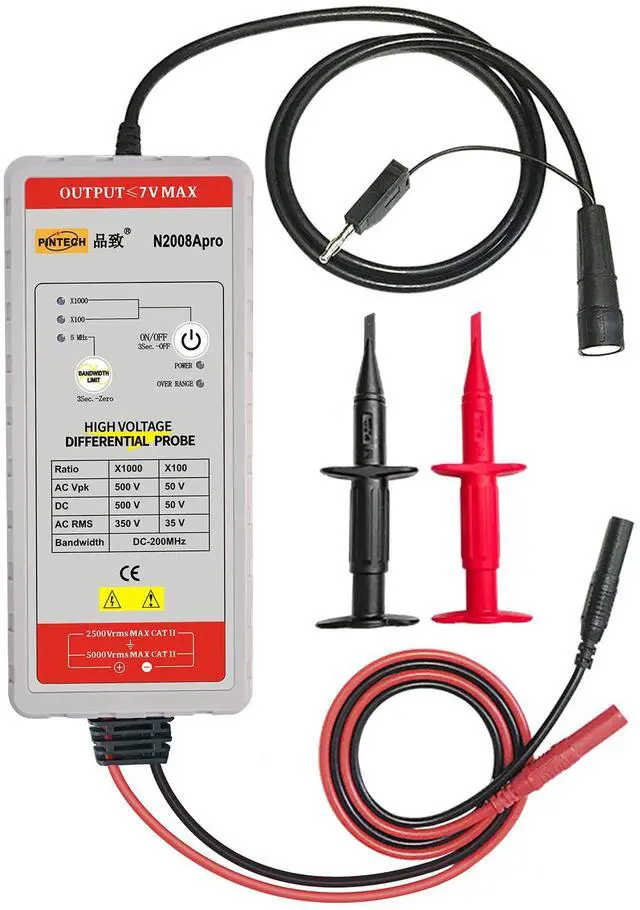



Any questions? Ask CelesteSM will help you find out quickly.
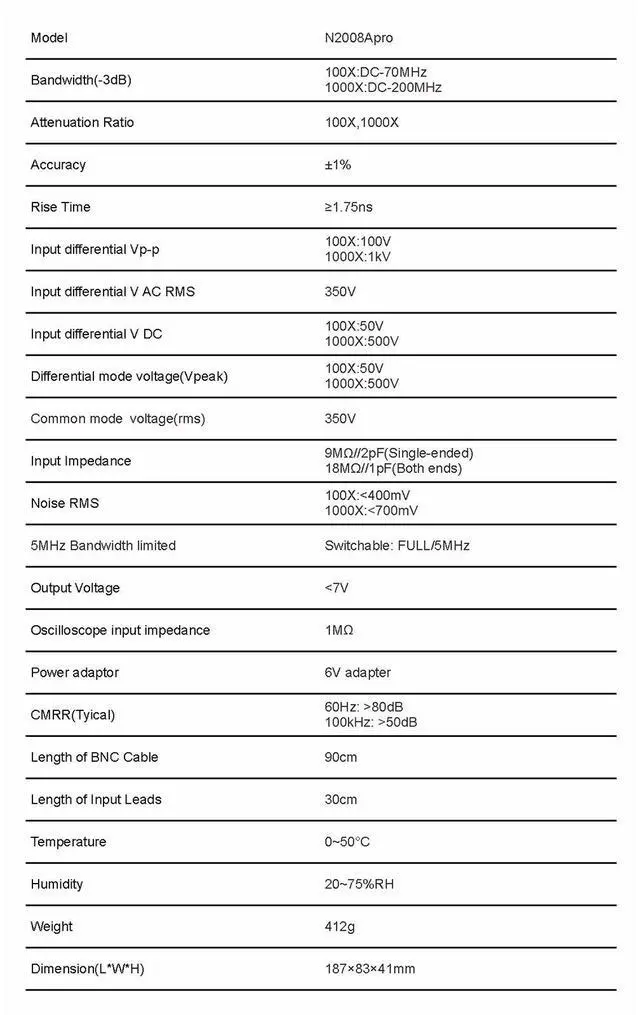
MODEL: N2008Apro
Bandwidth (-3dB): 100X: DC-70MHz; 1000X: DC-200MHz
Input Impedance: Between the two ends: 18M//1pF, Single-ended to ground: 9M//2pF
Attenuation Rate: 1000X/100X
Rising Time: 1.75ns
Output <7V
Accuracy: ±1%(After warming up for 3-5 minutes)
-Offset(typical): <±5mV
Oscilloscope Input Impedance: 1M
5MHz Bandwidth Limited: Yes
CMRR(typical): 60Hz:>80dB; 100kHz:>50dB
Testing Voltage(Vp-p):100X: 100V; 1000X: 1kV
Input DC Voltage: 100X: 50V; 1000X: 500V
Differential-mode voltage(Vp-p):100X: 50V; 1000X: 500V
RMS Value: 350V
Common-mode voltage RMS: 350V
Noise RMS: 100X: <400mV; 1000X: <700mV
Power: 6V Power Adapter
BNC Length: 90 cm/35.43 in
Length of Input Length: 30 cm/11.81 in
Weight: 412g/0.91lb
Dimension(LxWxH): 187x83x41 mm
The PINTECH N2008Apro is a 200MHz high-voltage differential oscilloscope probe kit designed for engineers, technicians, and lab users who need to safely measure floating or high-side signals up to 1kV in motor drives, power electronics, and general circuit testing.
| Attribute | Value |
|---|---|
| Best For | High-voltage differential measurements with oscilloscopes and general electrical testing — suited for lab and field troubleshooting of circuits (including motor circuitry) |
| Model Identifiers | PINTECH N2008Apro |
| Physical | Compact kit size 187×83×41mm |
| Measurement Accuracy & Certifications | Rated accuracy ±1% and CE certified |
| Sales | Sold individually (Each) |
| Product Type | Electrical testing & measuring equipment |
Q: Should I choose the PINTECH N2008Apro or a 100MHz high-voltage differential probe?
A: Choose the PINTECH N2008Apro when you need more headroom for faster edges, switching waveforms, or general-purpose power electronics work and still want 1kV differential capability. Its published rise time is 1.75ns and its top bandwidth is 200MHz in the 1000X range, which gives it more margin than common 100MHz alternatives for observing overshoot and transition detail. A 100MHz probe is still a practical choice when your signals are slower and budget matters more than extra bandwidth.
Q: Is the PINTECH N2008Apro a better fit than a higher-voltage probe like the N2015Apro or N2040Apro?
A: Choose the N2008Apro when 1kV differential range is enough and you want the highest bandwidth in this PINTECH family tier. PINTECH's own selection data shows the N2008Apro at 200MHz, while higher-voltage siblings such as the N2015Apro and N2040Apro trade some bandwidth for 2kV or 4kV capability. If your work includes higher-bus motor drives, larger inverter stages, or more safety margin on voltage, the higher-voltage models are the better match. If your priority is waveform detail at up to 1kV, the N2008Apro is the more performance-focused choice.
Q: Should I buy the PINTECH N2008Apro or a premium brand differential probe from Tektronix or similar vendors?
A: Choose the PINTECH N2008Apro when you want a self-contained BNC differential probe for standard oscilloscopes and your requirement is around 200MHz and 1kV. Community buying discussions often compare lower-cost active differential probes with used or premium-brand options, and one recurring trade-off is that some premium probes may need brand-specific power interfaces or external supplies. A premium model can make more sense when you need deeper ecosystem support, calibration workflows, or much higher bandwidth. For mixed-brand bench use with straightforward BNC compatibility, the N2008Apro is the simpler fit.
Q: For motor drives and inverter testing, is the PINTECH N2008Apro better than a standard passive probe?
A: Yes, if you need to measure floating or non-ground-referenced nodes safely and directly. The N2008Apro is an active differential probe designed to convert a two-point measurement into a ground-referenced oscilloscope signal, which is exactly the use case commonly discussed for motor circuits, mains-derived switching stages, and bridge outputs. A passive probe is still suitable for grounded low-voltage nodes, but it is not the right substitute for true differential high-voltage measurements.
Q: Who is this differential probe most suitable for?
A: This probe is best suited to bench users who need to safely measure floating or high-side signals in power electronics, motor drives, SMPS, inverters, or similar circuits. Its 1000X mode supports up to 1 kV peak-to-peak test voltage, and the BNC output works with standard 1 MΩ oscilloscopes. It is less suitable for basic low-voltage hobby debugging where a standard passive probe is simpler and cheaper.
Q: Is this a good choice for measuring inverter, motor-drive, or switch-mode power signals?
A: Yes, this is a practical fit for inverter, motor-drive, and switch-mode power measurements where the signal is differential and not ground-referenced. The product listing specifically positions it for motor circuits, and differential probes are commonly used for this exact job because they let an oscilloscope read the voltage between two points without tying either point to earth ground. The main limitation is that this model is a 1 kV-class probe, so it is not the right choice for applications that need several kilovolts of headroom.
Q: What are the trade-offs between the 100X and 1000X settings?
A: Use 100X when you need better sensitivity on lower-voltage signals, and use 1000X when you need higher voltage range and the full rated 200 MHz bandwidth. On this model, the listing shows 100X is limited to DC-70 MHz and about 100 Vp-p test voltage, while 1000X extends to DC-200 MHz and about 1 kVp-p. The trade-off is that higher attenuation is safer for larger signals but makes small signals harder to see.
Q: Will this work with my oscilloscope?
A: It should work with most standard oscilloscopes that have a BNC input and 1 MΩ input impedance. The product listing says it uses a BNC interface and specifies 1 MΩ oscilloscope input. You will still need to set the oscilloscope's probe factor correctly, typically 100X or 1000X, so the voltage reading is accurate. It is not a direct fit for meters or scopes that require proprietary smart probes.
Q: Is this better than using two standard passive probes and math subtraction?
A: Usually yes, if you care about safer setup and more reliable differential measurements. A dedicated differential probe is the normal choice for measuring the voltage between two non-ground points because it avoids grounding mistakes and generally gives more objective results than using two single-ended probes with channel subtraction. Two passive probes can work for basic experiments, but matching errors and common-mode noise usually make that approach less dependable.
Q: Who is the PINTECH N2008Apro actually suitable for?
A: It is best suited to users who need a differential probe for high-voltage or floating measurements, especially on power electronics, motor drives, mains-referenced circuits, and SMPS work. It is less suitable as a general-purpose low-voltage probe because its 100X/1000X attenuation greatly reduces small signals at the oscilloscope input.
Q: Is the N2008Apro a good choice if I mainly measure low-voltage signals?
A: Usually no. For mainly low-voltage debugging, a standard 10X passive probe or a lower-attenuation differential probe is often more practical. With 100X or 1000X attenuation, small signals become much smaller at the scope input, which makes low-level measurement harder even though the probe can technically still be used.
Q: Is 200 MHz enough, or is this probe too limited?
A: For many power electronics and general bench measurements, 200 MHz is usually enough. It is a trade-off rather than a universal limit: it fits most motor-control, inverter, and SMPS troubleshooting, but it is not the right tool for very high-frequency RF or fast digital work where bandwidth above 200 MHz is required.
Q: Is this worth buying instead of using normal scope probes for differential measurements?
A: It can be worth buying if you regularly need safe, direct differential measurements on non-ground-referenced or high-voltage nodes. The main value is convenience and safer measurement workflow. The trade-off is that it is more specialized than a normal probe, so it makes the most sense when high-voltage differential measurement is a recurring need rather than an occasional one.



