




 here!
I’m your shopping assistant for PC builds, upgrades, and everything tech.
Got questions? Ask away!
Start a conversation
here!
I’m your shopping assistant for PC builds, upgrades, and everything tech.
Got questions? Ask away!
Start a conversationShipped by GUANGZHOU PINTECH CO LTD

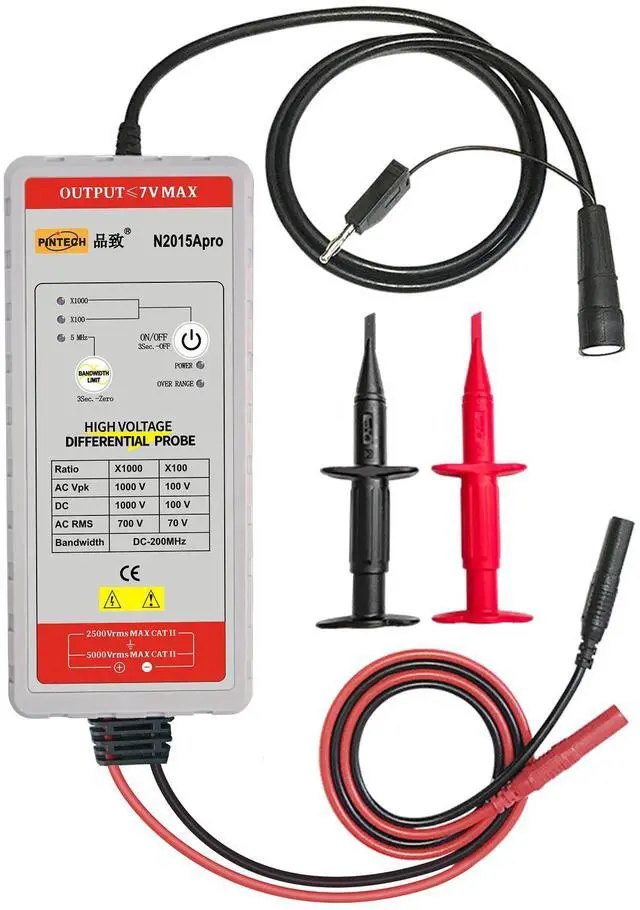



Any questions? Ask CelesteSM will help you find out quickly.
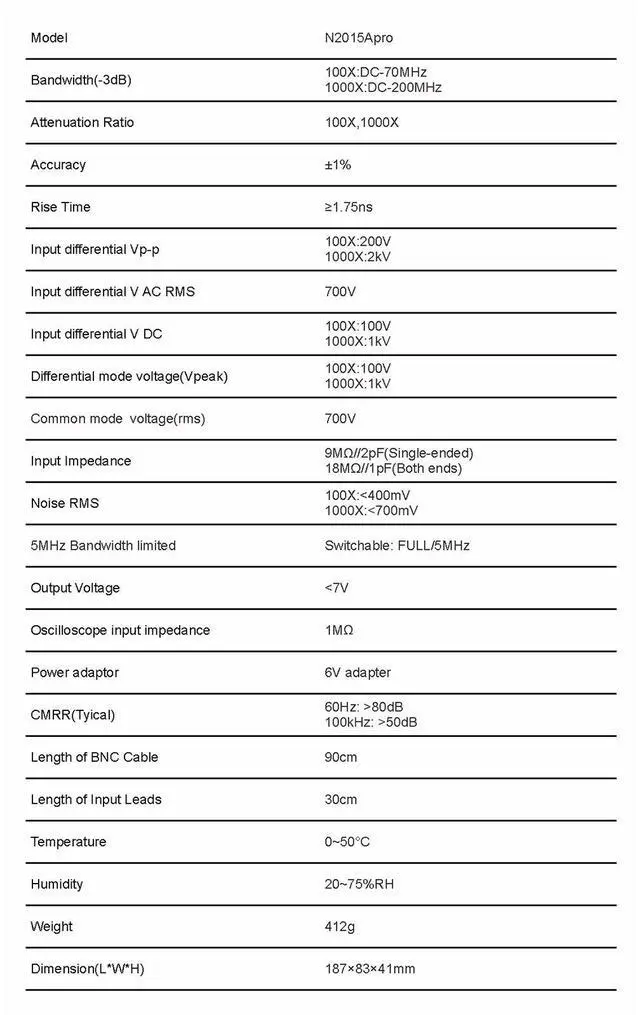
MODEL: N2015Apro
Bandwidth (-3dB): 100X: DC-70MHz; 1000X: DC-200MHz
Input Impedance: Between the two ends: 18M//1pF, Single-ended to ground: 9M//2pF
Attenuation Rate: 1000X/100X
Rising Time: 1.75ns
Output <7V
Accuracy: ±1%(After warming up for 3-5 minutes)
-Offset(typical): <±5mV
Oscilloscope Input Impedance: 1M
5MHz Bandwidth Limited:Yes
CMRR(typical): 60Hz:>80dB; 100kHz:>50dB
Testing Voltage(Vp-p):100X: 200V; 1000X: 2kV
Input DC Voltage: 100X: 100V; 1000X: 1kV
Differential-mode voltage(Vp-p):100X: 100V; 1000X: 1kV
RMS Value: 700V
Common-mode voltage RMS: 700V
Noise RMS: 100X: <400mV; 1000X: <700mV
Power Supply: 6V Power Adapter
BNC Length: 90 cm/35.43 in
Length of Input Length: 30 cm/11.81 in
Weight: 425g/0.94lb
Dimension(LxWxH): 187x83x41 mm
The PINTECH N2015Apro is a 200MHz high-voltage differential oscilloscope probe kit for engineers, technicians, and lab users who need to measure up to 2kV differential signals with ±1% accuracy on standard BNC-equipped oscilloscopes.
| Attribute | Value |
|---|---|
| Best For | Measuring differential two-point signals with oscilloscopes, meters, and data-acquisition equipment; commonly used for motor-circuit testing and general electrical testing |
| Model Identifiers | PINTECH N2015Apro differential probe (electrical testing & measuring) |
| Physical Dimensions | 187 x 83 x 41 mm overall dimensions |
| Accuracy And Measurement | ±1% stated measurement accuracy |
| Selling Info | Sold individually (each) |
Q: Should I choose the PINTECH N2015Apro or a 100MHz differential probe for power electronics work?
A: Choose the PINTECH N2015Apro if you need more headroom for fast switching edges or want a 1000X mode that extends to 200MHz. Official specs show the N2015Apro runs at DC-200MHz in 1000X mode, while many common 100MHz alternatives target lower bandwidth. A 100MHz probe is still a practical fit for slower power supply, inverter, and mains-related measurements where the extra bandwidth is not necessary.
Q: Is the PINTECH N2015Apro better than a 100X-only high-voltage probe?
A: The N2015Apro is the better choice when you want flexibility between higher sensitivity and higher voltage range. Its 100X and 1000X settings let you trade measurement sensitivity for voltage capability, which is useful across mixed bench work. A fixed 100X probe can be simpler for repeated measurements in one range, but it does not adapt as easily when your work spans both lower-voltage and higher-voltage nodes.
Q: Should I buy the PINTECH N2015Apro or move up to a premium Tektronix differential probe?
A: Choose the N2015Apro if you want standard BNC compatibility and a 200MHz, 2kV class differential probe without stepping into premium-brand pricing and ecosystem requirements. Move up to Tektronix if you prioritize premium accessory support, broader instrument integration, and stronger safety-positioning from the manufacturer. Community discussions also commonly associate premium probes with better noise and CMRR expectations, which matters more in demanding lab environments than in general troubleshooting.
Q: Is the PINTECH N2015Apro a better fit than a low-voltage differential probe for ripple or shunt measurements?
A: No. The N2015Apro is the better fit for floating, high-voltage, or mains-referenced measurements, not for very small-signal differential work. Its 100X and 1000X attenuation are useful for protecting the scope and extending voltage range, but they reduce effective sensitivity on low-level signals. If your main job is measuring small ripple, shunt voltage, or other millivolt-scale signals, a lower-attenuation differential probe is usually the more practical choice.
Q: Should I choose the PINTECH N2015Apro or a newer Micsig-style differential probe?
A: Choose the N2015Apro if you want a straightforward BNC-connected probe with familiar 100X/1000X operation and published 2kV-class capability. A newer Micsig-style option makes more sense if you are specifically shopping for lower published noise, updated product families, or a wider spread of voltage and bandwidth variants. Review and community content around Micsig often focuses on noise, waveform clarity, and side-by-side testing, so that route is more attractive when comparison-tested signal fidelity is a top buying factor.
Q: Who is this differential probe best suited for?
A: This probe is best suited for bench engineers, power electronics work, motor-drive testing, and other floating high-voltage measurements where a standard ground-referenced passive probe is not appropriate. It is a better fit for users who need differential measurement capability, up to 2 kV peak-to-peak in 1000X mode, than for casual low-voltage oscilloscope use.
Q: Will it work with my oscilloscope?
A: Usually yes, if your oscilloscope has a standard BNC input and supports setting the probe factor correctly. The product uses a BNC interface and is described as compatible with all oscilloscopes, but in practice you still need a scope input that matches the probe's expected 1 MΩ environment and lets you set 100X or 1000X attenuation so voltage readings scale correctly.
Q: Is the 1000X/100X switch actually useful, or can I leave it in one mode?
A: The dual attenuation is useful because it gives a trade-off between voltage range and signal detail. The 1000X mode is the right choice for higher-voltage work and the full 200 MHz bandwidth, while the 100X mode is better when you need more vertical sensitivity on lower-voltage differential signals, but it has a lower stated bandwidth and lower voltage limit. If you test a mix of power and control signals, the switchable modes are a practical advantage.
Q: Is this a good choice for inverter, motor-drive, or switching power supply work?
A: Yes, that is one of the strongest fits for this model. Differential probes are commonly chosen for motor speed controls, power supply design, and high-power converter measurements, and this PINTECH model is specifically positioned for motor circuits. Its differential measurement approach is more appropriate than a standard passive probe when you need to measure across two non-ground points safely and cleanly.
Q: What are the main trade-offs versus a simpler passive high-voltage probe?
A: The main advantage is that this probe measures the voltage difference between two points without forcing one side to oscilloscope ground, which is important for floating or non-ground-referenced circuits. The trade-offs are higher cost, added setup, and the need to manage attenuation and warm-up/zeroing correctly. A simpler passive high-voltage probe is usually cheaper and fine for ground-referenced measurements, but it is less suitable for true differential measurements in power electronics.
Q: Who is this differential probe kit actually suitable for?
A: This probe is best suited to users who need to measure floating or high-side voltages that a standard earth-referenced oscilloscope probe should not touch directly, such as power electronics, motor drives, and SMPS primary-side nodes. Based on its 200 MHz bandwidth, 2 kV rating, and 100X/1000X attenuation options, it is more appropriate for bench troubleshooting and design work on higher-voltage circuits than for basic low-voltage digital debugging.
Q: Is this a good choice if I mainly work on low-voltage logic signals?
A: Usually no. If your main work is low-voltage logic or bus signals with limited common-mode voltage, a standard probe setup, two-channel subtraction, or a logic analyzer is often the more practical choice. This probe makes more sense when isolation from scope ground and high common-mode voltage handling are part of the measurement problem.
Q: Is it worth buying instead of relying on regular scope probes?
A: It is worth buying if you regularly need safe differential measurements on non-ground-referenced or high-voltage circuits. The main benefit is avoiding the grounding limitations of a normal oscilloscope probe. The trade-off is that a differential probe is a more specialized tool, and users in community discussions often treat it as something to buy for specific power or high-side work rather than as an everyday default probe.
Q: What are the main trade-offs of this probe kit?
A: The main trade-offs are specialization and potential noise versus measurement safety and flexibility. Community discussions around high-voltage differential probes commonly raise noise floor, common-mode rejection, and whether the job really requires a true differential probe. In return, this model offers fast rise-time support, up to 200 MHz bandwidth, and 100X/1000X attenuation for higher-voltage measurements that are not suitable for a basic passive probe.
Q: Is this a practical option for motor drives and SMPS work?
A: Yes. Based on the product specs and the types of use cases repeated in Reddit discussions, this probe is a practical fit for motor circuits, switch-mode power supply primary-side work, and other differential high-voltage measurements where scope ground would otherwise be a problem. It is a better fit for those applications than for general-purpose everyday probing.



