




 here!
I’m your shopping assistant for PC builds, upgrades, and everything tech.
Got questions? Ask away!
Start a conversation
here!
I’m your shopping assistant for PC builds, upgrades, and everything tech.
Got questions? Ask away!
Start a conversationShipped by GUANGZHOU PINTECH CO LTD




Any questions? Ask CelesteSM will help you find out quickly.
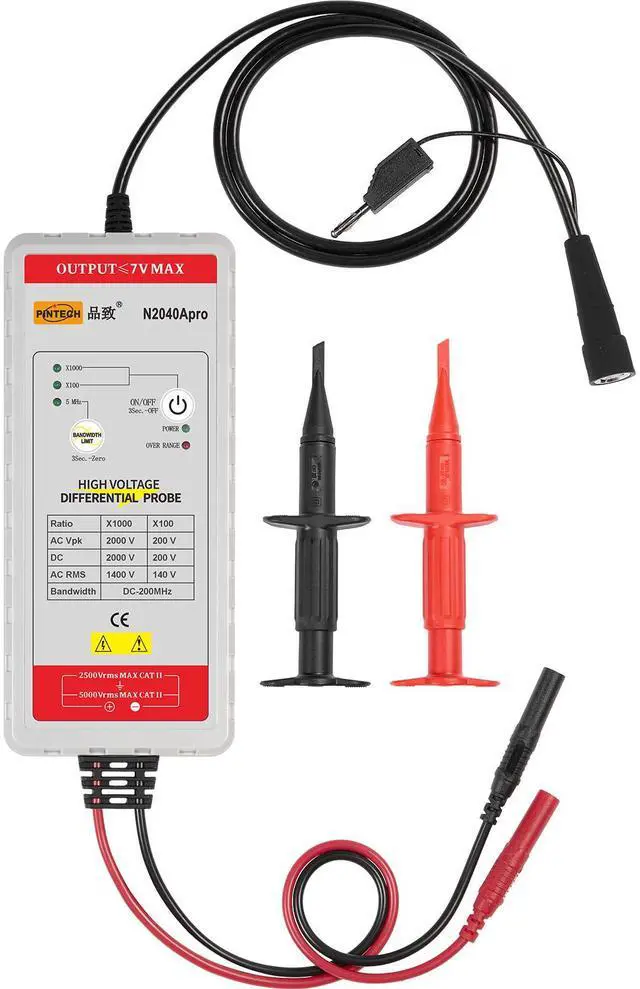
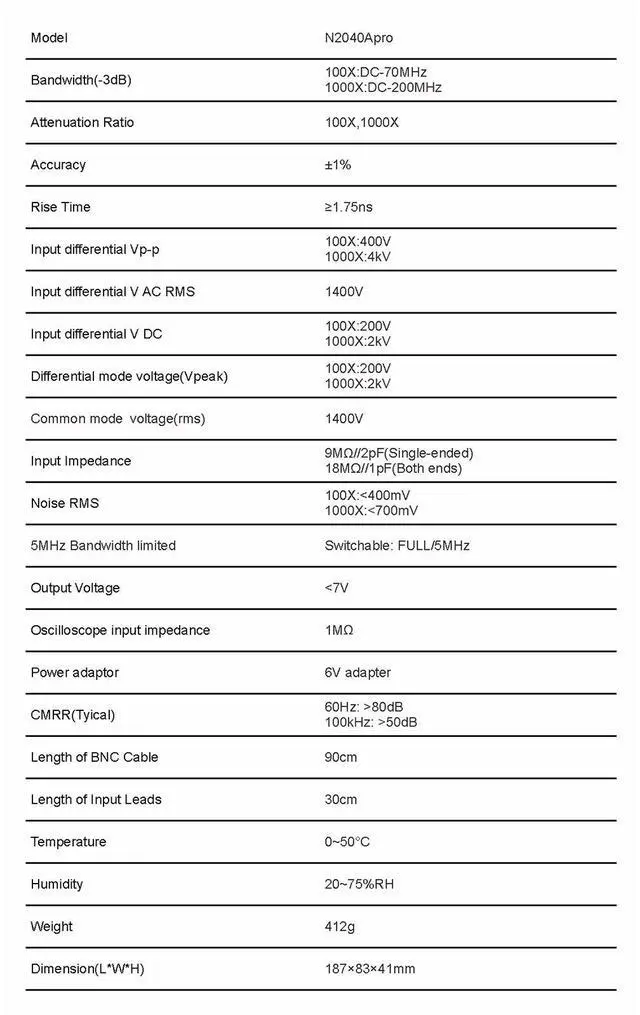
MODEL: N2040Apro
Bandwidth (-3dB): 100X: DC-70MHz; 1000X: DC-200MHz
Input Impedance: Between the two ends: 18M//1pF, Single-ended to ground: 9M//2pF
Attenuation Rate: 1000X/100X
Rising Time: 1.75ns
Output <7V
Accuracy: ±1%(After 3-5 minutes of warm-up)
-Offset(typical): <±5mV
Oscilloscope Input Impedance: 1M
5MHz Bandwidth Limited:YES
CMRR(typical): 60Hz:>80dB; 100kHz:>50dB
Testing Voltage(Vp-p):100X: 400V; 1000X: 4kV
Input DC Voltage: 100X: 200V; 1000X: 2kV
Differential-mode voltage(Vp-p):100X: 200V; 1000X: 2kV
RMS Value: 1400V
Common-mode voltage RMS: 1400V
Noise RMS: 100X: <400mV; 1000X: <700mV
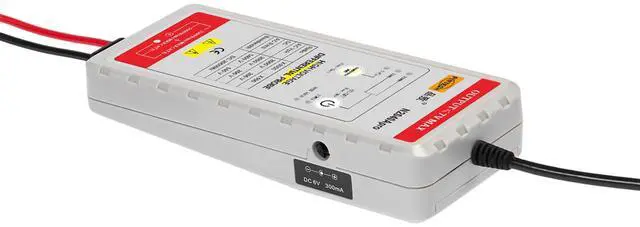
Power Supply: 6V Power Adapter
BNC Length: 90 cm/35.43 in
Length of Input Length: 30 cm/11.81 in
Weight: 425g/0.94lb
Dimension(LxWxH): 187x83x41 mm
The PINTECH N2040Apro is a 200MHz high-voltage differential oscilloscope probe kit designed for engineers, technicians, and advanced electronics users who need to safely measure floating or differential signals up to 4kV in motor drives, power electronics, and general circuit testing.
| Attribute | Value |
|---|---|
| Best For | Converting two-point differential signals for use with oscilloscopes, meters, and data-acquisition equipment; commonly used for testing motor and similar electrical circuits |
| Model Identifiers | PINTECH N2040Apro (electrical testing & measuring) |
| Physical Dimensions | 187 x 83 x 41 mm (product dimensions) |
| Accuracy | ±1% measurement accuracy |
| Selling Unit | Sold as each unit |
Q: Should I choose the PINTECH N2040Apro or a 100MHz high-voltage differential probe?
A: Choose the PINTECH N2040Apro when you need more headroom for fast switching edges, ringing, and higher-frequency content in power electronics. Its official positioning is a 200MHz differential probe with 100X and 1000X ranges and up to 4kVp-p capability, which is a step above many entry 100MHz differential probes aimed at lower-bandwidth work. A 100MHz model is usually the better fit when your measurements are mainly lower-frequency mains, inverter, or general service work and cost matters more than waveform detail at fast edges.
Q: Is the PINTECH N2040Apro a better fit than a lower-voltage 700V to 1500V differential probe?
A: The N2040Apro is the better choice when your work regularly includes higher bus voltages, floating measurements, or extra safety margin for motor drives, power converters, and similar circuits. Official specs place it at 4kVp-p with 100X and 1000X attenuation, while many lower-tier probes are positioned around 700V to 1500V ranges. A lower-voltage probe is still a practical choice for bench-level power supplies and lower-energy designs where that extra voltage range is not needed.
Q: Should I buy the PINTECH N2040Apro or move up to a 300MHz to 500MHz differential probe?
A: Choose the N2040Apro if your oscilloscope work is centered on mainstream power electronics, motor control, inverter outputs, and general high-voltage differential measurements. A higher-bandwidth 300MHz to 500MHz probe becomes the better fit when you need more accurate capture of very fast transitions, lower input capacitance in newer premium designs, or closer work on high-speed switching behavior. In short, the N2040Apro fits performance-first power debugging, while higher-tier probes fit more demanding edge-fidelity work.
Q: How does the PINTECH N2040Apro compare with portable entry-level differential probes for field use?
A: The N2040Apro makes more sense when measurement capability matters more than compactness, especially if you want 200MHz bandwidth, dual attenuation options, and higher-voltage coverage in one probe. Smaller entry-level probes can be easier to carry and sufficient for occasional troubleshooting, but they are commonly positioned with lower bandwidth or lower voltage range. If your measurements involve motor drives or higher-energy switching nodes, the N2040Apro is the more capable choice.
Q: Should I choose the PINTECH N2040Apro instead of a premium Tektronix-style differential probe?
A: Choose the N2040Apro when you want a standard BNC-compatible high-voltage differential probe for broad oscilloscope compatibility and solid bandwidth-voltage coverage without moving into premium specialized probe platforms. Premium Tektronix options are positioned for deeper integration with supported scopes and, in some families, more advanced isolation or specialized high-performance measurement goals. The trade-off is straightforward: N2040Apro favors broad compatibility and practical lab use, while premium probe systems favor advanced measurement workflows and instrument integration.
Q: Who is this differential probe most suitable for?
A: This probe is best suited for engineers, technicians, and advanced users who need to measure high-voltage differential signals on power electronics, motor drives, switching supplies, or other non-ground-referenced circuits. It is less suitable for basic bench debugging where a standard passive probe is enough. Its 200 MHz bandwidth, differential measurement design, and up to 4 kV peak-to-peak test voltage rating make it more relevant for floating and higher-voltage measurements than for entry-level oscilloscope use.
Q: Can I use this with any oscilloscope that has a BNC input?
A: Usually yes, but only if the oscilloscope has a 1 MΩ input and can accept the probe's output safely. The product page says it uses a BNC interface and specifies a 1 MΩ oscilloscope input, so physical connection is broad, but measurement accuracy and attenuation readout may still vary by scope. This is a practical fit for many general-purpose oscilloscopes, but it is not the same as full manufacturer-matched integration.
Q: Is this a better choice than using two standard passive probes and scope math?
A: Yes, if you need safer and cleaner differential measurements on floating or high-voltage nodes. A true differential probe is designed to measure the voltage difference between two points without tying oscilloscope ground directly into the circuit. Compared with two passive probes plus A-B math, it is generally the better choice for power electronics and motor-control work, though it costs more and is more specialized.
Q: What are the main trade-offs of this 200 MHz high-voltage probe versus a premium brand alternative?
A: The main advantage is value: this PINTECH model offers 200 MHz bandwidth, 100X/1000X attenuation, and up to 4 kV peak-to-peak test voltage at a much lower price than premium branded 200 MHz differential probes. The trade-offs are likely to be ecosystem integration, accessory depth, formal compatibility guidance, and brand-specific support. Buyers who want strong performance-per-dollar may find it attractive, while labs that prioritize tightly validated scope-probe pairing may prefer a manufacturer-matched model.
Q: Is this overkill for low-voltage everyday electronics work?
A: For many low-voltage bench tasks, yes. If you mainly test grounded, lower-voltage signals, a standard passive probe is simpler and usually more economical. This model makes more sense when you specifically need differential measurement, high common-mode tolerance, or higher-voltage capability. Its strengths are not office-style convenience or general hobby use, but handling measurement cases where ordinary probes are a poor fit.
Q: Who is the PINTECH N2040Apro best suited for?
A: It is best suited for users who need to measure high-voltage, non-ground-referenced, or differential signals on a standard oscilloscope. Based on repeated Reddit and YouTube discussion, that mainly means power electronics, motor drives, switch-mode power supplies, inverters, and similar work where a normal ground-referenced probe is unsafe or inadequate. It is less suitable as a general-purpose replacement for standard passive probes.
Q: Is the N2040Apro worth buying if I work on power electronics or motor circuits?
A: Yes, if your main need is safely viewing floating or high-voltage differential signals with up to 200 MHz bandwidth and up to 4 kV peak-to-peak input at 1000X attenuation. The main reason to buy it is capability: it solves measurement problems that standard passive probes and scope math often do not solve safely or cleanly. It is less compelling if your work is mostly low-voltage, ground-referenced debugging.
Q: Can the N2040Apro replace using two oscilloscope channels in math difference mode?
A: Usually yes for this use case, and often more appropriately. Community discussion repeatedly treats a true differential probe as the better choice when measuring high common-mode voltage or floating nodes, because it is designed for that job directly rather than relying on two single-ended channels and subtraction. The trade-off is cost and specialization: a differential probe is more expensive than using channels you already have.
Q: What are the main trade-offs of the N2040Apro?
A: The main trade-off is specialization versus convenience. Its strengths are high-voltage differential measurement, 200 MHz bandwidth, and compatibility with standard BNC-input oscilloscopes. Its limitations are the usual ones discussed by users considering differential probes: it is not the most economical choice for routine low-voltage bench work, and the 100X/1000X attenuation modes make it better for larger signals than for very small-signal measurements where maximizing sensitivity matters.
Q: Is the N2040Apro a good choice for low-voltage everyday oscilloscope work?
A: Not usually. It can measure low voltage, but the product’s 100X and 1000X attenuation modes and high-voltage design make it a more natural fit for higher-voltage differential work than for everyday low-level probing. If most of your tasks are standard ground-referenced signals, a regular passive or lower-attenuation active probe is usually the more practical choice.



