




 here!
I’m your shopping assistant for PC builds, upgrades, and everything tech.
Got questions? Ask away!
Start a conversation
here!
I’m your shopping assistant for PC builds, upgrades, and everything tech.
Got questions? Ask away!
Start a conversationShipped by GUANGZHOU PINTECH CO LTD




Any questions? Ask CelesteSM will help you find out quickly.
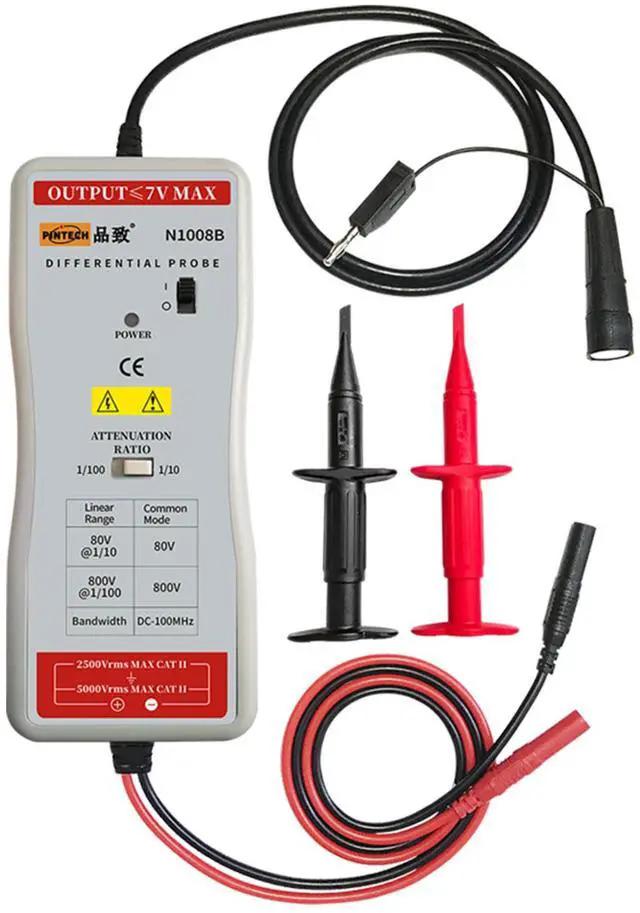
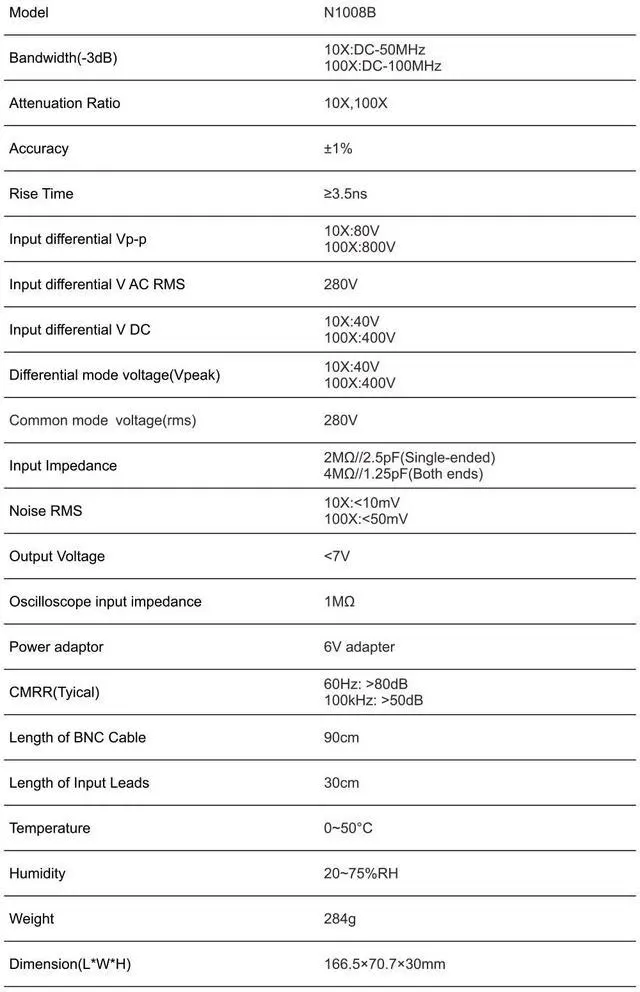
MODEL: N1008B
Bandwidth (-3dB): 10X: DC-50MHz; 100X: DC-100MHz
Output(into 50k load):<7V
Offset(typical):<±5mV
Attenuation Rate: 10X/100X
Rising Time: 3.5ns
Accuracy: ±1%
Input Impedance: Between the two ends: 4M//1.25pF, Single-ended to ground: 2M//2.5pF
Oscilloscope Input Impedance: 1M
CMRR: 60Hz:>80dB; 100kHz:>50dB
Testing Voltage(Vp-p): 10X: 80V; 100X: 800V
Input DC Voltage: 10X: 40V; 100X: 400V
Differential-mode voltage(Vp-p):10X: 40V; 100X: 400V
RMS Value: 280V
Common-mode voltage RMS: 280V
Noise RMS: 10X: <10mV; 100X: <50mV
Weight: 284g/0.63lb
Dimension(LxWxH): 166.5x70.7x30 mm
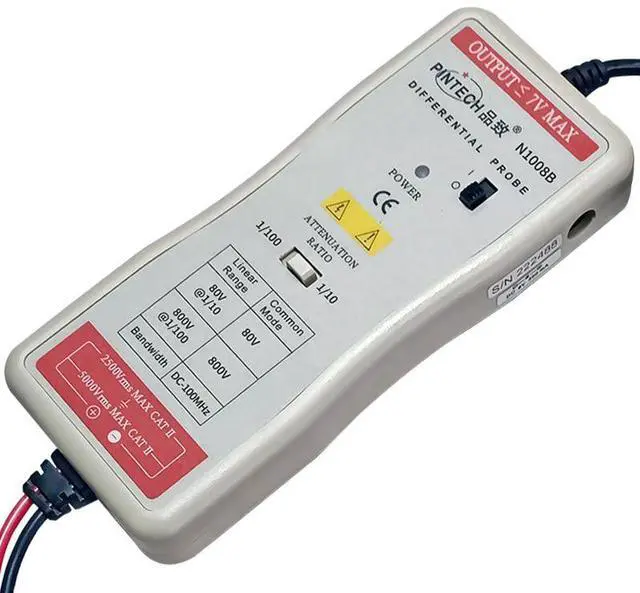
The PINTECH N1008B is a 100MHz high-voltage differential oscilloscope probe with 10X/100X attenuation and a standard BNC interface, suited for engineers, technicians, and lab users who need to measure differential signals up to 800Vp-p on compatible oscilloscopes.
| Attribute | Value |
|---|---|
| Best For | Differential-signal measurements and general electrical test & measurement tasks; intended to be used with oscilloscopes for comparative/diagnostic signal measurements |
| Model Identifiers | PINTECH N1108B differential probe model identifier |
| Product Type | Electrical Testing & Measuring instrument |
| Accuracy | ±1% measurement accuracy |
| Physical | External size 166.5 x 70.7 x 30 mm for bench or portable use |
| Standards And Certifications | CE certified |
| Selling Unit | Each |
Q: Should I choose the PINTECH N1008B or a typical 50MHz, 800V differential probe?
A: Choose the PINTECH N1008B when you need more headroom for faster edges and switching waveforms while staying in the 800V class. Official specs place the N1008B at 100MHz bandwidth, 3.5ns rise time, 10X/100X attenuation, and ±1% typical accuracy. Many competing 800V probes in the same general tier, such as Siglent DPB4080-class models, are positioned at 50MHz. A 50MHz alternative is still reasonable for lower-frequency power work, but the N1008B is the better fit when waveform detail above a few tens of MHz matters.
Q: Is the N1008B better than using two standard passive probes and scope math for differential measurements?
A: Choose the N1008B when you need a purpose-built differential measurement on floating or high-side nodes. Community discussions consistently note that two passive probes plus A-B math can work for simple cases, but it uses two channels and is less precise for small differential signals riding on common-mode voltage. The N1008B is designed as an active differential probe with standard BNC compatibility, so it is the better choice when measurement integrity and convenience matter more than minimizing tool cost.
Q: Should I buy the N1008B or a higher-voltage differential probe like a 1.5kV to 7kV model?
A: Choose the N1008B for lower-voltage work where 800Vp-p coverage and 100MHz bandwidth are the priority. Move to a higher-voltage probe when your application involves larger DC buses, mains-related transients, or extra safety margin beyond the N1008B's 800Vp-p class. Higher-voltage probes are officially positioned for power electronics and high-energy measurement, but that added range often comes with different size, cost, and sometimes lower bandwidth in comparable product families.
Q: For low-voltage signal work, should I use the N1008B in 10X mode or pick a higher-attenuation probe instead?
A: Choose the N1008B when you want flexibility across both lower-voltage and higher-voltage measurements, because its 10X and 100X settings let you trade range for signal amplitude. Community guidance around probe attenuation shows lower attenuation is more practical when signals are modest and you want better on-screen sensitivity, while higher attenuation is preferred when voltage could overload the scope front end. That makes the N1008B a practical choice if your work spans both conditions instead of staying only in high-voltage ranges.
Q: Should I choose the N1008B or a more portable passive probe setup?
A: Choose the N1008B when the job requires safe, direct differential measurement with standard BNC scope compatibility. A passive probe setup is simpler to carry and may be enough for ground-referenced signals, but it is not the same tool category and does not replace an active high-voltage differential probe for floating measurements. The N1008B is still relatively compact for a powered differential probe, so it fits users who want portability without giving up dedicated differential capability.
Q: Who is this differential probe suitable for?
A: This probe is best for bench technicians, electronics engineers, and repair users who need to measure floating or non-ground-referenced signals on a standard oscilloscope. A 100 MHz differential probe is commonly used for power electronics, switch-mode power supplies, motor drives, and other floating-circuit checks. It is less suitable if you only measure simple ground-referenced low-voltage signals, because a standard passive probe is usually cheaper and simpler for that job.
Q: Will it work with my oscilloscope?
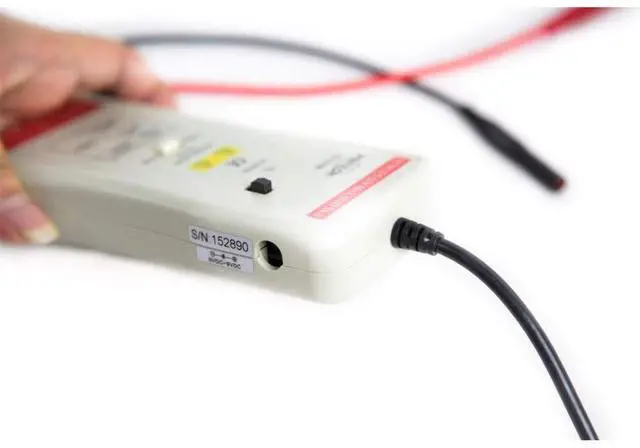
A: Usually yes, if your oscilloscope accepts a standard BNC probe input with 1 MΩ input impedance. This model is sold with a standard BNC interface and is described as compatible with all oscilloscopes, which makes it easier to use across mixed-brand benches than probes that require a proprietary interface. The trade-off is that you do not get the automatic probe recognition and deeper integration that some vendor-specific differential probes offer.
Q: Is 800 V enough for my work, or should I choose a higher-voltage probe?
A: Buy this model if your actual differential measurement stays comfortably within its rated range. The listing shows 800 Vp-p at 100X, with lower limits at 10X, so it fits lower-voltage floating measurements better than industrial high-energy work. If you regularly test mains, inverter, or motor-drive circuits with higher common-mode or peak voltage, a higher-voltage differential probe is the safer choice. In short: this model is better for lower-voltage lab and service work than for heavy high-voltage power applications.
Q: Is this a good choice for fast switching signals and power electronics debugging?
A: Yes, for general power electronics debugging, it is a practical fit. The product data lists up to 100 MHz bandwidth at 100X and 3.5 ns rise time, which is enough for many switching power supply and inverter waveforms. The main trade-off is that it is an entry-to-midrange differential probe, not a high-end model for very fast edges, very high common-mode voltage, or the lowest possible loading and noise.
Q: What are the main trade-offs versus a brand-specific differential probe from Siglent or Teledyne LeCroy?
A: The main advantage of this PINTECH model is flexibility: it uses a standard BNC connection and selectable 10X/100X attenuation, so it can be easier to use across different oscilloscopes. The main trade-offs are integration and headroom. Brand-specific probes often offer stronger oscilloscope integration, automatic recognition, and higher voltage or performance options. Choose this PINTECH model if cross-scope compatibility and moderate-voltage differential work matter most; choose a vendor-specific probe if you need deeper scope integration or substantially higher safety and measurement range.
Q: Who is this differential probe suitable for?
A: This probe is best suited to users who need isolated differential measurements on a bench oscilloscope, especially for power electronics, mains-referenced circuits, inverter work, and floating-node measurements. Its 100 MHz bandwidth and 10X/100X attenuation make more sense for troubleshooting switching waveforms and moderate-speed signals than for very small low-level signals.
Q: Is this a better choice than using two scope channels in math/difference mode?
A: Usually yes if the job involves floating or high-common-mode measurements. A dedicated differential probe is the safer and more practical choice because it is designed for differential measurements directly, while two-channel subtraction depends more on channel matching and scope setup. If you only measure low-voltage ground-referenced signals, two channels may be enough, but this probe is the better tool for repeatable differential work.
Q: Is it worth buying for low-voltage measurements?
A: Only if you specifically need differential isolation. For general low-voltage work, this is usually more probe than necessary. The product is rated up to 800 Vp-p and uses 10X/100X attenuation, so it is better aligned with higher-voltage or floating measurements than maximizing sensitivity on small signals. For low-level ripple or very small differential signals, the attenuation trade-off can make measurement resolution less convenient.
Q: What are the main trade-offs of this probe?
A: The main trade-off is capability versus sensitivity. You get safer differential measurement, 100 MHz bandwidth, and compatibility with standard BNC-input oscilloscopes, but in exchange you work through 10X or 100X attenuation and a product positioned around higher-voltage differential use. That makes it less ideal when your priority is the easiest possible viewing of very small signals.



