




 here!
I’m your shopping assistant for PC builds, upgrades, and everything tech.
Got questions? Ask away!
Start a conversation
here!
I’m your shopping assistant for PC builds, upgrades, and everything tech.
Got questions? Ask away!
Start a conversationShipped by GUANGZHOU PINTECH CO LTD




Any questions? Ask CelesteSM will help you find out quickly.
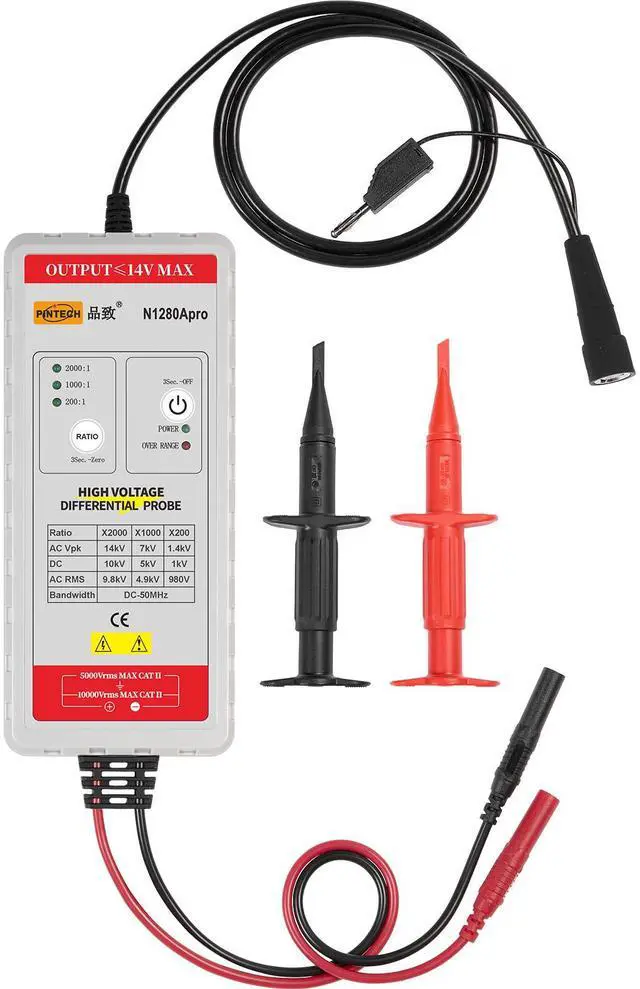
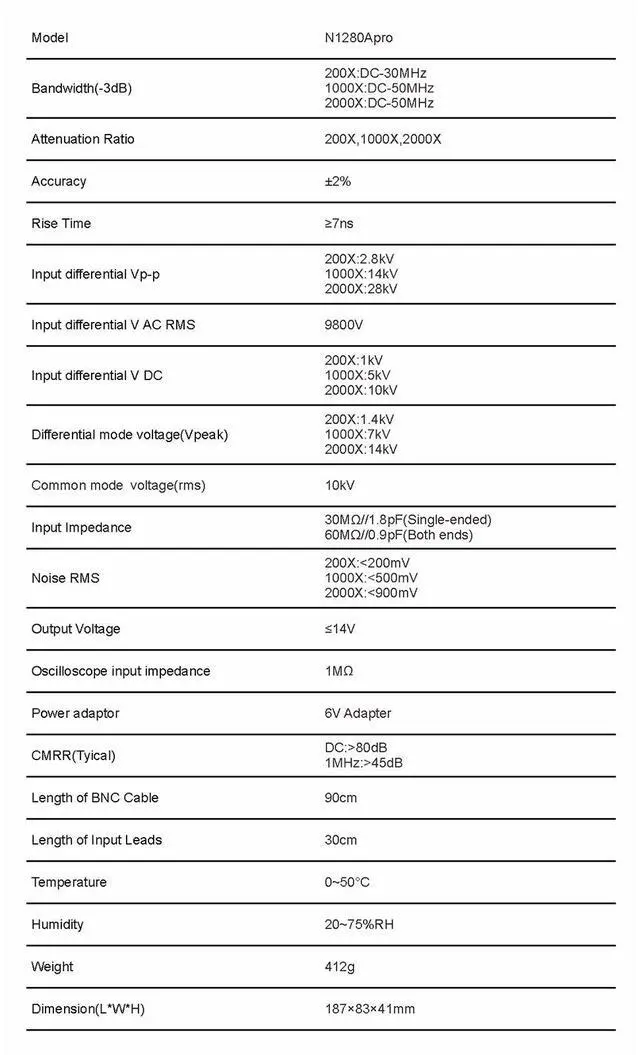
MODEL: N1280Apro
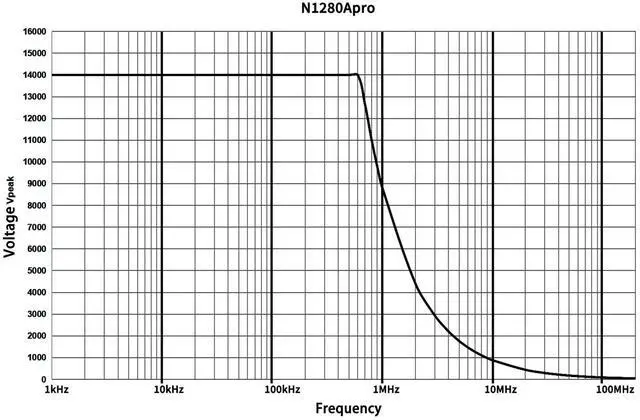
Bandwidth (-3dB): 200X: DC-30MHz; 1000X: DC-50MHz; 2000X: DC-50MHz;
Attenuation Rate: 200X/1000X/2000X
Accuracy(Guaranteed value): ±2%(After warming up for 3-5 minutes)
Accuracy(Typical value): ±1%(After warming up for 3-5 minutes)
-Offset(typical): <±5mV
Rising Time: 7ns
Testing Vp-p: 200X: 2.8kV; 1000X: 14kV; 2000X: 28kV;
Input DC Voltage: 200X: 1kV; 1000X: 5kV; 2000X: 10kV;
Differential-mode voltage(Vp-p): 200X: 1.4kV; 1000X: 7kV; 2000X: 14kV;
Input Impedance: Between the two ends: 60M//0.9pF, Single-ended to ground: 30M//1.8pF
Common Mode Voltage: 10kV RMS RMS Value: 9800V
Noise RMS: 200X: <200mV; 1000X: <500mV; 2000X: <900mV
Output 14Vp-p
Oscilloscope Input Impedance: 1M
CMRR(typical): 60Hz:>80dB,100kHz:>50dB
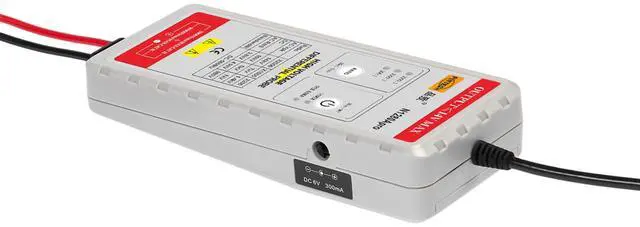
External (Optional): 6V DC/300mA mains adaptor
BNC Length: 90 cm/35.43 in
Length of Input Length: 30 cm/11.81 in
Weight: 412g/0.91lb
Dimension(LxWxH): 187x83x41 mm
The PINTECH N1280Apro is a high-voltage differential oscilloscope probe kit built for engineers, technicians, and lab users who need to safely measure floating or high-potential signals up to 28 kVp-p, with DC-50MHz bandwidth and selectable 200X, 1000X, or 2000X attenuation.
| Attribute | Value |
|---|---|
| Best For | High-voltage differential oscilloscope measurements and electrical testing, including two-point-to-ground signal conversion and troubleshooting of motor and power circuits |
| Product Type | Electrical testing & measuring differential probe (active differential probe for use with oscilloscopes and data acquisition equipment) |
| Model Identifiers | PINTECH N1280Apro |
| Physical Dimensions | 187 x 83 x 41 mm enclosure size |
| Accuracy And Certifications | ±2% accuracy; CE certified |
| Selling Information | Sold individually (Each) |
Q: Should I choose the PINTECH N1280Apro or a 100 MHz differential probe for power electronics work?
A: Choose the PINTECH N1280Apro when your priority is high-voltage headroom rather than higher-frequency detail. Official specs position the N1280Apro as a 50 MHz class high-voltage differential probe with 200X, 1000X, and 2000X attenuation and up to 28 kVp-p capability, which fits inverter, motor drive, and other high-energy measurements. A typical 100 MHz differential probe gives more bandwidth and faster rise time, but many common models are limited to much lower maximum differential voltage, often around 1300 V to 1500 V. If your signals are below those voltage limits and you need cleaner visibility on faster edges, a 100 MHz model is usually the better fit. If your measurements involve substantially higher voltage, the N1280Apro is the more appropriate choice.
Q: Is the PINTECH N1280Apro a better fit than a lower-voltage 50 MHz differential probe?
A: The N1280Apro is the better fit when you need a 50 MHz probe but your measurement voltage can exceed the range of mainstream lower-voltage models. Its official positioning emphasizes very high differential and common-mode capability with multiple high-attenuation settings. A lower-voltage 50 MHz probe can be more suitable for bench work on lower-voltage switching supplies because it may offer lower attenuation ranges and, in some models, less input-referred noise at modest voltages. The trade-off is straightforward: choose the N1280Apro for voltage margin, and choose a lower-voltage 50 MHz probe when the signal is safely within range and you want more sensitivity on smaller signals.
Q: Should I buy the PINTECH N1280Apro or step up to a premium Tektronix high-voltage differential probe?
A: Choose the N1280Apro when you need a BNC-compatible high-voltage differential probe focused on broad oscilloscope compatibility and extreme voltage range. Step up to a premium Tektronix model when your priority is lab-grade documentation, ecosystem integration, and higher-end safety and accessory support. Tektronix positions its high-voltage differential probes around stronger certification claims, extensive accessory options, and premium pricing, with many models costing several thousand dollars. The practical decision is that the N1280Apro fits buyers who primarily need high-voltage measurement capability, while a premium Tektronix probe fits organizations that value brand-standard workflows, support infrastructure, and formal qualification requirements.
Q: For mains-side and floating measurements, should I use the PINTECH N1280Apro or rely on an isolation transformer with standard probes?
A: Use the N1280Apro when you want a purpose-built differential measurement method for non-ground-referenced high-voltage points. Official guidance from major oscilloscope vendors consistently describes high-voltage differential probes as the appropriate tool for floating or isolated measurements, especially where common-mode rejection and safety are part of the requirement. Community discussions also commonly treat a differential probe as the cleaner and more direct approach than workarounds with standard probes and isolation transformers. An isolation transformer can still be part of a bench setup, but it does not replace the measurement advantages of a dedicated differential probe.
Q: Is the PINTECH N1280Apro better for portability-focused use or for performance-first bench use?
A: The N1280Apro is better matched to performance-first high-voltage bench use than portability-first field use. Its product positioning centers on broad oscilloscope compatibility through a BNC interface and on measuring demanding high-voltage differential signals. In comparison, some competing probes are reviewed favorably for battery-powered operation or flexible powering options, which can be more convenient away from a fixed bench. If your main need is safe, repeatable high-voltage probing on a standard oscilloscope, the N1280Apro is the stronger match. If mobility and self-contained operation matter more, a battery-oriented alternative may be more practical.
Q: Is this a good choice for high-voltage power electronics and motor-drive measurements?
A: Yes, if your main job is measuring floating or non-ground-referenced high-voltage signals in power electronics, inverters, or motor circuits. The N1280Apro is a differential probe with up to 50 MHz bandwidth, high attenuation options, and very high voltage range, which fits the same use case commonly discussed for differential probes on retail and probe-reference pages. The trade-off is that it is specialized: it is more appropriate for high-voltage switching and drive work than for everyday low-voltage bench debugging.
Q: Will it work with my oscilloscope?
A: Usually yes, but only if your oscilloscope accepts a standard BNC probe input and has a 1 MΩ input, which this listing specifies. That makes it broadly compatible across many bench oscilloscopes. The practical caveat is that attenuation may need to be set manually on the scope if automatic probe recognition is not supported, which is a common question on comparable probe Q&A pages.
Q: Is 50 MHz enough, or should I buy a higher-bandwidth differential probe instead?
A: 50 MHz is enough for many power-supply, inverter, PWM, and motor-control troubleshooting tasks, but it is not ideal for faster edge analysis or higher-speed digital work. If you need to inspect very fast transients, tighter rise-time detail, or higher-frequency switching behavior, a 100 MHz or 200 MHz differential probe is the safer choice. The benefit of this model is higher voltage capability and multiple attenuation settings; the trade-off is moderate bandwidth.
Q: Who is this probe suitable for?
A: It is best suited to engineers, technicians, and advanced users who need to safely measure high-voltage differential signals on grounded oscilloscopes. It is a better fit for lab, field-service, EV, power-conversion, and industrial motor work than for beginners doing general electronics. For basic low-voltage signal checks, a standard passive probe is simpler and more cost-effective.
Q: What is the main trade-off versus a comparable Tektronix or other premium differential probe?
A: The likely advantage of this PINTECH model is its very high voltage range with multiple attenuation settings and broad BNC compatibility. The main trade-off versus premium differential probes is that higher-end models often offer more bandwidth, clearer CAT safety ratings, tighter ecosystem integration, and more established documentation or support. Buyers choosing between them are typically deciding between maximum voltage range and value on one side, versus bandwidth, certification detail, and brand ecosystem on the other.
Q: Is this probe a practical choice for high-voltage power electronics work?
A: Yes, if your main need is isolated differential measurement on high-voltage circuits. The N1280Apro is positioned for motor drives, power stages, and other floating or non-ground-referenced measurements where a standard grounded scope probe is unsafe or unsuitable. Its main trade-off is that it is a specialized tool, so it makes more sense for power electronics and HV diagnostics than for general low-voltage bench work.
Q: Who is this probe suitable for?
A: This probe is best suited to users who need to measure differential high-voltage signals safely on a standard oscilloscope, such as power electronics engineers, inverter or motor-control users, repair technicians, and advanced hobbyists. It is less suitable for casual scope users who mostly test low-voltage logic or analog signals, because its attenuation settings and high-voltage focus are more than they need.
Q: Can this probe also be used for lower-voltage measurements?
A: Yes, but it is not optimized for very small signals. Community discussion around similar high-voltage differential probes shows they can read low voltages if the scope is set to the matching attenuation, but high attenuation reduces the signal seen by the oscilloscope. For example, this model’s 200X, 1000X, and 2000X settings make it better suited to medium- to high-voltage measurements than to sub-volt signal analysis.
Q: What are the main trade-offs of buying this probe instead of a standard oscilloscope probe?
A: The main advantage is safe differential measurement on floating or high-voltage nodes using a regular BNC-input oscilloscope. The trade-offs are lower suitability for tiny signals, extra setup because the scope attenuation must match the probe, and the fact that it solves a narrower measurement problem than a general-purpose passive probe. It is a better fit when isolation and differential measurement matter more than convenience.



