




 here!
I’m your shopping assistant for PC builds, upgrades, and everything tech.
Got questions? Ask away!
Start a conversation
here!
I’m your shopping assistant for PC builds, upgrades, and everything tech.
Got questions? Ask away!
Start a conversationShipped by GUANGZHOU PINTECH CO LTD




Any questions? Ask CelesteSM will help you find out quickly.
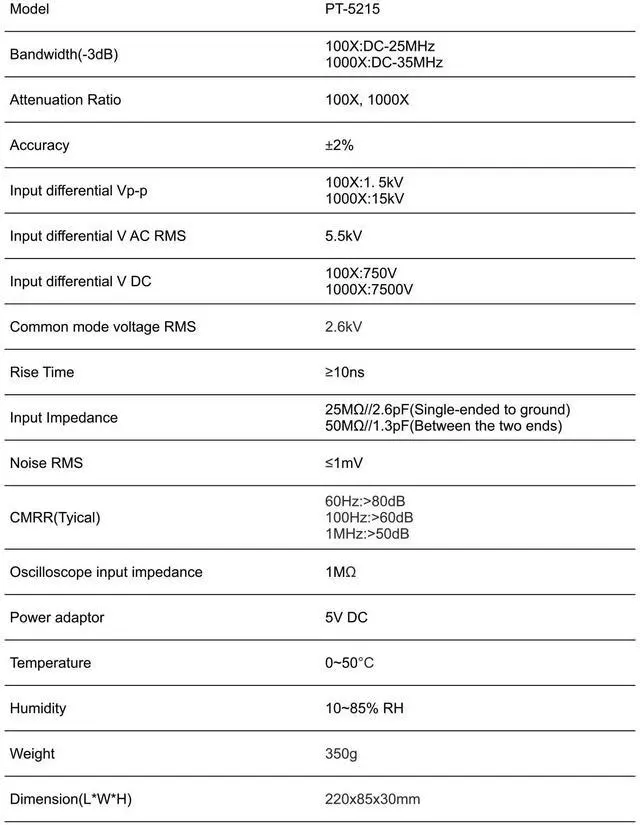
MODEL: PT-5215
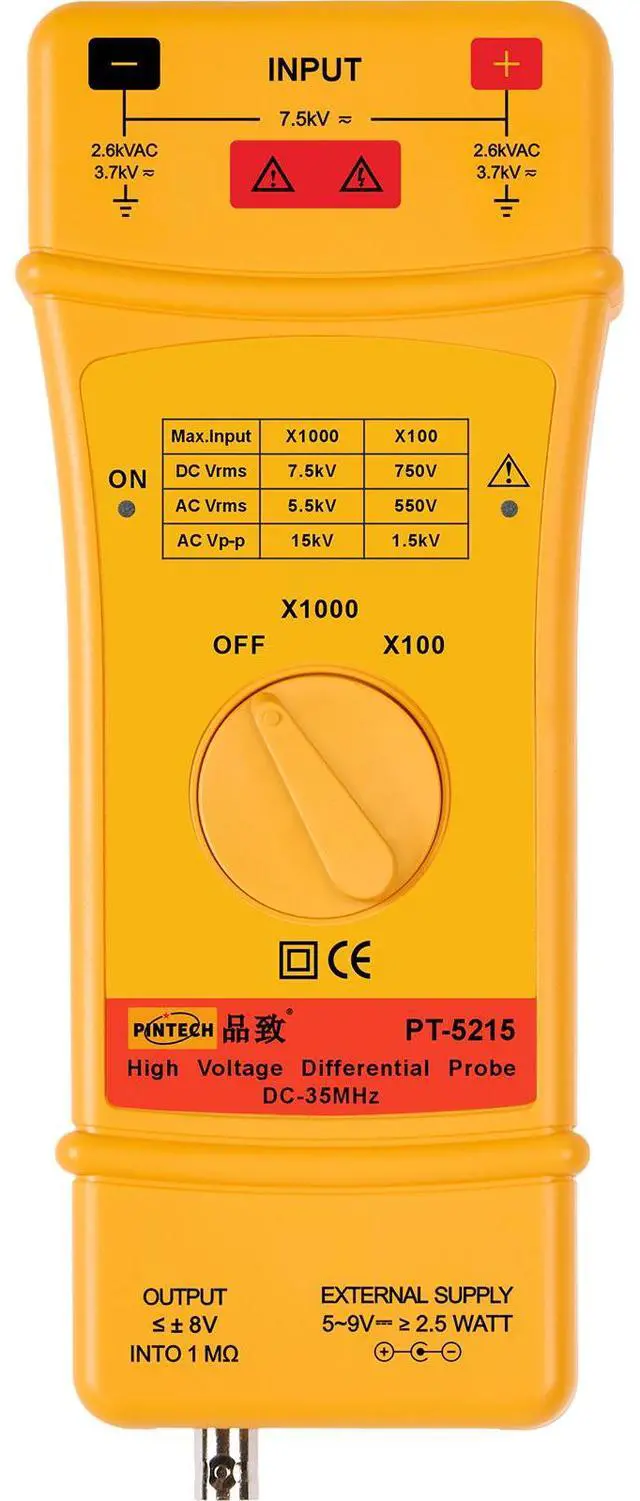
Bandwidth (-3dB): DC-35MHz(x1000), DC-25MHz(x100)
Testing Voltage(Vp-p): 1.5kV@1/100, 15kV@1/1000
Input DC Voltage: 750V@1/100, 7.5kV@1/1000
Attenuation Rate: 100X/1000X
Rising Time: 10ns
Accuracy: ±2%
Common-mode voltage RMS: 2.6kV
Noise: 1mV rms
Input Impedance: Between the two ends: 50M//1.3pF, Single-ended to ground: 25M//2.6pF
CMRR: 60Hz:>80dB; 100Hz:>60dB; 1MHz:>50dB
Oscilloscope Input Impedance: 1M
Weight: 350g/0.77lb
Dimension(LxWxH): 220x85x30 mm
The PINTECH PT-5215 is a 15kVp-p active high-voltage differential probe for oscilloscopes, designed for engineers, technicians, and advanced electronics users who need to safely measure floating or differential signals in motor drives, power electronics, and other high-voltage circuits.
| Attribute | Value |
|---|---|
| Best For | Measuring and diagnosing high-voltage differential signals with oscilloscopes, meters, and data-acquisition systems; useful for troubleshooting motor and other electrical circuits |
| Electrical Performance | Rated to 15 kV p‑p differential; DC–35 MHz bandwidth; typical accuracy ±2%; selectable 100X or 1000X attenuation |
| Compatibility & Interface | BNC output compatible with oscilloscopes; converts two-point differential signals to ground-referenced signals for oscilloscopes, multimeters, and DAQ equipment |
| Model Identifiers | PINTECH PT-5215 high-voltage active differential probe |
| Physical | Dimensions 220 × 85 × 30 mm; sold as an individual unit |
| Certifications & Warranty | CE certified; 1 year manufacturer warranty |
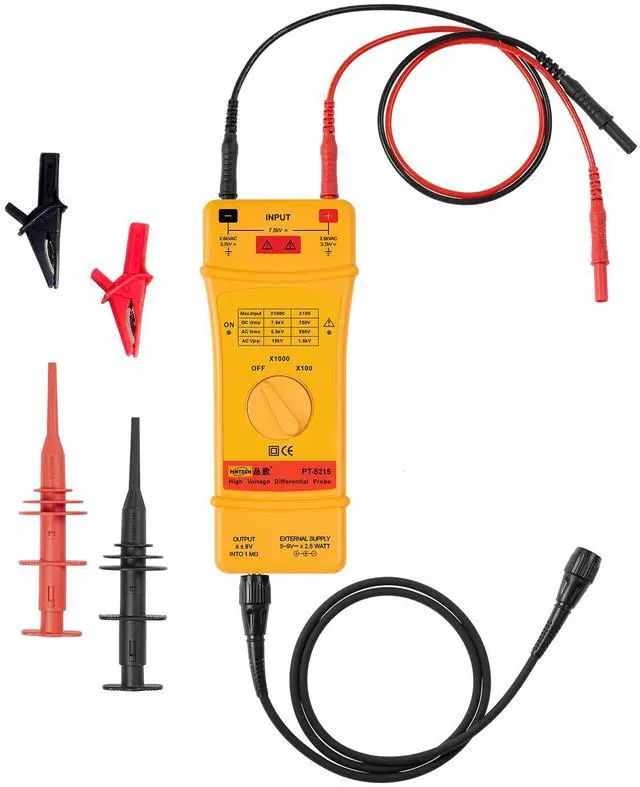
| Package Contents | Includes PT-5215 probe, adapter, 2 probe hooks, 2 alligator clips, BNC cable, and manual |
Q: Should I buy the PINTECH PT-5215 or use two standard oscilloscope probes with math subtraction?
A: Choose the PINTECH PT-5215 when you need to measure high-side or floating voltages safely and directly. A dedicated high-voltage differential probe is the normal tool for motor drives, mains-referenced power stages, and other circuits where neither point is at ground. Using two standard probes with channel subtraction can work for some low-risk bench cases, but it depends more on channel matching, uses two scope inputs, and does not replace the isolation and common-mode handling of a true differential probe.
Q: Is the PINTECH PT-5215 a better fit than a lower-voltage differential probe for inverter, mains, or motor-drive work?
A: The PT-5215 is the better fit when voltage headroom is the main requirement. Its product positioning centers on high-voltage differential measurement up to 15 kVp-p with 100X and 1000X attenuation, which matches use cases such as motor circuits and higher-voltage switching nodes. A lower-voltage differential probe is usually the more practical choice only when your signals stay well below that range and you want more sensitivity or less attenuation at smaller amplitudes.
Q: How does the PINTECH PT-5215 compare with a higher-bandwidth differential probe like the Tektronix P5205A or Micsig DP10013?
A: Choose the PT-5215 when you need more voltage range than speed and want a probe aimed at high-voltage measurement. Choose a higher-bandwidth model such as the Tektronix P5205A or Micsig DP10013 when waveform fidelity on faster edges matters more. External references commonly place those alternatives in the 100 MHz class, while the PT-5215 is sold around the 35 MHz class in channel listings and reseller pages. In practice, that means the higher-bandwidth options are better suited to faster switching transitions, while the PT-5215 is a more voltage-focused choice.
Q: Should I choose the PINTECH PT-5215 or a USB-powered portable differential probe?
A: Choose the PT-5215 when your priority is higher voltage capability and bench-style measurement with a conventional oscilloscope. Choose a USB-powered portable differential probe when cable simplicity and easier field setup matter more. Community discussions around Micsig's DP series frequently point out the convenience of USB power, while bench-oriented high-voltage probes like the PT-5215 are more about measurement range than portability.
Q: Who is the PINTECH PT-5215 most suitable for?
A: The PT-5215 is most suitable for users who need to measure floating or high-side voltages on grounded oscilloscopes, especially in motor drives, power electronics, inverters, and other circuits where neither test point should be tied to scope ground. Its 15 kVp-p differential rating, 100X/1000X attenuation options, and BNC scope compatibility make it a better fit for bench troubleshooting and power-stage work than for low-voltage general-purpose probing.
Q: Is this better than using two standard scope probes and the oscilloscope's A-B math function?
A: Usually yes for this type of work. A true differential probe is the safer and more practical choice when measuring voltage between two non-grounded points, because it avoids grounding mistakes and preserves both scope channels. Two standard probes plus math can work for rough checks, but it is less convenient and can be less reliable for floating high-voltage measurements.
Q: Will the PT-5215 work with my oscilloscope?
A: It should work with most oscilloscopes that accept a standard BNC input, which matches the product's stated compatibility. The main trade-off is that generic BNC probes may not provide automatic attenuation readout on the oscilloscope, so users may need to manually set the channel scale for 100X or 1000X to keep voltage readings accurate.
Q: What are the main trade-offs versus a higher-end differential probe from Keysight or Tektronix?
A: The PT-5215 offers much higher stated differential voltage capability than many premium probes, but the trade-off is lower bandwidth at 35 MHz and fewer ecosystem features. Higher-end models often provide faster bandwidth, tighter integration with supported oscilloscopes, and features like auto readout or branded probe interfaces, which matter more for high-speed power analysis or advanced lab workflows.
Q: Is 35 MHz enough, or should I buy a faster differential probe?
A: 35 MHz is enough for many industrial power, inverter, motor-drive, and general high-voltage switching measurements, but it is not ideal for fast digital buses or higher-speed edge analysis. If your main job is power electronics troubleshooting, this bandwidth is often sufficient. If you need detailed switching transitions or high-speed serial signal work, a higher-bandwidth probe is the better choice.
Q: Who is the PT-5215 a good fit for?
A: The PT-5215 is best suited to users who need to measure high-voltage signals between two non-ground-reference points, especially in power electronics, motor drives, mains-related circuits, and other floating measurements. It is less suitable if your work is mostly low-voltage bench debugging, where a standard probe is usually simpler and more cost-effective.
Q: Is the PT-5215 worth buying instead of using two scope channels in math-difference mode?
A: Yes, if you need safer and cleaner measurement of high-voltage differential signals. Community discussion around differential probing repeatedly treats a true differential probe as the better choice for floating or mains-referenced measurements. The trade-off is that this model is specialized: you are buying isolation-oriented probing, not a general-purpose everyday probe.
Q: Can the PT-5215 still be used for low-voltage measurements?
A: Yes, but it is usually not the most practical choice unless you specifically need differential measurement or isolation. The PT-5215 can measure lower-voltage signals, but its core value is safe high-voltage differential work. For ordinary grounded low-voltage signals, a standard probe is typically easier to use.
Q: What are the main trade-offs of the PT-5215?
A: The main trade-off is specialization. The PT-5215 offers high differential voltage capability, 35 MHz bandwidth, 100X/1000X attenuation, and BNC compatibility, which makes it useful for demanding high-voltage measurements. In return, it is less convenient for quick everyday probing, and its bandwidth and attenuation make it a fit for power and high-voltage diagnostics rather than precision low-level signal work.



